


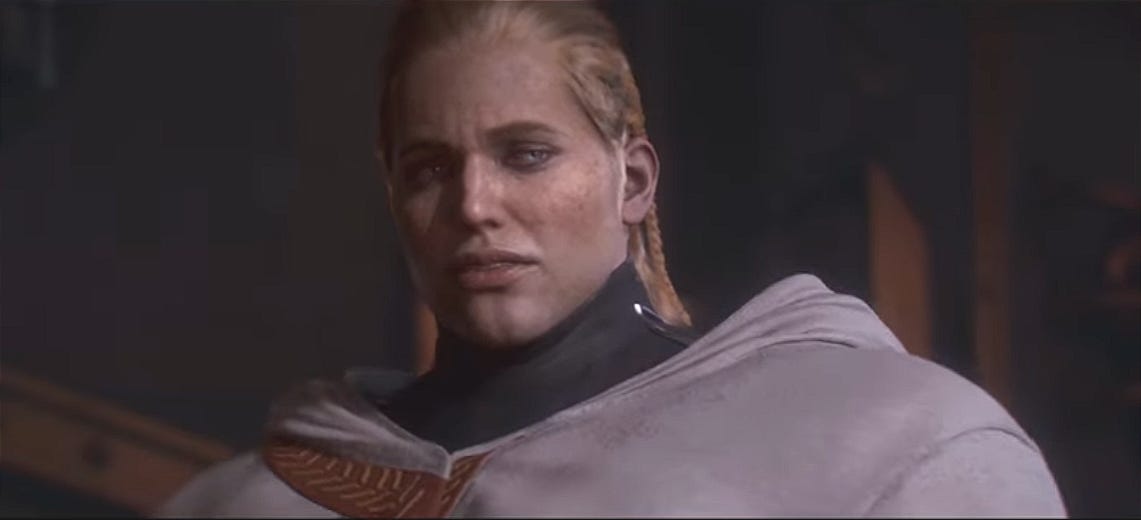
I've recently heard from at least two, ostensibly, Conservative commentators that Warhammer 40k is somehow immune to wokeness, with one even promoting the world as "Fascist" in nature. The former assertion is incredibly naïve to say for reasons I will explain while the latter only gratifies the common Leftist diatribe about "Fascism" in general.
At appreciable length, John F Trent has already covered Carl Benjamin's take on Warhammer 40k here on Fandom Pulse and much of what he wrote in response is measured and well thought. I don't believe I can add much to it other than minor lore details that Carl gets wrong. But I don't want to make this essay about how an outsider tourist got a bunch of details about a fictional world incorrect. Instead, I want to issue that Warhammer 40k is a Leftist wet dream even as much as it is for Conservatives and I will explain why.
In addition to Carl, commentator Auron Macintyre called Warhammer 40k "the most Right-Wing-coded intellectual property in the world" in addition to "Fascism works in space." This description only gratifies the lie that the cultural identity of the Right is about draping ourselves in the colors our enemies have assigned us. The Right is not defined by Fascism nor is Warhammer 40k "Fascist in space." A better term for it would be "Pharisees in space."
The Warhammer 40k setting borrows freely from Christian imagery, and this borrowing deepens its mythic resonance. Yet the religions that populate its universe are not Christian in substance. They are Pharisaical in the theological sense and equally applicable to either side of the political spectrum (although, I would argue more effectively on the Progressive Left).
Modern Progressivism often treats dissent as heresy, policing its boundaries with a zeal that rivals any inquisitorial order. The language of inclusion becomes a mechanism for exclusion, and those who fall outside the accepted orthodoxy are cast as moral contaminants. Because of this, the identification with the Imperium or its Space Marines is not a uniquely Right‑Wing phenomenon. The same dynamics of purity, performance, and punitive belonging operate across the political field. The difference between the Left and the Right in this regard is that the Left is allowed to get away with it. This imbalance endures because many on the Right take the progressive self‑portrait at face value, mistaking its rhetoric of tolerance for the reality of its disciplinary logic. Those who have seen through the façade often respond not with a different imagination but with imitation, adopting the same liturgies of antagonism and attempting to surpass their opponents at their own game.
Jordan Peterson, for all his faults, identified this dynamic when he described the rise of the Alt‑Right. The terms of debate were set by identity politics and dissidents on the right responded by adopting the same grammar as their enemies. If politics is a contest of tribes, then one must choose a tribe. If cruelty is the currency of attention, then cruelty becomes a strategy. Figures like Nick Fuentes embody this logic with said cruelty: a kind of performative sadism and ritualized antagonism that thrives only within the insulated spaces of digital life. This posturing, however, is not a rejection of the system but an imitation of it, a mirror image of the very liturgies they claim to oppose.
This is why the desire to claim Warhammer 40k as a uniquely Right‑Wing property is understandable but misguided. Its themes are not proprietary. They expose the spiritual poverty of any community that grounds its identity in opposition rather than communion. The Imperium of Man becomes a canvas onto which anyone can project their own anxieties about purity, loyalty, and corruption. The factions of 40k are not allegories for particular political groups but parables of what happens when cultures forget that righteousness is a gift rather than a possession. In such worlds, every side becomes Pharisaical, and every enemy becomes a heretic.
Hence, I call it "Pharisees in space."
Who Were The Pharisees?
The Pharisees were a Jewish movement and school of thought active during the Second Temple period, roughly from the second century BC until the destruction of the Temple in 70 AD. They became especially influential because their teachings and interpretive methods formed the foundation of what later became Rabbinic Judaism.
The Pharisees emerged in the Second Temple period as a lay‑scholarly movement devoted to interpreting the Torah with meticulous care. They believed that God had given Israel not only the Written Law but also an Oral Law. The Oral Law was an interpretive tradition that clarified how the commandments should be lived in daily life. This commitment made them influential among ordinary Jews, especially in contrast to the priestly Sadducees, who rejected the Oral Law and were tied more closely to Temple authority. After the destruction of the Temple in 70 AD, Pharisaic methods of interpretation became the foundation of Rabbinic Judaism, shaping Jewish practice for centuries.
The Gospels, however, present a more conflicted picture of the Pharisees, not because they were uniquely corrupt but because Jesus confronted them at the precise point where religious authority, interpretation, and lived obedience met. His rebukes, most sharply expressed in Matthew 23, were not aimed at the gap between their teaching and their practices. Jesus accused them of hypocrisy, of “tying up heavy burdens” for others while refusing to bear them themselves, and of performing righteousness for public approval rather than out of genuine love of God. He challenged their tendency to elevate human traditions above the heart of the Law, their fixation on external purity while neglecting justice, mercy, and faithfulness, and their resistance to His authority when His teaching exposed their inconsistencies. In this sense Jesus’ rebuke was an insistence that the Law’s purpose is fulfilled only when its outward forms are matched by inward transformation.
Pharisaical Empires
Games Workshop has described the Warhammer 40k as a satire, a grimdark parody of empire and ideology. Every major faction in the setting is built on the same spiritual pathology that Jesus rebukes in the Gospels: performative righteousness and the elevation of ritual over mercy. This turns the galaxy of the forty-first millennium into vast theater of Pharisaical systems, each one a monument to the human capacity to mistake performance for true holiness.
The Imperium of Man is the clearest expression of this dynamic. What began as a project of unification has calcified into a labyrinth of rites, purity tests, and bureaucratic liturgies. The Emperor’s memory has been embalmed in a thousand contradictory doctrines, each guarded by institutions that demand obedience not for the sake of truth but for the sake of their own survival. Citizens are crushed beneath impossible burdens of loyalty, confession, and sacrifice, while the upper echelons remain insulated from the consequences of their decrees. The Imperium does not ask whether its rituals produce justice or mercy but whether they are performed loudly enough. In this way, it mirrors the very image that Jesus critiques in Matthew 23: a system that polishes the outside of the cup while leaving the inside untouched.
The Tau Empire offers a more polished but no less Pharisaical alternative. Its rhetoric of the Greater Good functions as a moral totality that absorbs dissent into a technocratic vision of order. Their caste system is justified as natural and necessary. Public conformity is treated as virtue and re-education is framed as benevolence. The Ethereals serve as a priestly class whose authority is beyond question. Here too, righteousness is not lived but displayed. The moral life becomes a matter of alignment with an ideology rather than a transformation of desire.
The Aeldari embody a more esoteric form of the same impulse. Their survival depends on strict adherence to ritual paths and disciplines, each designed to prevent the resurgence of the catastrophic excess that once destroyed their civilization. Their codes are precise, their practices exacting, their purity anxiously maintained. They are a people who know the cost of unrestrained desire, yet their response is to bind themselves to a system in which the form of righteousness becomes a substitute for its substance. Their tragedy is their devotion has become its own cage of virtues.
Even the forces of Chaos, which present themselves as the antithesis of order, participate in this Pharisaical logic. Their rebellion is not freedom but inversion. They replace one set of rituals with another, one form of purity with a different and darker form. Their gods demand performance, sacrifice, and visible displays of allegiance.
If anything, the grimdark universe is a warning about the human tendency to build societies in which the appearance of holiness replaces the reality of love.
Christ’s Way and the Temptation of Cultural Self‑Regard
For communities shaped by Christian memory, it is tempting to imagine that the fruits of the Gospel are the products of our own ingenuity. We begin to treat grace as an inheritance we possess rather than a gift we receive. In this way, our cultural confidence becomes a subtle form of pride, a belief that our virtues are self‑generated rather than bestowed.
Modern societies are formed by institutional lies that teach us to see ourselves as autonomous individuals, each the author of his own meaning. The Gospel cuts against this by insisting that whatever good we possess is derivative. While we may count ourselves as exceptional because of our Christian heritage, we are not less sinful than others because we inhabit a culture shaped by Christian norms. That is, essentially, what it means to be equal in the eyes of our creator.
The distinctions made between peoples is a difference in the degree to which Christ’s grace has been bestowed. Any cultural good that endures is a sign of God's blessing and not a badge of superiority. This is why the New Testament refuses to flatter its readers. Israel is chosen, but not because of its greatness. The early church is beloved, but not because of its purity. The pattern is always the same: God elects the unexceptional so that no one may boast. The moment a community begins to treat its virtues as inherent, it repeats the very error Jesus rebukes in the Pharisees. They were for imagining that their obedience originated in themselves and not participation in God’s life.
NEXT: The Creativity Myth And The Conservative Surrender Of Imagination

It must be a joke that they think, at this point, that they are immune; it reminds me of anime fans, but at least they had a more solid point. It's well known that there are woke circles dedicated to this franchise that try to cancel anyone who doesn't agree with their ideas, as well as trying to ban the right in general from public spaces for gaming or any other activity, especially if you dare to question their pronouns. Incidentally, once again the right is playing the left's game and, as always, is allowing them to tell them and define who they are, first by telling them that they are inherently fascist, in the same way that they have linked them to being inherently Nazi. The way things are going, I wouldn't be surprised if people took it seriously and made a parody of it. Once again, Jean Madiran hit the nail on the head in his observation of how this game works.
The single interest people have in warhammer 40k is its pittance of Catholic Capital. No satanic posturing from you or your former compatriots on “the left” will change that.
your curses are Consummately Returned back to whence they came with A St Michael Prayer and A St Benedict Prayer.