



The Late Show with Stephen Colbert tapes its final episode on May 21. Last night Colbert assembled fellow late night hosts Jimmy Kimmel, Jimmy Fallon, John Oliver, and Seth Meyers for what NPR described as a Strike Force Five reunion, named for the podcast the five hosts recorded together during the 2023 WGA strike.
Colbert told the Hollywood Reporter what he thinks his cancellation means: “the win of going out as a martyr.”
That is the word he chose. Martyr. Not “unfortunate timing.” Not “financial headwinds.” Martyr.
CBS announced the cancellation in July 2025, calling it “purely a financial decision against a challenging backdrop in late night.” The network noted the show had been number one in late night for nine straight seasons. David Letterman, who handed the franchise to Colbert in 2015, did not accept that framing. “They’re lying,” Letterman told the New York Times. “They’re lying weasels.”
Colbert has spent eleven years making anti-Trump content the defining feature of his show. He was an outspoken critic of Paramount’s decision to settle a lawsuit with Trump. He recently made what he called “a light roast” joke about Melania Trump that Trump responded to by calling for his cancellation. Senator Adam Schiff posted about the show’s end: “If Paramount and CBS ended the Late Show for political reasons, the public deserves to know.”

Kimmel, appearing on the reunion episode, offered the night’s most self-aware moment. He noted that when he was briefly suspended by Disney and ABC over political controversy, fans canceled their Disney+ subscriptions. Nobody canceled Paramount+ for Colbert. “When I got knocked off the air for a few days, people canceled Disney+,” Kimmel said. “The republic rolled on, Jimmy, can you believe it?”
Late night as a format built its last decade on one bet: that a large enough audience hated Trump enough to watch five nights a week. The bet worked for ratings during the first Trump term. It did not work for the economics. Streaming fragmented the advertising market. The core audience that watched Colbert, Kimmel, Fallon, Oliver, and Meyers skews older, watches on linear television, and is shrinking as a demographic. Combine that with 50% of the audience tuning out and you have a recipe for disaster. That half found other things to watch.
Colbert’s own show provides the clearest numbers. The Late Show was number one in late night for nine straight seasons and still got cancelled because number one in a collapsing format does not generate the revenue a network needs to justify the cost. CBS is not replacing the franchise. The Late Show name, the franchise David Letterman built over decades, ends permanently on May 21 alongside Colbert’s run.
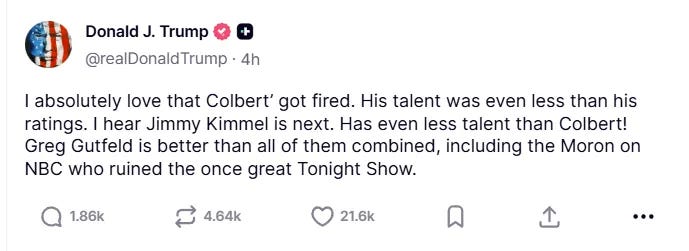
The hosts who built their identities on political opposition to a sitting president are now watching those identities become liabilities as the financial model that sustained them collapses. Colbert sees that as martyrdom. The more direct reading is that he built a show around contempt for half his potential audience and then watched that audience find the remote.
Stephen Colbert will go to Middle-earth next. He is attached to Peter Jackson’s Lord of the Rings film project. Whether the audience that didn’t cancel Paramount+ to save his show will turn up for that one is the actual question his post-CBS career needs to answer.
Is political late night dying because of financial pressures, political backlash, or both?
NEXT: Christopher Nolan’s The Odyssey Has a Casting Problem And Nobody Is Talking About Half of It
"We canceled the show because it was expensive, nobody watched and we lost a ton of money."
"You are lying!"
"Well, here is the publicly available data that is the basis for our explanation."
"No, it was political! Admit it, you lying weasel!"
"Any evidence despite pondering your orb told you so? If not, well..." *points at publicly available data*
"REEEEEEEEEEEEEEEEEEE"
I mean, that's what it sounds like to me, at least.
Oh and also: Poor Stevie, failing and falling up the ladder, right into Middle Earth. Done with late night and on to ruin the next cultural institution, are ya? Looking forward to The One Syringe to vax them all...
His ilk don’t believe in principles like martyrdom