


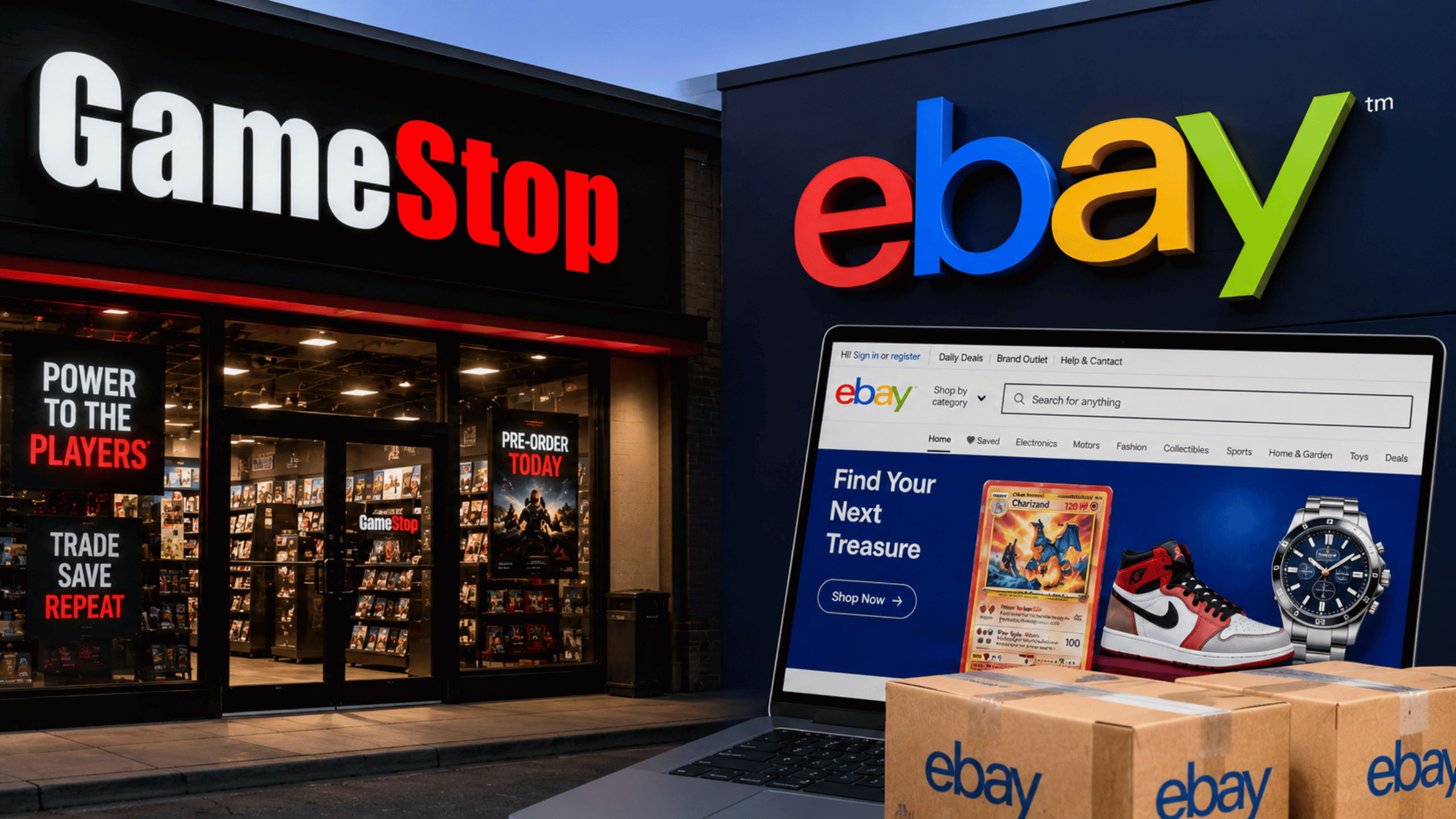
On May 3, 2026, Ryan Cohen sent a letter to eBay’s board chairman. The letter was also filed with the SEC.
GameStop Corp., the letter said, was proposing to acquire all common stock of eBay Inc. at $125.00 per share, a 46% premium to eBay’s closing price on February 4, the day Cohen started quietly building a position in the company. Total equity value: approximately $55.5 billion. Structure: 50% cash, 50% GameStop common stock. Financing: GameStop’s $9.4 billion cash pile plus a $20 billion committed credit line from TD Securities. eBay’s board was asked to respond.
eBay confirmed receipt of the offer and stated it had received no prior outreach from GameStop before the letter arrived. Its shares rose 5% on Monday. GameStop’s shares fell 10%.
That gap tells you what Wall Street thinks. GameStop’s market cap is roughly $11-12 billion. Cohen is proposing to buy a company nearly five times that size. Michael Burry, who has been a GameStop shareholder and whose short-squeeze battle with Cohen in 2021 made both men famous, sold his entire GME position after the announcement. His stated reason: “Never confuse debt for creativity.”
Cohen appeared on CNBC’s Squawk Box on Monday and was combative throughout. When pressed on how a company with an $11 billion market cap finances a $55 billion acquisition, he pointed to the TD Securities credit line, the cash on hand, and the stock component of the deal. “We are offering half cash, half stock, and we have the ability to issue stock in order to get the deal done,” he said. He declined to get specific about the gap between what GameStop has and what the deal requires. Institutional enthusiasm cooled further after the interview.
The underlying business logic, however, is not crazy. Cohen’s SEC filing makes a specific case. eBay spent $2.4 billion on Sales and Marketing in fiscal 2025 and added exactly one million net active buyers, growing its user base from 134 million to 135 million. Cohen proposes cutting $1.2 billion from that marketing budget alone, $300 million from product development, and $500 million from general and administrative costs, for $2 billion in annualized savings within twelve months of close. On cost reductions alone, eBay’s earnings per share would go from $4.26 to $7.79 in year one. He points to GameStop as the proof of concept: from a $381 million net loss in 2021 to $418 million in net income in 2025, with SG&A down 47%, approximately $800 million cut from the cost structure in under four years.

The strategic piece is where it gets interesting. Cohen’s vision is to turn GameStop’s approximately 1,600 U.S. store locations into authentication, intake, fulfillment, and live commerce hubs for eBay sellers. GameStop employees already inspect and grade trading cards and hardware daily. Sellers would walk in, items would be verified on the spot, and listings would carry a trust badge. Live sales broadcasts from GameStop locations featuring eBay products. A national physical network underpinning the world’s second-largest online commerce platform as a direct challenge to Amazon.
For collectors, this is not an abstract corporate transaction. The MTG counterfeit story Fandom Pulse covered recently is a direct symptom of the peer-to-peer authentication problem Cohen is proposing to solve at scale. eBay’s collectibles market has a trust problem. Fake cards, ungraded items sold as graded, counterfeit merchandise moving through anonymous sellers with no physical accountability. GameStop’s physical authentication infrastructure, if Cohen can execute the vision, addresses exactly that vulnerability.
Whether the deal closes is a different question. eBay’s board has a fiduciary duty to evaluate a 46% premium offer. It also has no obligation to accept a proposal from a company that would need to lever up significantly to fund it. The bid is non-binding. The financing gap is real. Cohen on CNBC was evasive about details in ways that did not reassure institutional investors.
Cohen posted on X during the week’s coverage, linking to his personal eBay seller account where he was listing GameStop merchandise. “I’m selling stuff on eBay to pay for eBay,” he wrote. His username on the account: ryan_5050. A nod to the deal’s 50/50 cash-and-stock structure.
The meme stock era never really ended.
Does Ryan Cohen’s vision for GameStop as the backbone of eBay’s physical authentication network make business sense, or is this the meme economy’s last and biggest play?
Epic Fantasy hasn’t been this hard-hitting since Tolkien. In a world where humanity is akin to a Roman legion, a great darkness arises. Read A Throne Of Bones today.
He's trying to sell a vision, it makes sense, let's see if people buy it.
eBay stores used to be a thing until they weren't. Maybe it will be a good partnership. Game Stop is one of the last vestiges of a bygone era still clinging on. It beat up Blockbuster Video when it entered the ring with Game Rush, buy and trade in systems and games. Maybe another 10 years?