


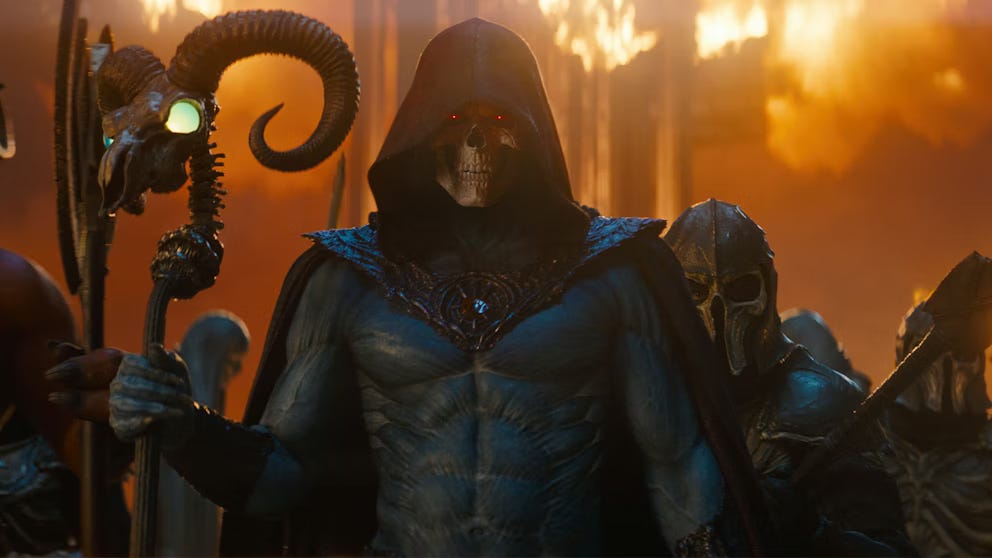
Travis Knight, the director of Amazon MGM Studios’ upcoming Masters of the Universe film, recently shared more details about Jared Leto’s Skeletor describing him as “the embodiment of toxic masculinity.”
As part of his interview with Empire, Knight discussed the character of Skeletor and what Jared Leto is bringing to it.
First, he shared, “Skeletor was a really interesting villain. He looked cool. He was scary. He was funny. He was insecure. And then of course he had this distinctive voice.”
Next, he shared, “I wanted someone to craft their own version of that.”
“Jared [Leto] approached us, because he loves Skeletor and has his own history with the character. He wanted to swing for the fences. And ultimately we landed on something that I’m really happy with,” he continued. “Skeletor’s kind of the embodiment of toxic masculinity.”
While it appears there will be some significant changes to Skeletor, one thing that won’t be changing is the character’s design. Referencing previous iterations of the adaptation and at least one that depicted Skeletor with a golden skull mask, Knight shared, ““I said, ‘[Expletive] that [expletive]. Skeletor has a skull face.”
“That’s just the way it is. It’s a living, talking, emoting skull, and that’s that,” he declared.
Travis Knight’s choice to call Skeletor “the embodiment of toxic masculinity” may seem fitting for a villain defined by aggression, domination, and rage, yet it still imports a secular framework that Deacon Harold Burke-Sivers rightly critiques as "a really narrow and repressive description of manhood, which basically designates manhood is defined by violence, and sex, and status, and aggression. It’s this cultural myth about manliness, where strength is everything while emotions are weakness.”
As Deacon Sivers notes this framework reduces manhood to violence, sex, and status rather than recognizing these as universal sins that corrupt any person, male or female.
Skeletor’s evil isn’t proof that masculinity itself is toxic; it’s a vivid picture of fallen, unredeemed manhood twisted by pride and wrath, the very vices grace is meant to heal and redirect toward heroic virtue. By framing the villain through this modern lens instead of letting his actions speak as straightforward moral failure, the film risks implying the problem lies in male nature rather than in sin.
Given this, one has to wonder, if Skeletor embodies toxic masculinity, how exactly will He-Man defeat him? If the problem is in male nature as feminists posit with the “toxic masculinity” phrase then it’s likely that He-Man will only be able to defeat him by becoming a more “feminist” or “deconstructed” version of himself.
Hopefully, this is not how this plays out and instead we get a virtuous He-Man showing courage, justice, humility, honesty, wisdom, self-control and other virtues as the original 1980s cartoon did.
NEXT: Sci-Fi Author Michael F. Kane Explains Why Woke Activists Try To Take Over Wholesome Stories
This movie will flop.
Now that Man-at-Arms is black, he's been renamed Man-with-Warrants.