


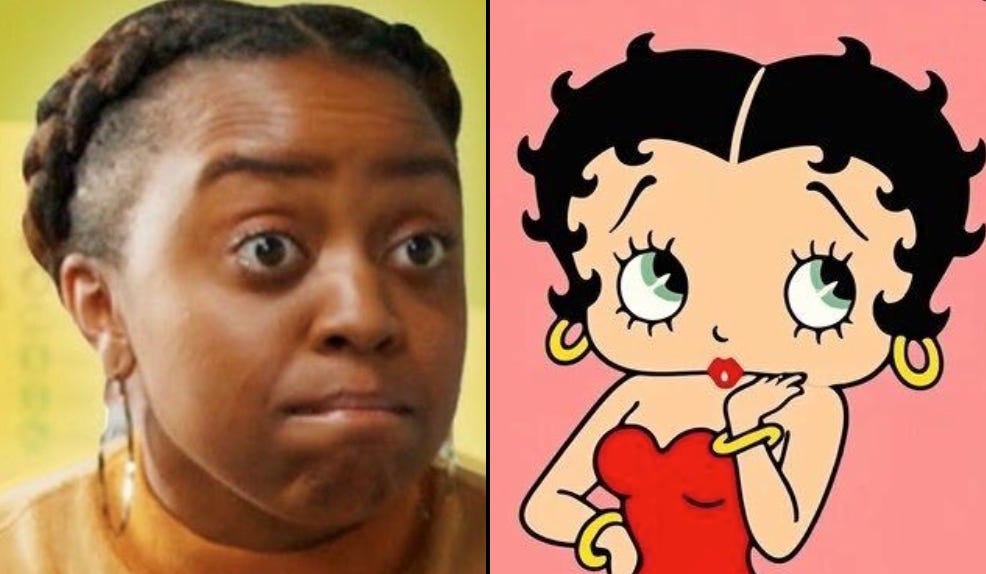
Quinta Brunson will star as Betty Boop in a feature film developed through her Fifth Chance Productions and Fleischer Studios, per a Variety exclusive published yesterday. The film will trace the origin and evolution of Betty Boop through the perspective of her creator, Max Fleischer.
Betty Boop was created by Max Fleischer in 1930. She appeared in more than 100 cartoons during her original run, evolving from a poodle-like nightclub singer into the fully human Jazz Age icon recognized around the world today. She was the first cartoon character profiled by A&E’s Biography. She is white. She has always been white. Her visual identity, including the pale skin, the red lips, and the flapper-era aesthetic, is inseparable from the character’s Jazz Age origins and decades of cultural presence.
Brunson is Black. Nobody at Variety, Fifth Chance, or Fleischer Studios addressed this in the announcement. The trade press covered the casting as an uncomplicated celebration.
Matt Walsh of The Daily Wire responded on X: “There is only one reason to bring back an iconic piece of Americana just to race swap it like this. Even a faithful Betty Boop reboot probably wouldn’t sell many tickets. A race swapped Betty Boop has absolutely no chance of success. But they do it anyway out of spite. They aren’t even trying to make money. It’s just pure resentment.”
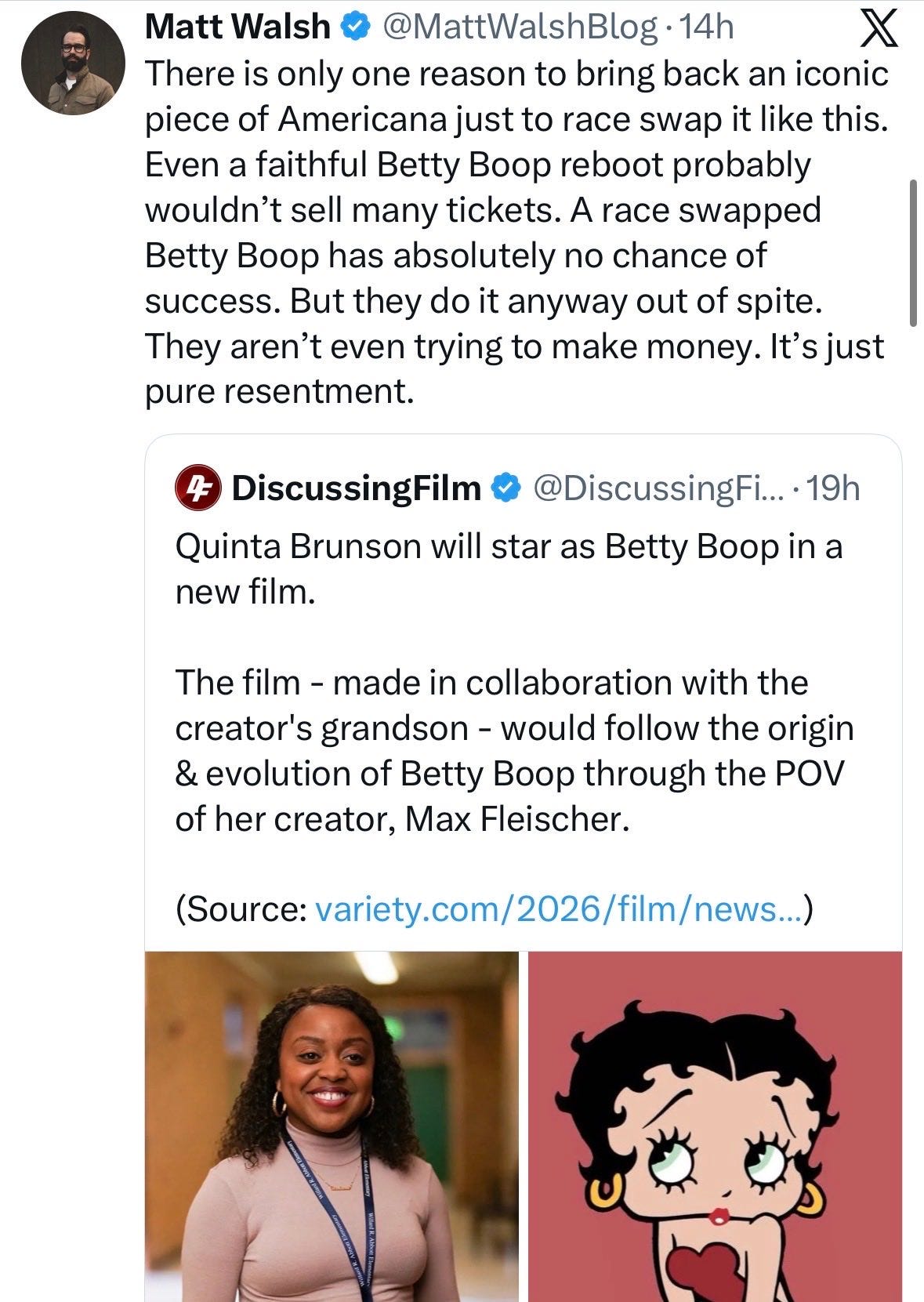
The account that broke the news, @DiscussingFilm, turned off replies and blocked Walsh.
Walsh then posted: “The account ‘Discussing Film’ turned off the comments and then blocked me. This is a pretty interesting way to have a discussion about film.”
@DiscussingFilm has 2.8 million followers and bills itself as “Your leading source for quick reliable news. Home for healthy and liberating discussion on all things pop culture.” Blocking critics of a casting announcement is the extent of the liberating discussion they offer. Fandom Pulse can confirm this pattern from direct experience: the account blocks outlets and individuals who cover Hollywood critically rather than as a promotional relay service. The name is ironic at this point.
The Betty Boop casting lands inside a well-documented trend. Hollywood has spent the last decade race-swapping established white characters with enough frequency that the pattern requires no elaboration. Ariel in The Little Mermaid. The Witches remake. The upcoming Odyssey from director Christopher Nolan casts Lupita Nyong’o as Helen of Troy, a character whose identity is built around the ancient Greek ideal of beauty. Anne Boleyn in a Channel 5 series. Snow White. Hermione in some stage adaptations. The list runs long.
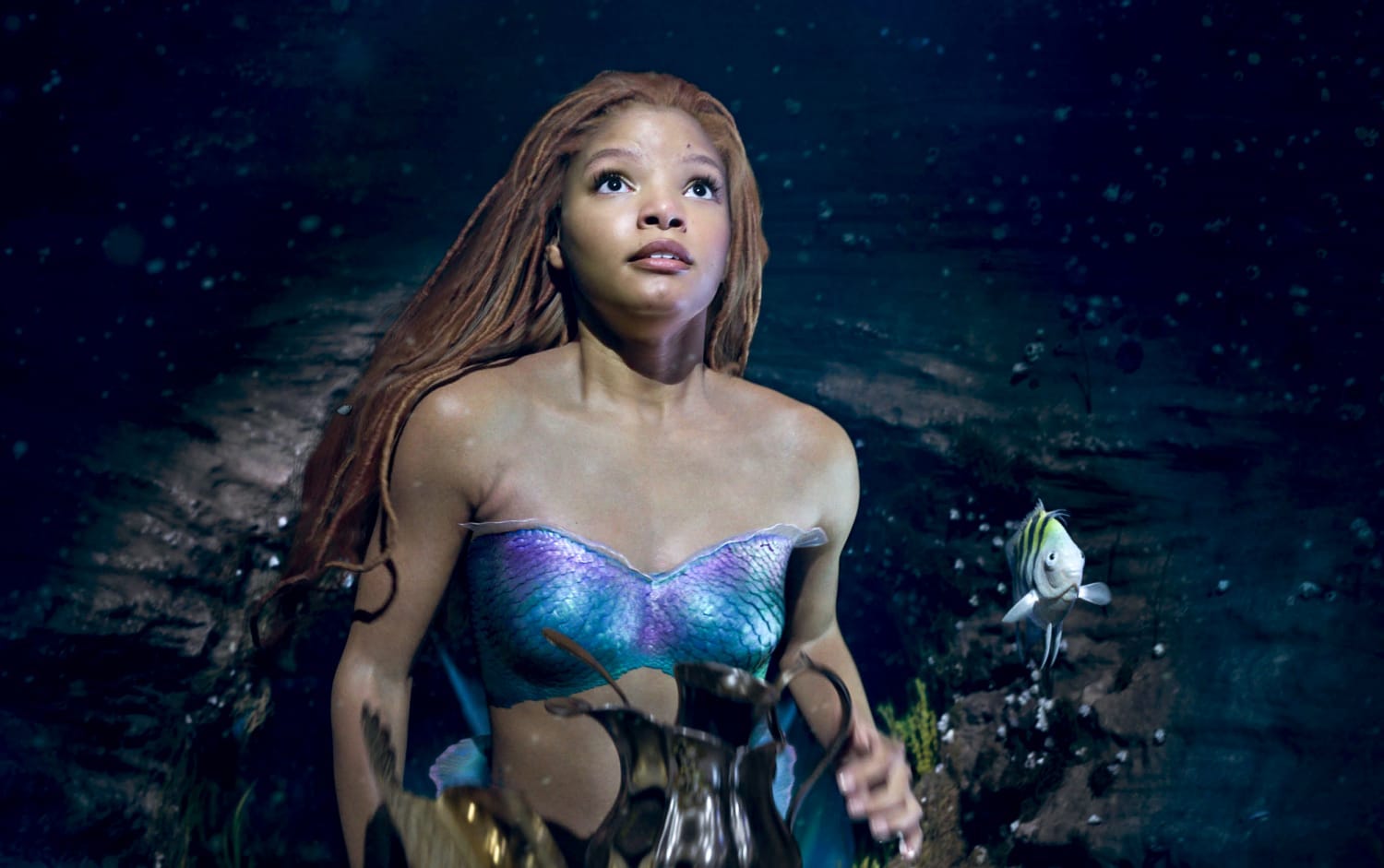
The consistent feature of every announcement: the trade press treats the casting as progress and anyone who objects as a bigot. The consistent feature of the box office: these films underperform relative to their production investment, the audience that might have shown up for a faithful adaptation stays home, and the studio writes off the loss while preparing the next one.
Variety’s framing compared Brunson to Greta Gerwig and Margot Robbie with Barbie, describing the project as “a formidable female creator-star reimagining a nearly century-old female character through a contemporary lens.” The Barbie comparison will not survive contact with the opening weekend numbers. Barbie worked because Margot Robbie is Barbie and the film leaned into the character’s existing visual identity rather than replacing it. This film will ask audiences to accept Quinta Brunson as a character whose entire iconography depends on a specific look she does not share, in a biopic framed through the perspective of a Jewish immigrant animator whose greatest creation she is replacing.
Brunson’s statement described Betty Boop as “pleasantly niche” and said there was “a much deeper story to tell” that “could be explored in a way that feels refreshing, subversive, and timeless.” Subversive means replacing what exists. The character described as having “a quiet but undeniable impact on culture for nearly a century” is being handed to a production company whose stated focus is “diverse voices,” which is industry language for a specific mandate.
Mark Fleischer, the creator’s grandson, blessed the arrangement. He said Brunson “so embodies Betty’s love of life, intelligence, humor, sassiness and compassion” that the relationship between the two “burst into life at its mere mention.” None of those qualities are race-specific. None of them require replacing the character’s visual identity. The endorsement from the Fleischer estate will be used to deflect criticism, and it does not answer the question nobody in the press is asking: why does this character need to be reimagined rather than played straight?
The answer Matt Walsh gave is the one the film’s own promotional framing supports. This is not a commercial calculation. Variety named no studio, no distributor, no release date, and no production start. The announcement is an announcement of intent, not a film. When the box office results arrive, assuming the film gets made, the same outlets that blocked critics of the casting will explain the underperformance using reasons unrelated to the casting.
What do you think of the Betty Boop casting? Let us know in the comments.
450 pages of classic superhero storytelling that puts character first. The Flying Sparks Omnibus collects the complete saga of Meta-Girl — the kind of cape comic the mainstream forgot how to make. Sign up to get your copy.

The press wouldn't cheer if Kid Rock was cast for Jimmi Hendrix.
So, it's not about race swapping: it's about replacement.
Erase history, erase culture, erase white-white marriage, erase white males. What's left?
It is genocide.
Why? 10 lost tribes.
It occurs to me that skinsuiting serves several purposes, to include *poisoning the well.*