


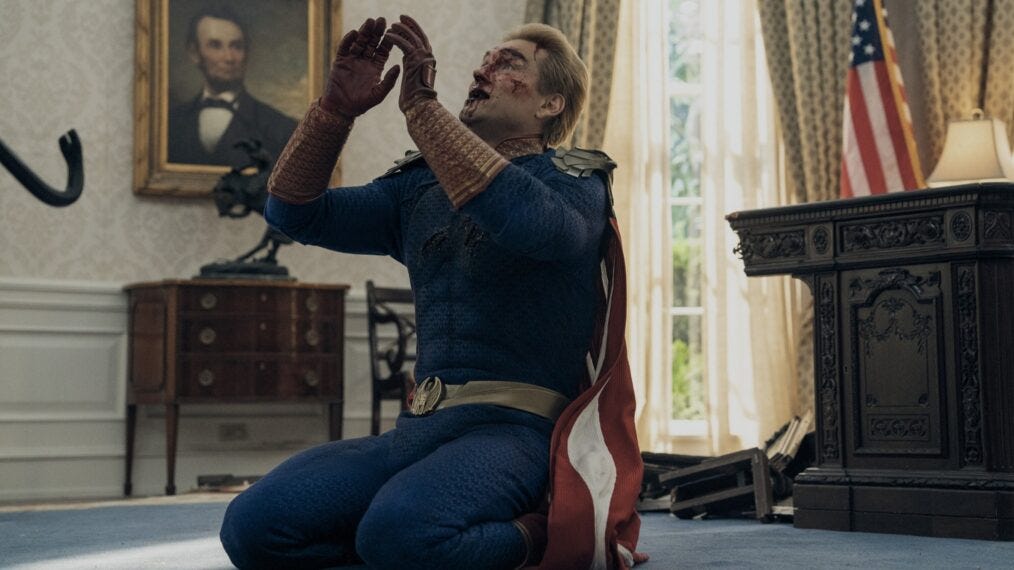
The Boys series finale aired Wednesday night, and Eric Kripke spent the week before release doing press interviews about how reality keeps catching up to his satire of Donald Trump. Then the finale aired, and reality caught up again, just not in the way Kripke intended.
The episode introduces a character named Gunter Van Ellis, described by Oh Father as the world’s richest man with 17 children and an amateur astronaut background. Van Ellis arrives at the White House wearing a black hat reading “We Believe In Homelander” and immediately pitches Homelander on “white fertility rates.” Homelander’s response is to take him outside and fly him into space, leaving the punchline to land when Oh Father asks what happened: “He was an astronaut. I took him to space.”

The character is not a subtle allusion. The world’s richest man. Seventeen children. Amateur astronaut. Fertility rates. A MAGA-style hat with Homelander’s name on it. This is not satire. It is a name search away from a defamation filing.
On X, analyst and writer Kangmin Lee posted a thread on the finale: “The show writers turned Homelander into a Trump analogue, and this is how they choose to end The Boys. This entire show was just a deranged sexual humiliation fantasy projected onto Trump. They can’t even produce a decent superhero parody without injecting their twisted fetishes into every script.”
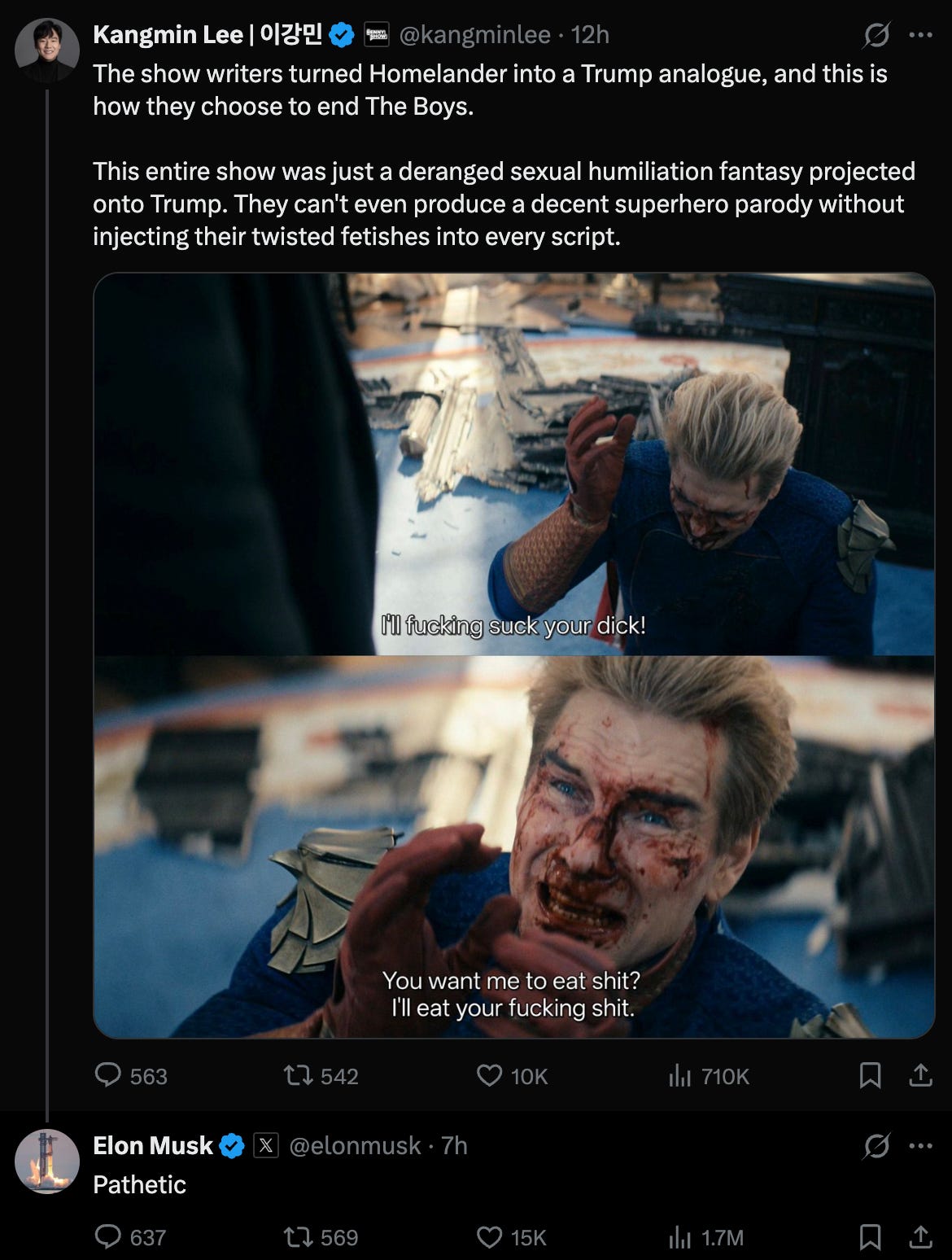
Elon Musk replied to the thread with one word: “Pathetic.”
That single word reached 1.7 million impressions.
Kripke then quote-tweeted Musk’s response to Lee’s thread and posted: “OMG this is his review of what @TheBoysTV did to Homelander. I’ll never get a better review ever. #TheBoys”
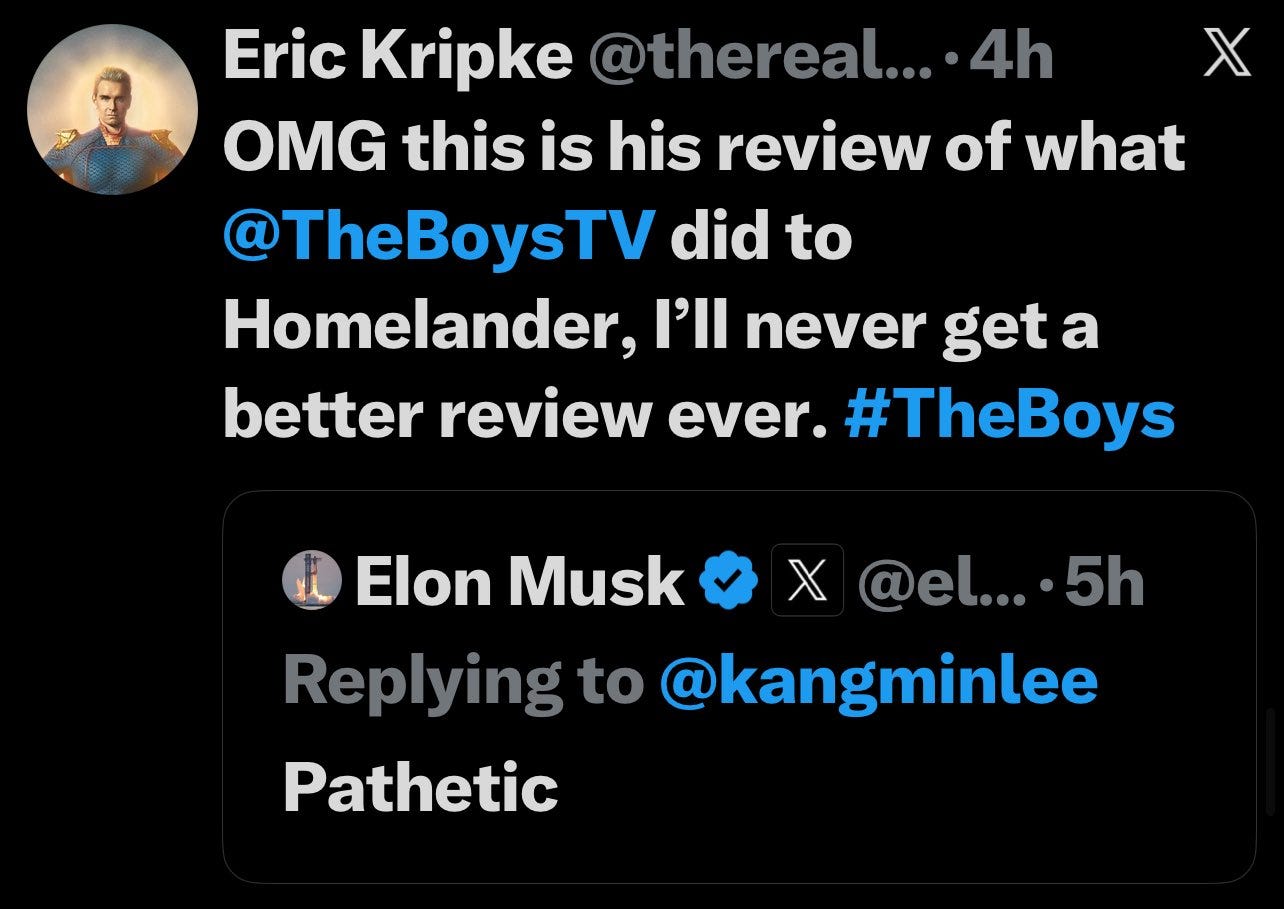
The showrunner celebrated Musk calling his finale pathetic as a marketing triumph. He is correct that it generates attention. He is incorrect if he believes that attention translates into the audience he lost over five seasons of increasingly narrow political targeting.
Kripke’s political commentary has been a documented feature of the show’s press strategy for years. In 2024, the Hollywood Reporter asked him directly about the Homelander-Trump parallel and he confirmed it without hesitation, describing the character as “an authoritarian proxy for Donald Trump.” After Trump won re-election in November 2024, Kripke gave an interview saying he was “bummed out” the final season had been written before the election, describing an upcoming plot point as “already happened” in real life and calling the experience “really f**king unsettling.” In April 2026, when Trump posted an AI image of himself as Jesus Christ on the same week Homelander declared himself a god on the show, Kripke told Polygon: “I am really tired and weary of the world reflecting the show before we get a chance to do it. I appreciate the marketing.”
That is the creative posture of a showrunner who has spent five seasons treating his show as political intervention and his audience as either fellow travelers or targets. The Garth Ennis comic that inspired The Boys was a savage satire of superhero culture and corporate corruption with no single political target. Kripke narrowed it to a Trump allegory, then a Trump-and-Musk allegory, and spent the press cycle for his finale marveling at his own prescience while Musk called the result pathetic to 1.7 million people.
This is the second time the Boys universe has gone after Musk. In Gen V Season 2, a goat named Elon was violently exploded on screen. Musk responded to that one with a joke about blowing up a hotdog named Jeff Bezos. This time he did not joke. “Pathetic” is a different register.
The finale’s Rotten Tomatoes audience score, the show’s viewership trajectory, and Amazon’s decision to cancel Gen V rather than continue the universe are all part of the same picture. The Boys built a devoted audience on sharp superhero satire. It ended as a political broadcast for an audience that already agreed with it, killed a thinly veiled version of the world’s most prominent figure in its final episode, and then celebrated when that figure called it pathetic.
Eric Kripke made the show he wanted to make. The question is whether he made the show the audience wanted to watch.
What do you think, did The Boys finale stick the landing or spend its last episode on political targets instead of story? Let us know in the comments.
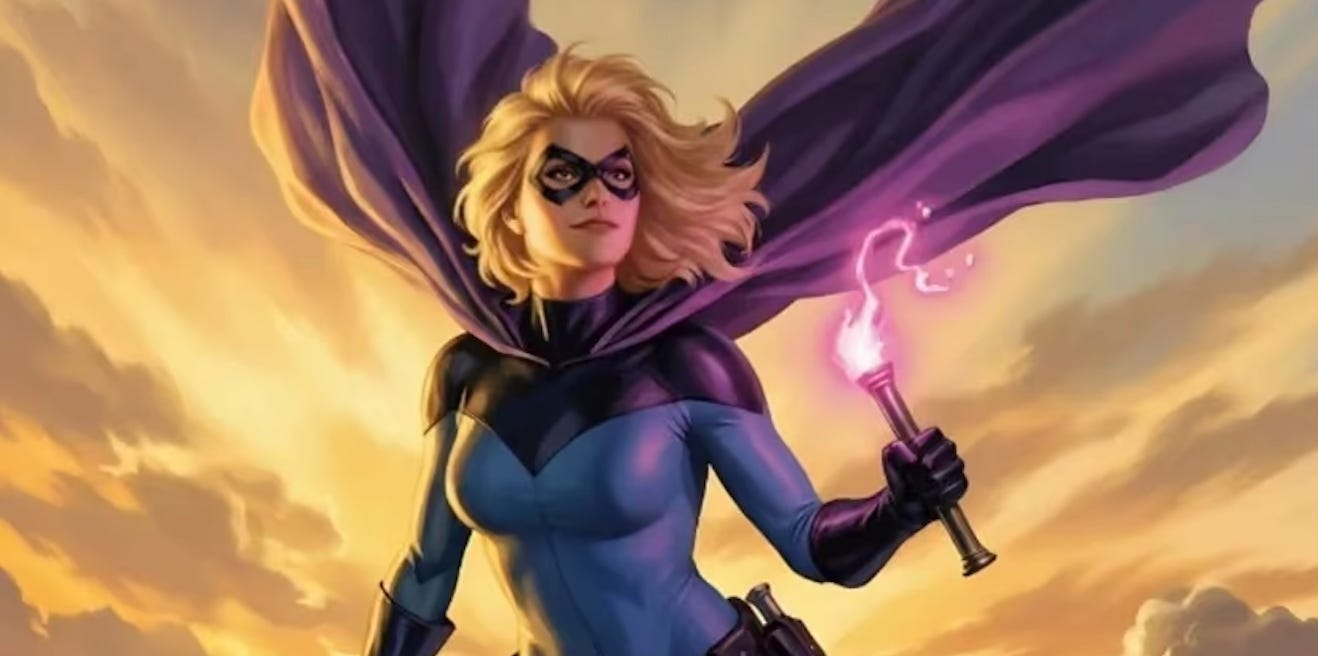
450 pages of classic superhero storytelling that puts character first. The Flying Sparks Omnibus collects the complete saga of Meta-Girl — the kind of cape comic the mainstream forgot how to make. Sign up to get your copy.
Never watched it, never heard of it.
Apparently, to my benefit: I'm old enough to not want to waste my time.
The Boys is such a cultural phenomenon that despite me watching the first two seasons I thought the series ended 2 or 3 years ago.