


I’m pretty late today and going to send this off in the email with the Fandom Pulse Daily Briefing so it doesn’t double up on emails right away, so hopefully you've checked it! Sorry for the delay; it got busy, and there was a lot going on with this as well and the edits took longer than I thought. Hopefully I’ll be able to keep up the pace. We’ll see!
Thanks for continuing to make this a huge success. We gained another bunch of paid subscribers today! I appreciate you reading!
Catch up on prior chapters:
Chapter 1 (READ THIS FREE!)
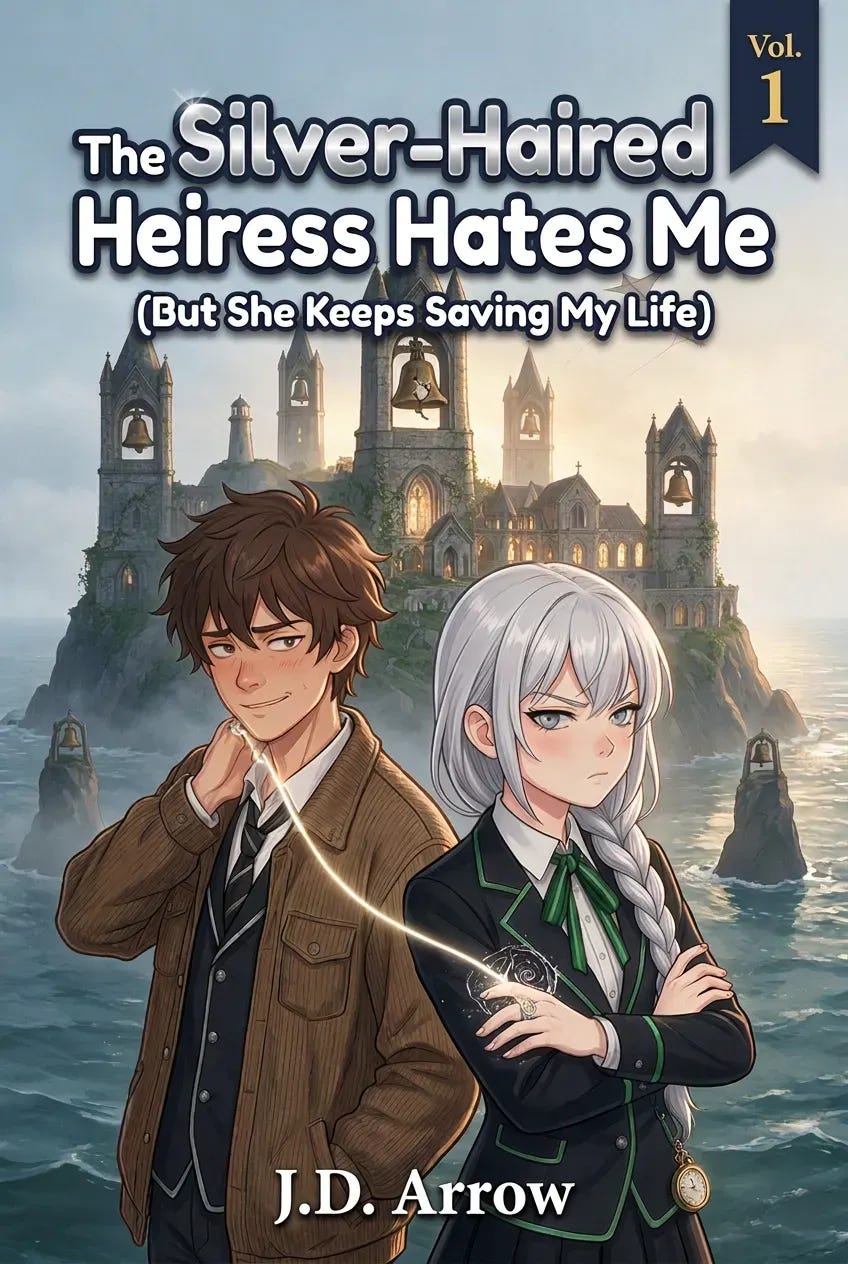
From the Collegium Handbook, Section 2: The Kindling
A student’s Court is decided by the student’s stone and by nothing else. The decision is final. Requests to pledge a different Court may be submitted in writing to the Provost, who will read them aloud at dinner.
By the time the ferry bumped against the island’s dock, the whole boat knew what I’d done. Whispers and gosip started in the cabin while I was still eating Teo’s empanada. Kids leaned their heads together and looked at me and then looked away fast. Somebody near the urn laughed. Another “cocoa” with a laugh loud enough to hear over the engine.
“You’re famous, güero,” Teo said, with his mouth full. “First day. That’s gotta be a record.”
“I don’t want to be famous.”
“Too late.” He licked grease off his thumb. “I heard a kid in the back say you threw it at her on purpose.”
“I didn’t throw it! The boat moved!”
He shrugged. “I like the version where you threw it way better.”
Pip leaned across the aisle. She had her primer open on her knees and a pencil behind her ear. “Statistically, if each person who saw it tells three other people, and each of those tells three more, then by breakfast tomorrow about two hundred students will have heard about it. By lunch, everyone.” She looked at me over her glasses. “That’s assuming they only tell three. Most people tell more.”
“Thanks, Pip,” I said. “Really helpful.”
“You’re welcome,” she said, and meant it.
Nobody spoke to me, which made the situation worse. A boy with red hair walked past our bench and pretended to trip and slosh an invisible mug in my direction, and two of his friends cracked up. I looked at the floor. I hadn’t been at this school for one single hour yet, and I already had a reputation of the worst kind. They made jokes about me.
Back in Barstow, I’d spent my whole life trying to stay invisible. Delphine always lectured me not to do the compass trick for the wrong people. Don’t let the lights flicker in front of anybody. Keep your head down and count the till. I’d been good at it. And on my very first night in a place where I was supposed to finally fit in, I’d managed to make myself the most talked-about kid on the boat.
The ferry slowed and stopped. Ropes thumped onto the dock. Up on the deck, Fintan’s voice boomed out over everybody.
“Off you go, then! Trunks stay on the dock, they’ll be brought up! Mind the steps, they’re slick, and if any of you falls in, I’m not fishing you out until after supper!”
Everyone grabbed their bags and crowded up the ladder and across the deck to the gangplank. I hung back on purpose so I wouldn’t have to squeeze past anyone, which is how I ended up at the top of the plank at the exact moment Corinne Stanhope got there.
She’d taken her braid and pinned it up in a tight bun at the back of her head. I could still see a brown stain in the silver, right in the middle of it. Dorian walked in front of her, and Dunstan walked behind.
She stopped, and looked at me for one long second without word, and then she stepped around me and went down the gangplank.
“Oof,” Teo said behind me.
“Yeah,” I said.
The harbor was a stone pier at the bottom of the cliffs, lit by more of those green lanterns that didn’t flicker. A long staircase zigzagged up the cliff face toward the school, hundreds of steps cut into the black rock, with a rope railing on the ocean side. We climbed. It took forever. Halfway up, Pip had to stop and catch her breath, and Teo shared his last empanada with her, and I stood beside them on the steps and looked up at the five towers glowing above us against the dark sky.
Everything here was so big, and old, and strange, and every single other kid on these steps knew where they were going.
“Hey,” Teo said. He’d come up beside me while Pip was resting. “Don’t worry about the Stanhope thing.”
“Easy for you to say.”
“No, for real. My brother Nico set his Court’s banner on fire his first week. By accident. It was a whole thing. Everybody called him Torch for like two years.” Teo grinned. “Now he’s a prefect. People forget.”
“Did anybody hate him? Like, specifically? A rich girl with two bodyguards?”
Teo considered that. “No, not that I can think of.”
That didn’t make me feel better.
At the top of the stairs there was an archway, and through the archway there was a cloister, a big square courtyard of grass with stone walkways around all four sides and pillars holding up the roof. Long wooden tables had been set up in rows down the middle of the grass, covered in white cloths, with candles burning in glass jars all along them. The five towers stood up at the corners and the center of the school around us, and the bells in them caught the candlelight.
Older students already sat at the tables. There were hundreds of them, all ages, from kids a year older than me to people who looked like they could be in college. They sat in five big groups, and each group wore a scarf or a pin in a different color. Red-gold. Sea-green. White. Green. Black and silver.
When the first-years came through the archway, the whole cloister turned to look at us. I tried to stand behind Teo, which didn’t work with Teo being shorter than me.
A teacher in a long sea-green coat pointed us toward one long table at the front that had been left empty. “First-years here, please! Sit anywhere you like! Don’t be shy!” He had a round, friendly face and a pair of wire glasses, and he smiled like it was the best day of his life. A silver brooch was pinned to his coat, shaped like an old-fashioned seal.
We sat down near the end of the first-year table. Corinne sat down at the opposite end, as far from me as the table allowed, with Dorian and Dunstan on either side of her. The seats around them stayed empty.
Dinner came out on its own. I don’t know how else to say it. Big tureens of soup floated out from a doorway on the far side of the cloister and set themselves down on the tables, one every few feet, with loaves of black bread on wooden boards behind them. The soup was some kind of fish stew, and in every bowl there were little pieces of white fish that glowed faintly blue, like Pip’s fingernail.
“Lantern-fish,” Pip whispered. “They’re perfectly safe to eat. Probably.”
I ate it. It was good, salty and peppery and warm. Teo had three bowls.
At the head of the cloister, on a raised stone platform, there was a high table where the teachers sat. In the middle of it was an old woman, the oldest woman I’d ever seen, with white hair piled up on top of her head and a cardigan full of holes. Bees were crawling in her hair. Real bees. Dozens of them. Nobody was bothered by it, including her. While she ate, she held up a spoonful of honey, and three bees came down out of the dark and landed on the spoon, and she said something to them like they were old friends.
To her left sat the friendly teacher with the silver brooch. To her right sat a man with a grimace on his face.
He was tall and thin, with grey in his black hair and a black patch over his left eye. His right eye was dark and sharp. He didn’t eat. He stared down the length of the first-year table, one face at a time, the way Delphine looks at a tray of rings to see which ones are fake.
His eye reached me, and stopped.
He looked at me for a long time. Then the man with the eyepatch leaned over and said something to the old woman with the bees, and she looked down the table at me, too.
“Why is he staring at you?” Teo whispered.
“I don’t know,” I said.
“Do you think he heard about the cocoa?”
I didn’t think it was the cocoa. I put my spoon down. I wasn’t hungry anymore.
Down at the far end of the table, Corinne had stopped eating too. She was watching the man with the eyepatch watching me, and her hand had gone to the pocket of her coat, where she kept her watch.
The old woman with the bees stood up, and the whole cloister went quiet.
###
The Provost’s voice carried to every corner of the cloister, soft and creaky and Irish, like she was standing right next to you even while across the room.
“Welcome home,” she said. “To those of you who’ve been home before, welcome back. To the first-years, welcome for the first time, which is the best time, though you won’t believe me until you’re old.” A bee crawled across her forehead. She didn’t brush it away. “I’m Provost Dunphy. I’ve been here longer than the plumbing, and I’ll be here after it, God willing. Now. You didn’t come all this way to listen to an old woman talk. You came for the Kindling.”
The older students cheered and pounded the tables. Pip grabbed my arm so hard her nails dug in.
The Provost waited for the noise to die down. Then she explained, and I listened to every word, because for once somebody was telling me how things worked instead of saying ask the Provost.
Every one of us had been born with a lodestone, she said. It grew in the chest beside the heart, small and hard, and it got stronger every year until we turned fourteen. A stone left in too long gets restless. That was why watches died around us and compasses followed us and lights acted funny when we lost our tempers. Tonight, our stones would come out. Each of us would come up to the front, one at a time, and she would draw the stone out with a sigil, and the stone would kindle with the color of the Court it belonged to.
“Your stone knows you better than you know yourself,” she said. “It’s had fourteen years to make up its mind. So don’t argue with it. Many have tried. The stone has never once lost.”
The older students laughed. They must have known a story about that.
“Once your stone kindles, you’ll pledge to its Court, and your Court’s bell will ring for you, and you’ll go and sit with your new family. Tomorrow the smiths will set your stones in rings.” She smiled down the first-year table. “We call you up in order of your birthdays, eldest first. So if you were born in September, my sympathies, you’ll go first. And if you were born last week, my sympathies, you’ll go last.”
My birthday had been on Saturday. I did the math, and my stomach sank all the way into the lantern-fish soup.
Professor Pellow stood up beside her, holding a long scroll, and unrolled it with a happy flourish. “Aoife Brennan!”
A tall girl with freckles got up from the far end of our table and walked to the front. A stone basin stood in the middle of the platform, about waist high, filled with seawater, and she stopped beside it. The Provost raised one finger and traced a sigil in the air over the girl’s heart.
The line was gold, the color of honey in sunlight. It looped twice and closed.
Something rose out of the girl’s chest, right through her sweater, without tearing a single thread. It was small, about the size of a marble, and grey like a pebble off the beach. It floated into the air between them. The girl cupped her hands under it, and it dropped into her palms.
Then it lit up from the inside, sea-green, bright enough to throw her shadow across the grass.
Out in the dark, a bell rang. It was deep and clear and it came from the tower at the left of the cloister, and the whole sea-green table jumped up and roared. Aoife Brennan burst into tears and laughed at the same time and ran to join them, and somebody threw a scarf around her neck before she even sat down.
“Tide!” Pip whispered. “That was Tide! Did you see that?”
“I saw it,” I said.
I’d forgotten about the cocoa. I leaned so far over the table that my elbow was in the bread.
They kept coming. A boy pledged Thorn, and his stone glowed green like new leaves, and a bell rang from the right side of the cloister, a low, woody note. A girl pledged Gale, and her stone burst white, and the Gale bell rang high and quick, almost a whistle. The red-haired kid from the ferry turned out to be named Callum, and he pledged Tide and swaggered the whole way to his table.
The girl with the ferret pledged Thorn. The ferret came with her, riding on her shoulder, and when the Thorn bell rang, it squeaked and dove into her hood. The Thorn table cheered for the ferret louder than they cheered for her. She was laughing too hard to mind.
Every time a stone came out, I felt it. I don’t know how else to put it. A tug, right under my breastbone, like something inside me had turned its head to look. And every time a stone came out, the tug got a little stronger.
“Mateo Bustamante!”
Teo stood up so fast he knocked over his spoon. He wiped his hands on his jeans, looked at me, and grinned. It was a nervous grin.
“Here goes nothing, güero.”
He walked up to the basin. The Provost traced her gold line over him, and his stone rose out and dropped into his hands, and for one second it was just a grey pebble.
Then it blazed red-gold, like the coals in a forge, so bright that people at the back tables shaded their eyes.
The Ember bell rang from the tower straight across the cloister, loud and brassy, and the Ember table went completely nuts. Four big boys with Teo’s same round face jumped up on the benches and started chanting “BUS-TA-MAN-TE!” and banging their mugs. One of them, I guessed it was Nico, picked Teo up off the ground in a bear hug and carried him to the table like a sack of rice. Teo had his fist in the air the whole way.
I was clapping so hard my hands stung.
“Philippa Ostrander!”
Pip squeaked. She grabbed her primer, then remembered she didn’t need it, then put it down, then picked it back up, and finally took it with her. She held it against her chest all the way to the basin. When the Provost traced the sigil, Pip shut her eyes tight.
Her stone came out and burst white like a camera flash, and every candle on the Gale table flared up at once. The Gale bell rang high and fast, and Pip opened her eyes and stared down at her own hands with her mouth open.
“It’s white,” she said, loud enough for everybody to hear. “That’s Gale. Chapter four, page sixty-two. They have flying.”
The whole cloister laughed, but in a friendly way. The Gale table pulled her in, and she disappeared into a crowd of white scarves, still holding her book.
Then it was just me at our end of the table, surrounded by empty seats and somebody’s abandoned bread. The tug in my chest was so strong now that I kept my hand pressed flat against my shirt, the way you hold a door shut in the wind.
“Corinne Stanhope.”
The older students stopped talking when her name was announced. At the Ash table, the black-and-silver table in the shadows under the tallest tower, a few of them sat up straighter. A tall older girl with a prefect’s pin and a severe black ponytail didn’t move at all, but she watched Corinne walk to the front without blinking.
Corinne walked up like she owned the platform like she owned it. She then stopped at the basin with her chin up and her hands folded, the same way she’d sat on the ferry, and she looked straight ahead at nothing while the Provost traced the gold line over her heart.
Her stone came out. It hung in the air for a second, grey.
Then it kindled black and silver at the same time, the way her sigil had on the dock, dark and bright together. It burned steady, cold and perfect.
Every other Court’s bell had rung. The Ash bell didn’t. Instead, from the tallest tower in the middle of the school, the cracked bell let out one long, low hum.
The Ash table applauded. It was polite applause, the golf-tournament kind. A few other tables clapped too, though not many. Corinne inclined her head about one inch, like the applause was rent and she was collecting, and she walked to the Ash table and sat down beside the prefect with the ponytail. Dorian and Dunstan had already pledged Ash, and they made room for her.
She never looked at me once, but she did look at the high table, at Master Haskett, and her hand went to her coat pocket again.
“Last of all,” Pellow said, and the cheer in his voice softened a little. He lowered the scroll and looked at it for longer than he needed to. Then he looked at the Provost, and she nodded.
“Weston Merrow.”
The cloister went quiet. The older students stopped talking all at once, and the teachers at the high table went still. A boy at the Tide table leaned over and whispered something to the girl next to him, and she shushed him without taking her eyes off me. The first-years looked around at each other, confused, the way I was confused, because none of us knew what was happening.
Even the bees had stopped moving in the Provost’s hair.
All I’d done was spill some cocoa. I couldn’t stop thinking about it. Was that why everyone’s eyes were on me? No, this felt different. Every person in that cloister who was older than fourteen had heard my name before tonight, and I was the only one who didn’t know why.
Across the cloister, at the Ember table, Teo stared at me with his mouth open. Pip had stood up on the Gale bench to see better.
My legs didn’t want to work. I made them work anyway. I stood up, put my hand flat over the tug in my chest, and walked up to the front.
###
I counted my steps on the way to the front, just like I would the till back at the pawn shop. It was what I did when I was nervous. It took forty to get there.
Hundreds of people sat at those tables, and not one of them made a sound, and all I could hear was my own sneakers on the grass and the ocean down at the bottom of the cliffs.
I climbed the two steps onto the platform and stopped beside the stone basin. The seawater inside it was perfectly still. Up close, the Provost was even older than she’d looked from the table. Her face was all soft, folded wrinkles, and her eyes were very bright and very blue.
She looked at me for a long moment with curiosity.
“You have her chin,” she said in a quiet tone so only I could hear it.
“Whose?”
“We’ll talk, you and I. Not tonight.” She patted my cheek with a dry little hand. “Tonight, hold still.”
She raised one finger and traced the sigil over my heart.
I watched the gold line loop once, then twice, and close. The tug in my chest turned into a pull. It wasn’t painful, exactly. It was like the feeling you get at the very top of a roller coaster, right before the drop, when your stomach is still at the bottom of the hill. Something deep inside me let go of something it had been holding on to for fourteen years.
The stone came out of my chest.
It moved slower than the others had. Then it was out and floating in front of me in the gold light, a small round pebble, grey like everyone else’s.
I cupped my hands under the stone. It dropped into my palms, and noted how warm it was. Then, I waited for it to light up.
The grey faded away in front of me, like fog burning off and opening to the island. And when it was gone, the stone in my hands was clear. I could see the lines of my own palm through it.
No bell rang.
I stood there holding it. Out in the dark, the five towers stood silent. I waited for one of them to ring, any of them, even the cracked one. Nothing sounded.
At the high table, Master Haskett’s chair scraped back. He had half risen out of it, both hands flat on the table, and his one eye was fixed on the stone in my hands. The Provost reached over without looking and put her hand on his arm, and he sat back down slowly.
On the Provost’s other side, Professor Pellow stopped smiling. His hand had gone up to the silver brooch on his coat, and he held on to it tightly.
I looked down at the stone again. The candlelight from the tables shone through it, and where the light came out the other side, it fell onto the water in the basin in a tiny smear of color. Red and gold and green and white, all mixed up. A little rainbow, no bigger than a thumbnail, trembling on the surface of the seawater.
A buzzing sounded, and a swarm of bees flew down out of the dark, out of the bell lofts at the tops of the towers. At first there were only a few of them, and then there were dozens, a soft humming cloud of them drifting down over the cloister. People ducked. A girl at the Thorn table squealed. The bees ignored everybody. They flew straight to the platform and settled onto my shoulders, one after another, until both shoulders of my mother’s jacket were covered in a layer of slow, crawling gold.
I stayed still, unafraid. Bees didn’t bother me, as odd as it was that they were here.
The Provost watched them with her head tilted, like she was listening to them talk. Then she nodded, as if they’d told her something she already suspected.
“Well,” she said, and this time her voice carried across the whole cloister. “Ash Court, I think.” She paused. “For now.”
The bees lifted off my shoulders all at once and drifted back up into the dark.
Nobody clapped for my pledge.
I stood there with the stone in my hand and my face burning. For maybe five seconds, there was no sound at all. Then, from the Ember table, a single pair of hands started clapping, loud and slow and stubborn. It was Teo. He was standing up on the bench, and he was clapping like it was the World Series, and his brothers were staring at him like he’d lost his mind.
A second later Pip joined in from the Gale table, still holding her book under one arm, clapping against it. Then the ferret girl at the Thorn table. Then a few more, scattered here and there. It wasn’t much. But it was something, and I’ll never forget them for it.
I walked down off the platform toward the Ash table.
It was the table in the shadows under the tallest tower, the one with the cracked bell, and the closer I got, it felt like I didn’t belong.
The prefect with the black ponytail looked at me, then at the stone in my hand, then at me again. “Sit,” she said. That was all she said. She pointed to an empty spot on the bench.
Of course, it was directly across from Corinne Stanhope.
I sat down. She looked at me. Her expression couldn’t have been more icy with annoyance.
“Of course,” she said. “You would be here, wouldn’t you?”
“I didn’t exactly pick it,” I said.
“Nobody picks it. That’s the point.” She looked at my stone, sitting in my open palm, still clear, still throwing its tiny smear of color onto the white tablecloth. Her jaw tightened. “Put that away before somebody sees it.”
“Everybody already saw it.”
“Then stop making it worse.”
I looked down the table. Half of Ash Court stared at me. Across the cloister, kids at the other tables were leaning together, and the whispering had started again. Instead of “cocoa” it was now “clear.” What was it with c words?
An hour ago, I had been worried that the cocoa thing was going to ruin my whole year. I’d been worried about being the kid people made up jokes about. Now I would have given almost anything to go back to being cocoa boy.
I closed my hand around the stone. It was still warm, and through my fingers I could feel it beating, very faintly, in time with my heart.
Nice. The stones pick instead of a dusty old hat.
A ferry instead of a train and bees talking to the provost.
Oh, you might wanna fix something.
Corinne walked up like she owned the platform (like she owned it.) You duplicated the owning of the platform.
One Issue: I'm not sure if you properly introduced Pellow and Haskett"s names properly. They were described physically, but no one mentioned them by name.