


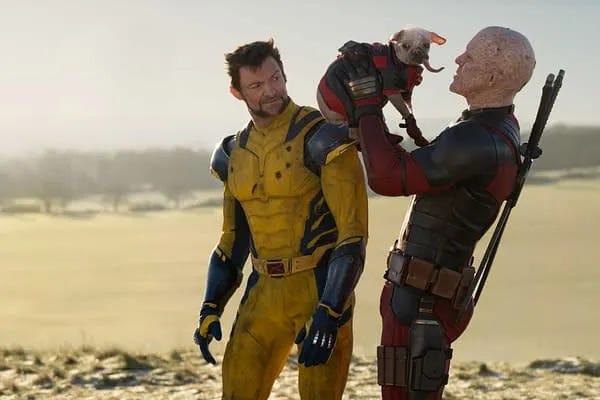
The last line of my Deadpool & Wolverine article drew a useful objection. I wrote that under the current system these properties were unlikely to become themselves again. A reader put it more precisely: the answer is actually yes. It is just a disappointing yes.
Let us take the formulation seriously. A property can look like itself again. The condition is that the story be told the way a general audience already expects a “superhero movie” about that character to be told. “Doesn’t feel like a Spider-Man movie” remains one of the most common complaints aimed at the early Tom Holland films. The phrase does not usually mean the film failed as cinema. It means the film failed a cultural recognition test. Something in the tone, the supporting cast, the humor, the moral weather, or the density of franchise furniture did not match the picture the audience was already carrying of who “Spider-Man” was.
Sam Raimi’s first two Spider-Man films felt like Spider-Man movies to a generation because they assembled a then-dominant public image of the character: working-class blues, soap-opera sincerity, and a New York that still looked like a city rather than a rotating set of Marvel cameos. Later films were inevitably judged against that standard and against the comic-book image stacked on top of it. Departures from the expected picture were often received not as interpretation but as error.
Deadpool makes the same mechanism obvious by running it at full volume. Deadpool & Wolverine “felt like a Deadpool movie” because it was packed with references, fourth-wall rupture, and licensed refuse from the earlier Fox pictures. For a large part of the audience, the references are the character. Deadpool’s cultural identity is already the mechanism that undercuts seriousness. Fill the frame with that mechanism and the movie “is itself.” Strip any of it away and people will say it doesn’t feel like Deadpool, even if what remains is a tighter and more meaningful story. The real question is whether “good” and “recognizable” have been fused so tightly that they can no longer be separated.
Holland’s Spider-Man shows the same fusion from the other side. The earlier solo films were not widely treated as disasters of craft so much as insufficiently “Spider-Man.” Brand New Day has been received more warmly in part because it offered a more familiar weather system: a college-aged Peter still paying for earlier choices, a darker city, and a light scattering of Marvel figures around the edges of his suffering. The cameos do not have to dominate the plot. They only have to confirm that this Peter still lives in the house the audience has already bought.
Once the recognition tax is paid, the movie can do the older work of character drama.
That is the disappointing part of the yes. The path back to a franchise “being itself” does not recover the original source of the character’s significance. It restores the most commercially legible version of the archive. The burning building and the life saved in the earlier analogy stay forgotten. What returns is the brand image of the hero, tuned until the audience stops noticing the machinery.
This is why established icons are now so expensive to risk and why teams of relative nobodies still have room to move. *Thunderbolts** could be written with more freedom because the public had not yet finished the sentence “a Thunderbolts movie should feel like…” Yelena, Walker, Ghost, and Sentry arrived with some prior residue, but not with a sacred checklist. An icon arrives with the checklist already laminated. The more publicly fixed the identity, the smaller the acceptable range of writing becomes. A departure asks the audience to think about the character in a way they have not already agreed to think, and a mass audience trained on recognition will often recoil from that demand. Large producers are not mysterious for declining to spend a fortune on that recoil.
None of this means the older films were freer in some pure artistic sense. Raimi’s Spider-Man was also managing an image. It was simply managing an image that had not yet calcified into a compliance regime. Once a character has been filmed, merchandised, memed, and rebooted enough times, “identity” stops meaning the inner logic of the fictional world and starts meaning the set of traits the market will still accept as authentic. At that point the writer is no longer discovering the character through further iterations. The writer is administering a public memory to people who want exactly what they already expect.
These properties can become themselves again. Under present conditions, “themselves” usually means the version that most efficiently triggers prior recognition without asking the audience to renegotiate what the character is for. That is still a closed loop. It is simply a more comforting one. The franchise does not have to look like a junkyard of variants in order to be ruled by the archive. It can look sincere, grounded, even moving, and still be doing the same work: preserving the usability of a memory.
What do you think? Is “feeling like itself” enough, or have we reached the point where recognition has fully replaced worth as the standard by which these stories are judged?
NEXT: “Off-Hour” Turns Strange New Worlds Into a Disaster Movie, With a Prequel Problem It Can’t Escape

It is a thing that cuts both ways. In the worse the image of the hero is cardboard cutout. In the better, whether the fire is remembered or not, you have living, breathing myth, and between the two, one is far more likely to lead remembrance to the source, even if only echo.
The "level of familiarity can be a gauge on how much latitude a creator has with the property" is similar to one I use to explain why so many Marvel products failed in the MCU time frame. Because they don't map to the things the MCU established, and it doesn't take much to get rejected.
The first time you hear Thor and he doesn't have Hemsworth Aussie accent, the first quip from Tony that doesn't sound like RDJ, the first "Ok, let's ger serious" line from Captain America that doesn't sound like Chris Evans... none of the characters match the mind cannon people have developed from years and years of MCU.
Recovering from that level of dissonance is very difficult. The audience is gone.
On the other hand, a property like Spiderman, which has rotated out the same character multiple times, is not held to the same unconscious standard. There's a vast gulf between "Didn't really feel like a Spiderman movie," and "I don't understand why these characters aren't what I've been trained to expect."
I suspect the reason the Spiderman and Batman properties did better is because we have decades and multiple actors so the consistency isn't required, or at least it is diminished to the "I can stand it, even though it is different," territory.