


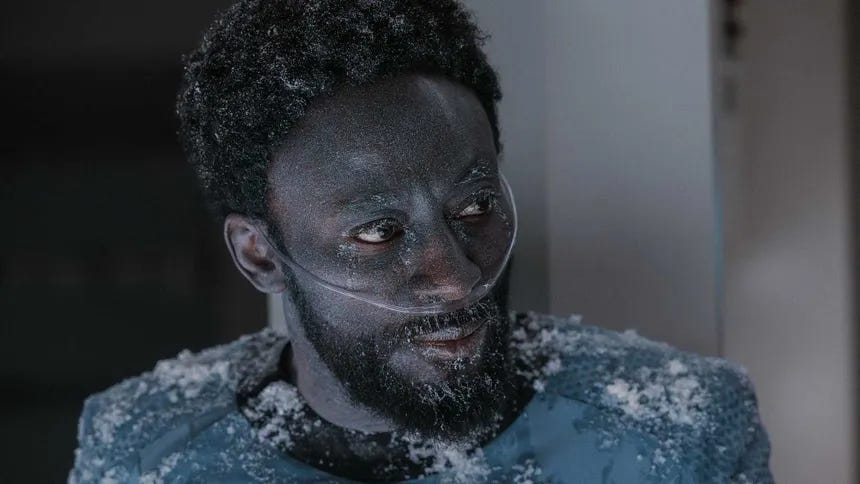
Star Trek: Strange New Worlds delivered its long-teased disaster movie episode this week with “Off-Hour,” and the hour lands on strong character work weighed down by a structural problem the show cannot escape: everyone watching already knows how it ends.
The episode opens on a smaller, personal thread before the crisis hits. Christine Chapel and Dr. M’Benga discuss Dr. Boyce, the CMO from “The Cage” who has returned to the Enterprise on second shift after his transfer to the USS Sunita didn’t work out. M’Benga brings up leaving Starfleet altogether, a plot thread that sets up Boyce’s eventual promotion back to full CMO, and by extension paves the way for a familiar face down the line: Dr. McCoy.
Strange New Worlds usually treats continuity questions as background noise, so the choice to address what happened to Boyce between “The Cage” and now stands out. Boyce appears on screen only briefly, roughly thirty seconds of runtime, but the scene advances the season’s ongoing succession arc. The casting itself is a point worth raising: this version of Boyce is bald and reads younger than the character audiences saw in the original 1965 pilot, a choice that doesn’t track well against established visual continuity for a character with an already-defined look.
From there, the ship gets caught in the slipstream of a wormhole en route to Starbase 7, and the Enterprise cannot break the warp threshold without tearing itself apart. A “Shipboard Chronometer” graphic counts down the minutes on screen throughout, a device that recalls the real-time thriller structure of shows like 24 more than it recalls classic Star Trek disaster episodes. Bill Wolkoff’s script leans into it hard: the clock returns every few minutes, whether or not the story needs the reminder.
The crew scatters across a ship in freefall. Corridors freeze over. Life support starts failing in sections. At one point the ship becomes electrified and nobody can touch a console without getting thrown, including Captain Pike himself, who takes a jolt and goes flying across the bridge. Spock ends up outside the ship entirely, climbing the hull while the Enterprise is still at warp, a sequence that owes a visible debt to the exterior-peril set pieces in films like Gravity and Sunshine. La’an goes out after him. The ship fries the data they need to retrieve, so Spock mind melds with her to hand off what Scotty needs to jury-rig a fix, and the ship breaks free before the clock hits zero.
Along the way, the episode stages a fake-out: the crew jettisons an escape pod they believe Spock is trapped inside, and it explodes the instant it clears the ship. Anyone watching knows this isn’t a real death. Spock serves under Kirk in a few years. The show cannot kill him here, and dressing up a foregone conclusion as a cliffhanger asks the audience to manufacture dread that the premise itself refuses to support.
None of that undercuts the character work, which carries the episode. The Chapel and M’Benga material lands, giving weight to their history together through the Klingon war rather than leaning on the ship’s peril alone. Boyce’s return and the succession question with M’Benga get room to breathe even inside a crisis structure that could have crowded them out. The technobabble driving the crisis stays on the vague, modern-Trek side, closer to a mood than a system a viewer could follow step by step the way older Star Trek allowed, but it does its job of moving the plot without derailing the episode.
That’s the larger issue running through the whole hour. The countdown to the ship’s destruction does little to build real tension in a prequel stacked with legendary, contractually immortal characters. The only stretch of the episode that carries actual risk is the M’Benga and Chapel material, where M’Benga is crushed and left in critical condition, and even that thread runs on borrowed urgency since Strange New Worlds has already shown its hand about which characters survive into the Original Series era. The disaster-movie plot and the medical crisis both suffer from the same trap: know the ending, and the machinery built to hide it becomes visible.
The specific homage behind the premise is the drawn-out wormhole sequence from Star Trek: The Motion Picture, stretched from a single scene into a full hour. That’s a fitting reference point for a season that’s been paying tribute to classic disaster movies, and the structure borrows from more than one source. The crew scattered into isolated compartments, each solving its own piece of a survival problem while cut off from everyone else, is the same shape used in The Poseidon Adventure and its ensemble-in-crisis descendants. The power-down urgency paired with an injured crew member worsening in the background is closer to Apollo 13. The ship threatening to break apart under structural strain rather than an outside attacker echoes Titanic and The Towering Inferno as much as it echoes The Motion Picture. “Off-Hour” pulls pieces from all of them rather than committing to one clean homage.
That blend also explains some of the visual choices, including the split-screen wipe transitions used a few times this season to cut between simultaneous scenes. The technique has real pedigree, tracing back to Brian De Palma’s work and The Thomas Crown Affair, and it was common in 1970s disaster films built around ensembles scattered across a single location. Reviving it here reads as a deliberate period quotation for the disaster-movie framing, but it lands as jarring rather than immersive, breaking the show’s usual visual grammar for a callback that draws attention to itself instead of disappearing into the story.
The bigger problem for the show is Captain Pike himself, and “Off-Hour” is a clear example of a pattern that has held for the past couple of seasons. Pike gets one moment, the electrified console jolt that sends him flying across the bridge, and then spends roughly half the episode unconscious while Spock, La’an, Chapel, M’Benga, and Scotty carry the crisis. A show built around Christopher Pike keeps writing him as a secondary character in his own series. That’s not new to this episode. It’s a season-over-season trend of sidelining the lead in favor of letting the rest of the ensemble shine, and it works against the entire premise Strange New Worlds was built on.
Underneath the effects and the countdown graphic, “Off-Hour” is a simple disaster plot built around a clock and a set of characters solving separate pieces of the same problem until Scotty delivers the fix. The plot holds together and the emotional beats land. The character work is some of the strongest the show has put out this season, even with a couple of moments along the way that don’t quite hold up to scrutiny. The prequel-stakes problem and the Pike-as-bystander problem keep it from reaching the top tier, but “Off-Hour” is a competently built hour of television that earns an 8 out of 10.
Does Strange New Worlds have a way around the prequel-stakes problem for the rest of this season, or is the show now content to keep Pike as a background player in his own series while the rest of the cast carries every crisis?
First contact with the Oridians was supposed to be humanity’s proudest moment. Instead, their chief engineer is dead, their ship is sabotaged, and an ancient alien technology is stealing souls. Book one of the Valiant Frontiers series delivers exploration, mystery, and the kind of crew you’ll want to follow across the galaxy. Read The Soul Catcher on Amazon and start the adventure.
NEXT: Dynamite’s Buffy And Angel Cancellations Expose A Publisher In Freefall
Yet another something that's not Star Trek. We know M'benga, Chapel, Spock, Number One, Scotty, and Boyce survive. M'Benga came back in an original episode of ToS. I believe he was mentioned on the Immunity Syndrome as a doctor of the Intrepid. This show didn't have to be a prequel show. It could have been a new show about a new constitution class ship set during the time period.
I miss Star Trek, the way it was written without gimmicks, and stupid puppet ideas, and musical numbers, and references to other shows.
Can we have an Airplane >> Zero Hour, but in space?
Meaning, can we take a bad parody, in this case (but not Airplane's), and make it into a good disaster film?
This Off Hour episode proves that THEY can't, but I'm pretty sure it could be done and would love to see it.