


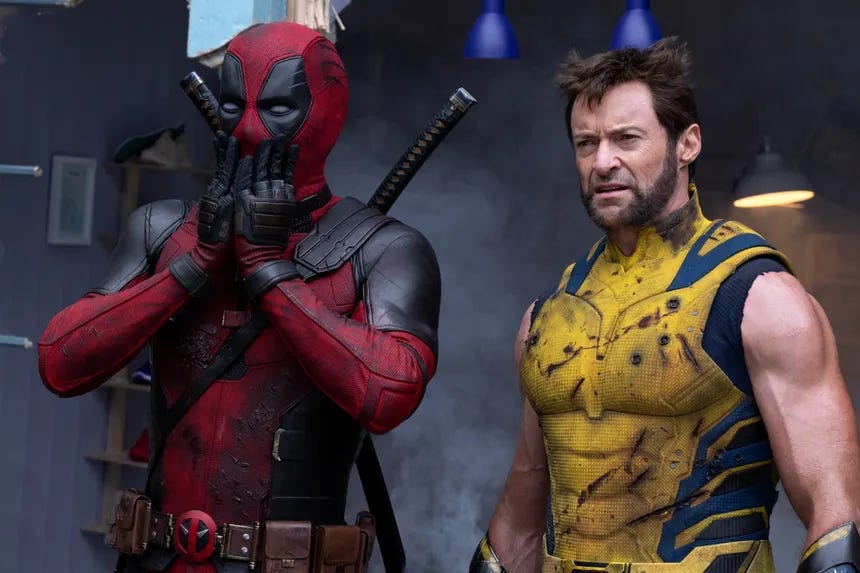
There’s a part in Deadpool & Wolverine that keeps replaying in my head, and likely not for the reason the movie’s writers want.
Deadpool and Wolverine are mid-brawl in the Void when a cloaked figure interrupts them, warning that Cassandra Nova’s scavengers are already closing in. The figure lands, throws back his hood, and reveals Chris Evans, who Deadpool (and the audience) immediately register as Captain America. However, Evans later shouts “Flame on,” ignites, and the misdirection collapses: it’s Johnny Storm, the Human Torch. His role is played for a gag as he launches skyward in full flame only to have his powers drained from him mid-flight by the mutant Pyro.
Johnny then plummets, clips a structure with his crotch on the way down, and smashes into the ground in pure slapstick. Not much later, the movie’s villain, Cassandra Nova, unmakes him with a thought. She kills him with telekinesis, peeling every inch of skin from Johnny’s body in one instantaneous motion. What’s left collapses into a wet heap of muscle, organs, and bones in a spreading pool of blood. He has just enough time for a final shocked blink before his body falls apart.
Whether it is the slapstick fall or being stripped of his flesh by the villain, both events are registered as “true” inside the movie’s logic. The first is true because the movie has already declared that physical consequence is optional when the joke requires it. The second is true because the movie needs a demonstration of the villain’s power. However, neither moment is about Johnny Storm as a character with history, body, or stakes. Instead, both are about the audience’s prior investment in The Human Torch as a piece of recognizable intellectual property.
The Existential Question
The movie summons its figures, plays upon the audience’s memory of them, and then discards them when the recognition has served its turn. Never once is the audience led to ask whether a thing that exists only to be recognized still possesses any substance, any dignity, or any claim upon one’s own moral imagination. If anything, the opposite is promoted. The movie’s central joke is that every question of existential value must be undercut before it can become serious. Whenever the story approaches questions about whether these characters possess any worth beyond their place in the franchise, the comedy arrives to deflate them. This has, more or less, become Deadpool’s entire character no matter where he shows up. He becomes the mechanism by which the work prevents itself from having to take its own existence seriously.
The joke is always there to remind us that none of this really matters, even as the plot insists that everything matters enormously.
The reason any character becomes popular is because he possessed some quality that made him worth remembering in the first place. His actions, loves, sacrifices, loyalties, and virtues give rise to his significance. Recognition is supposed to be the consequence of worth, not its source.
Consider a simple example: Imagine a man who becomes a hero because he runs into a burning building and saves someone. His heroism has an objective reference. He actually did something heroic. Now imagine that, years later, someone makes a movie about him. People remember the movie, admire the character, and call him a hero. But eventually everyone forgets why he was a hero. Nobody remembers the burning building. The rescue itself has disappeared from cultural memory, leaving only the image of “the hero.” At that point, something important has been inverted. The memory of the hero has survived, but the reason for remembering him has not.
This is analogous to the problem with the movie’s conception of its characters. It begins with recognition and then reasons backward toward value. Because audiences still recognize the old characters and properties, their continued existence becomes something worth fighting for. The conclusion is assumed at the beginning: these things are valuable because they are valuable enough to be remembered.
But that is circular. It never asks the prior question: what was there about these people that made them worth remembering in the first place? The movie replaces that question with something even more circular: these characters are only worth remembering because they are valuable intellectual properties, and they are valuable intellectual properties because people continue to remember them. The franchise becomes its own justification. The burning building is gone, and so is the heroic act that once gave the hero his meaning. What remains is the copyright, the brand, the market value, and the audience’s continued recognition of the property. The movie then asks us to treat the preservation of that property as though it were the preservation of something intrinsically worth saving.
Cultural Nihilism
Thematically, Deadpool & Wolverine is about a man confronting meaninglessness and choosing purpose. The movie contains an emotional architecture indicative of a classical dramatic arc.
But even in doing so, the well was poisoned by a substrate in which continuity, physical law, character history, and even death are provisional. In other words, even this movie is subject to franchise nostalgia, studio accounting, and the audience’s ability to recognize prior works. If we take as granted that this substrate is in place, then it won’t matter if the movie keeps gesturing toward “something,” because the writers have already told us everything is just ornamental anyway.
The actions of the heroes only matter because the story establishes that individual universes can be terminated or preserved according to corporate or metaphysical rules. The writers want us to believe that the characters are performing what are illustrated as genuinely existential acts: prevent a universe from dying, defeat someone capable of destroying timelines, and ultimately determine whether an entire reality continues to exist. Yet the writers also reduced that reality to something that can be administratively managed, licensed, and ultimately discarded by an external authority. What does this do other than make said heroism feel less metaphysically consequential?
Think about it: the characters are fighting to save a universe that the movie itself has taught us is ultimately somebody else’s intellectual property. Therefore, if the universe’s continued existence is ultimately contingent on a corporate decision about whether a property remains active, then Deadpool and Wolverine aren’t really defending existence itself. They’re defending the continued use of a franchise.
The Void is the franchise’s unconscious made literal: a dumping ground for discarded intellectual property that still carries residual cultural resonance. Spider-Man: No Way Home served the same purpose, thematically, by dredging up prior iterations of the titular character despite the fact that said iterations hold no existential value outside the meta.
Deadpool’s journey through the Void is less a hero’s quest than a guided tour of the archive, where every continuity is another reminder that these characters only continue to exist because the audience still recognizes them. The meta is not commentary on the story. Under the conditions the movie itself creates, the meta is the story. Sure, the writers wanted the emotional payoff of its titular characters’ resistance to erasure and the discovery that their lives have value because they save “the world.” But simultaneously, we are told that “the world” is the franchise itself and that its only value is commercial. Any classical dramatic gesture, whether “we need to stop them from destroying the world!” or “these people are worth saving,” becomes a kind of residual gesture, a fossil from an older kind of storytelling that still presumed these stories were about something other than their own conditions of production.
When the meta is all that remains, what exactly is left? The answer: copyright continuity. The characters persist not because the story has given us a reason to believe they matter, but because the property itself must continue to exist. In the end, what is being preserved?
Ownership. Can these properties ever become themselves again? Under the current system, that seems unlikely. The archive has become the meaning. Characters survive because keeping old stories alive keeps people recognizing and buying them. And “new” stories matter only when they connect back to the meta.
NEXT: Spider-Man 2: When Superhero Movies Were Made With Love

I like superhero movies as much as the next guy, but this was one of the most wicked, perverse movies I have ever seen.. I couldn't watch past about 10 minutes or so and had to turn it off.
I think with things like superhero movies the audience is mostly looking for entertainment (and the fanboys for easter eggs), so the issue of whether all these in-jokes eliminate the emotional stakes of the franchise is less relevant.
Also, this particular movie came as the MCU franchise was starting to decay, and poking fun at themselves and being 'meta' is something a lot of franchises will do when they're on the way down.
But you have a counterexample: the DCEU took itself very seriously and never did as well as the MCU. (Deadpool even comments on this in one movie.) DC's heroes are supposed to take heroism more seriously and are from a pre-Sixties age, so the experiment of making superhero movies that seriously examine the idea of heroism was tried. It only seems to work for Batman and in one case Superman.
An interesting exception is the Lego Batman movie, which made enormous fun of the illogical time scale, merchandise shilling, and numerous reboots of the franchise and the way Batman is a power fantasy and still managed to tell an emotional arc about isolation.