


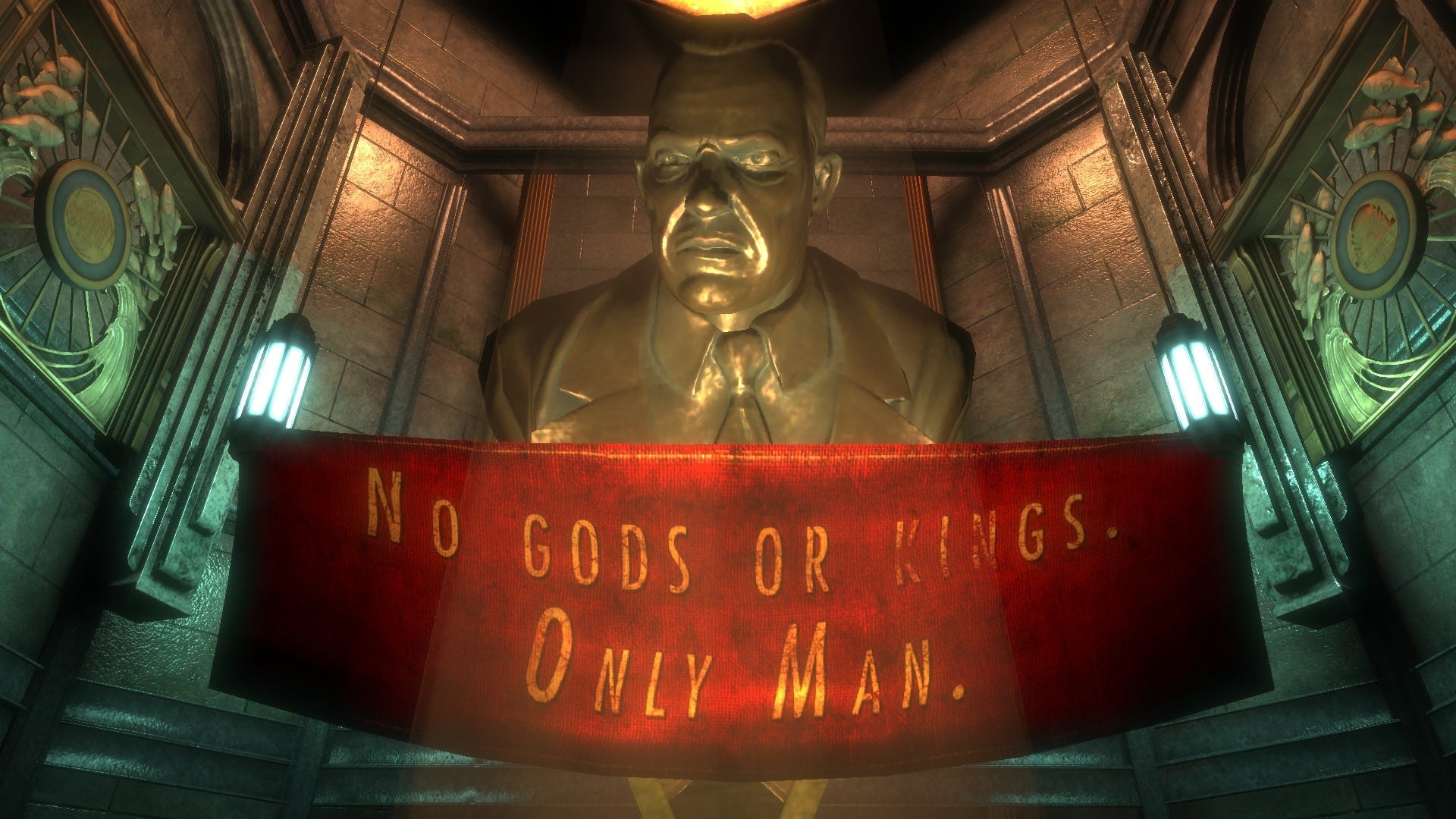
BioShock's Rapture was built on the promise that no man would kneel. The irony of this would be hammered home as the player marched through ruins of a majestic, underwater city.
Many remember Andrew Ryan's famous phrase, "Would you kindly..." which was spoken with the softness of a butler and the authority of a tyrant. The phrase was a hidden command trigger implanted in the player‑character’s mind to guarantee obedience. Every time an NPC uses it, the protagonist is compelled to obey without question. This was a twist that revealed many of the actions you thought you chose freely were actually the result of Andrew Ryan's conditioning. The revelation reframes the entire first half of the game as an illusion of agency, exposing that the player has been following orders all along simply because he was told to.
BioShock even tried to summarize its message in a single line: "A man chooses. A slave obeys." Andrew Ryan's words were meant to sound like a thunderclap, a reminder that true freedom requires one to act on conviction. Yet, history has shown us that most gamers received this message like a slogan on a poster. It was something to nod at rather than live by. The game preached choice while the medium itself was already drifting toward a future where obedience would be the default posture. The line might as well be a motto for people who never noticed how quickly they accepted the role of a slave.
Even today, the game's twist is praised as if it were the birth of some higher consciousness. In those days, the critics spoke with the same triumphant tone that would later fill a thousand Reddit threads. They declared that the medium had achieved some kind of self‑awareness through commentary and congratulated themselves for recognizing the meta: games were built on corridors, prompts, and glowing arrows. They treated this recognition as a kind of spiritual achievement, as if pointing out the rails meant they were set apart from the roller coaster.
In the later 2000s, we caught the first glimmers of a culture that believed it could not be manipulated because people had been taught the vocabulary of manipulation. "Media Literacy" is often invoked as though it were some rare skill, but it isn’t. Everyone who loves media knows the basics and everyone uses them. The issue isn’t knowledge but competition. Each person wants to prove he understands a medium better than the next and elevate his own tastes as the standard for everyone else.
This is Reddit culture in a nutshell. These are a people who recite the tropes and name story devices with the belief that doing so grants them some kind of authority over the products they consume. They imagined that spotting the puppet strings granted them authority over the stage. And they mistook their commentary for some kind of stewardship over the product itself. In their minds, this awareness has elevated them into a priesthood of taste.
Much of Redditor dialogue has become pure performance because the overriding goal is to be correct at all costs. Nuance has no place in that economy. Admitting uncertainty would threaten the persona you are trying to build. In an older world, people might have conceded a point for the sake of a work’s integrity. Now that the integrity of the self has replaced the integrity of the franchise, the argument isn’t about understanding anymore, it’s about signaling status.
The stereotypical “Redditor” is simply what you get when performance replaces thought. As a system built on upvotes, downvotes, and attention‑metrics, Reddit is doing exactly what it is designed to do and therefore cannot produce avid discernment. Due the constraints of technological efficiency, the site is specifically designed to produce metrics that chase visibility. This means the loudest takes rise, the quirkiest references float to the top, and the most reactive postures are rewarded. Meanwhile, the most reflective or thoughtful posts are doomed to be buried.
Nuance disappears because it doesn’t travel fast enough. Conformity rises because deviation risks being buried. Shallow takes becomes currency because they are easy to display and easy to reward. Groupthink also hardens because the system punishes anything that slows the scroll.
This is the natural outcome of a population shaped not by conviction or understanding, but by whatever earns the most engagement in the moment. The website is not designed to curate deep thinkers, but a community of the most avid reactionaries.
This mindset governs not only Reddit but also YouTube, X, and any other attention-driven platform. While so many commentators project themselves as guardians of franchises they never built, time has shown they will never take a stand against the whims of Progressive politics, even as those politics fundamentally change what these franchises fundamentally are (or were, as the case may be.)
Fans who latch onto this false priesthood of influencers and commentators may have believed, at one point in time, that they were actually gatekeeping the soul of the medium. In reality, most of what they do is spend their time policing other fans who dare to question the new order. Very few prominent influencers or commentators on Reddit or YouTube ever dare to condemn the creators who hollowed out the old stories. These platforms reward only the safest, most centrist postures. In other words. Anything sharper risks downvotes, demonetization, or exile from the algorithm’s favor.
This is what the term “controlled opposition” actually describes. It is commentary that presents itself as resistance while carefully policing its own vocabulary to remain safe, palatable, and non‑confrontational. It gestures at critique but never risks saying anything that might fall outside the platform‑approved center. Therefore the loudest voices train themselves to say nothing of consequence, and the culture drifts along without anyone willing to name what was lost and what needs to be regained.
All the leading influencers on YouTube posture as neutral arbiters, preaching a politics of permanent indecision to an audience that treats fence‑sitting as a virtue. Nothing is affirmed, nothing is rejected, and nothing is risked. In that vacuum of conviction, the medium drifts along the prevailing cultural current, inch by inch, into the same Progressive politics that currently dominates every other corner of modern entertainment.
It’s ironic that this obsession with being correct has simultaneously produced a posture where no one actually takes a stand. Nobody wants to risk being wrong, or worse, upsetting the crowd, so they retreat into a safe, centrist, Overton‑window position. The result is people who engage in a performative certainty but avoid any real conviction, forever playing a game of signaling their intelligence while refusing to stake themselves on anything real.
History has shown us that BioShock’s supposed revelation was not what everyone thought it was. Games had not yet been reduced to glowing arrows, yellow paint, and compulsory corridors. The irony is that almost two decades ago, people treated this twist as some kind of a profound dystopic warning when, at that very moment, the industry was primed to make that warning come true within our lifetimes. Players naively believed the game had exposed a long‑standing truth about society and obedience, when in fact it was only describing the future everyone would soon accept without protest. Players had been trained to obey long before they ever heard Andrew Ryan's words.
The irony is simple: the game declared that obedience is a form of hypnosis while the industry itself was busy perfecting the trance. The years that followed did not produce a generation of liberated players who think for themselves but a generation of players who need quest markers and constant voices in their ears. Judging by how people spoke of BioShock at the time, one might have expected the game's twist to have shamed the players and the medium into some mode of genuine self-reflection. Instead, it just served as a preview of the world yet to come. History has made the lesson plain: give players a narrow lane, cordoned off by invisible walls and they will walk it without hesitation, proudly calling the arrangement a video game. They will follow the path of least resistance, wrapped in the illusion of choice, and they will call it gameplay.
It is almost comical that “meaningful choices” has become its own genre tag on Steam, as if the very idea now requires special labeling. In the old world, it was commonplace to puzzle things out for yourself. Meaningful choices had to be uncovered through a keen eye and shrewd discernment. In the new world, every step might as well be delivered as a digital “Would you kindly…” for a people no longer expected to choose anything meaningful at all. The modern player is not asked to think. He is only taught how to comply.
Incidentally, this why so many video-game speed-runners or tournament players (who are mostly male) end up becoming transgender. They are compliance‑driven people who have trained themselves to interpret every circumstance as something inflicted upon them, echoing the passivity celebrated in so much modern female romance fiction. Having surrendered even the appearance of agency, they slip easily into whatever the ready‑made script of Current Year helplessness is and recite it as if it were their own story.
A complaint‑driven personality doesn’t just trap a man in powerlessness, it makes him exquisitely vulnerable to the prevailing political faction of the day. Modern media, including video games, are made to curate people into vessels for the prevailing winds of woke politics. This is the "modern audience" which the industry wishes to promulgate. They are men who will never resist the whims of cultural upheaval, especially when it is far easier for them to surrender their manhood and be carried along by the institutional authority of the Progressive Left.
The chopping off of one's penis is the physical representation of a spiritual surrendering. Thus, the male makes himself as woman-like as he can be, readily compliant to the pseudomasculine authority of the Progressive State. This is the path of least resistance, much like how our modern video games are now structured.
This sin, which is rooted in homosexuality (or just plain sexual immorality), is one of many perverse sexual activities that will be judged at the Last Day. But the sins we commit in life are also a judgment in and of themselves. They bring judgment, but they also are a judgment. The wrath of God is visited from Heaven, Paul says (Romans 1:18). God’s wrath (His judgment) is manifested. The way His wrath manifests is that God gives them up to their perverse desires (Romans 1:24). When He does this, they will run headlong into His judgment.
Mercy is given to us by God when we say to Him, “Thy will be done.” Judgment is poured out over our heads when God says to us, “Thy will be done.” That is when he gives us over to our vain desires. He lets go of the reins of His merciful restraints and we rush headlong into the destruction of our own making. And the only means of reversal is to cry out to Him in repentance.
In the years following BioShock and so many other good old games, we have seen the medium stripped of depth and nuance. Designers have removed the silence in which a man might think for himself and work through a puzzle. Instead, he obeys because a medium either no longer trusts him and, instead, seeks to program him according to the desires of Soft Power.
Prominent video game critics and commentators of the 2000s once said that BioShock had confronted us with dystopia about our own enslavement. They were wrong. In reality, it was confronting us with a servitude that many gamers had already accepted. The real twist is not that the player was being controlled the whole, but that he has shown he actually prefers it.
And so the prophecy fulfilled itself. A phrase that once shocked the gaming world has become unnecessary. The industry need no longer ask nor whisper "Would you kindly..." because it no longer needs to. The player is conditioned to push the left analog stick upward because forward the only direction we are allowed to go. And he obeys because obedience has become the grammar of modern game design.

"The inutility of fiction as a warning". Four years ago, I was told this about the world of cinema, and there were plenty of examples against authoritarianism and totalitarianism; it seems that Bioshock is its equivalent in the world of video games. It was also mentioned that we had been living under authoritarianism for more than a decade, unlike now, when it is pretended that we have only been under it for a year, which is not the case. Similarly, in cinema, warnings were issued about corporations and conspiracies. But all this turned out so badly that what was interpreted was: “That couldn't happen in real life.” The most sinister thing about this is that Hollywood learned from it and, on occasions, seeks that purpose, and on others changes the way it operates, ceasing to pretend to paint fiction to say that it films reality or a longing for what it desires. Let's remember that in recent days it turns out that the conspiracies they tried so hard to deny us are now real, but only for what we need, only to further their own agenda. Let's ignore the fact that Gnosticism seems to rule the world and reduce everything to the material. And the media now ask us: Would you Kindly outrage?