


History speaks in commands. It orders us to remember, to repent, and to change. If we refuse these commands, we do not silence history. We simply try to invent a past that flatters us.
Modern media has become a workshop for such inventions. Every age rewrites its memories, but ours does so with a peculiar anxiety. We fear that the truth of the past will judge us. So we craft a gentler one; a past that already believes what we believe the whole time. This past affirms what we affirm and never resisted our ideals.
But this is not true remembrance. This is therapy.
Munching on Carpets in 1348 Ex Voto
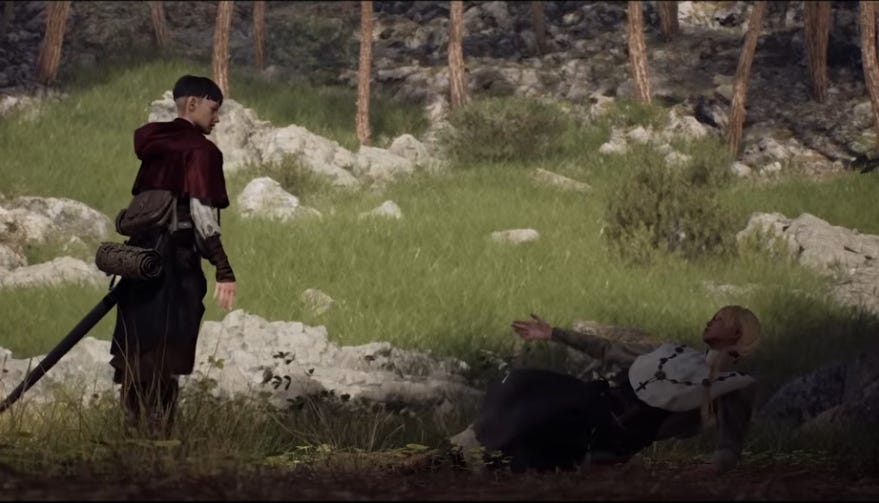
The video game 1348 Ex Voto offers a clear example of what I mean. Its creators place a postulant in a medieval convent, then free her from the very structure that defined her life. Father Brendon LaRoche reminds us that a postulant lived under an unyielding horarium. This meant work, prayer, silence, and community. No wandering in forests, no private visits, and no leisurely encounters with outsiders. The medieval world was not a stage for personal exploration, it was a crucible that shaped souls through discipline.
To place a romantic lesbian storyline inside that crucible without acknowledging the instability it would create is to empty the setting of its truth. It is to invent a therapeutic past for a false history. This game does not portray the Middle Ages as they truly were, nor does it seek to. Instead, it portrays our own century wearing medieval costumes, turns history into a blank canvas for whatever whims we wish to instill within it. This means 1348 Ex Voto will be nothing less than a demand that history echo modern convictions rather than illustrate life as it truly was.
Sadly, our culture treats minority identities as moral credentials (not to mention the unfortunate affair of needing to categorize individuals within identity groups in the first place.) To represent identity groups in media is to signal virtue and to omit them is to risk accusations of racism or bigotry.
However...
This logic turns representation into a ritual of self‑absolution. Creators imagine that by populating the past with the identities they celebrate Progressive ideals and heal the wounds of history.
Yet the more they do this, the more they erode the very memory that was supposed to have made those wounds in the first place.
Imagine sitting with a counselor who listens to your grief, nods solemnly, and assures you that your pain is real. Then, with the same breath, he informs you that the events that caused it never happened as you remember them. They know your history, but they redraw it to suit a more comforting picture. They replace the hard edges with ideals they prefer. Your wounds remain, but the world that produced them is rewritten. You are consoled, but not told the truth.
This is essentially what modern storytellers do with the past. They keep the language of oppression intact but they erase all the conditions that were supposed to have made the oppression effective. They keep the rhetoric of suffering, but they remove the structures that produced it. And once the past has been redrawn to soothe us, a deeper contradiction appears: a story that rewrites its own origins cannot sustain its own future. If the wounds remain but the world that caused them is erased, then what reason would any later generation have to remember them at all?
Why would anyone make a game about an oppression that, in our retellings, never truly existed?
A culture that edits the past into a mirror of its own ideals destroys the very drama it claims to honor. It keeps the language of struggle, but it removes the conditions that made the struggle meaningful. It celebrates the triumphs of the oppressed, but it erases the world that made those triumphs costly. It demands remembrance, yet it removes the reasons to remember.
This is the fatal irony of these Progressive narratives. Future generations will inherit stories that no longer match the history those stories claim to remember. Young people will be the first to sense the contradiction because they will grow up inside a world where the wounds are still invoked but the world that caused them has been erased. They will be asked to honor a past that has been emptied of its substance and told to remember what we have also been told to forget.
And here the strangest of consequences appears: a culture that insists on the permanence of oppression, while simultaneously rewriting the past to remove its causes, must eventually manufacture the very hostilities it claims to condemn. If the real conditions of prejudice are no longer present, they must be simulated. If the past no longer contains the bigotry that once shaped it, then new generations must be taught to imagine it, reenact it, or dramatize it, all for the purposes of keeping the narrative alive.
This is the price of rewriting history. A society that refuses to let the past speak in its own voice must invent new voices to fill the silence. A society that demands remembrance without truth must eventually teach falsehoods.
If every medieval convent is depicted as a place where modern sexual identities flourish without consequence, then the claim that such identities were once suppressed becomes contradictory.
If every frontier town or Viking village or Roman legion is shown as casually diverse, then the narrative of racial homogeneity collapses.
The past becomes a mirror that reflects only our own desires.
Stranger Things and Silly-billy Sentimentality
The same pattern appeared in later seasons of Stranger Things. Lucas Sinclair was not allowed to simply be a black child in a group of friends. No, the writers felt compelled to add a racist antagonist to the story. Not because the story required it, but because mainstream narratives demanded it.
The 1980s were often marked by quiet separation rather than open hostility. People often lived near each other without mixing. They did not always embrace, but they did not always hate. The show replaces this complexity with a moral tableau that comforts modern Progressive sensibilities a the cost of a nuanced history. It allows the audience to condemn a villain rather than confront the subtler truth of the 1980s were often marked by quiet separation rather than open hostility. It was a world shaped by unspoken lines that most people did not question.
Moreover, the 1980s did not treat homosexuality with open affirmation. While homosexuals have existed in every town and every decade, other people in the community often knew who they were. They were acknowledged, but they were not celebrated. They were never lifted up as symbols of personal identity and some may have even chosen to marry the opposite sex and raise families. This was because the center of life was not the solitary expression of the self. The center was the household, the neighborhood, the Church, and the shared duties that held a community together. Identity was not a banner to wave, it was a private fact carried within a larger loyalty.
To place a modern coming out narrative inside that world without the weight that world would have imposed is to repeat the same gesture we have already seen. The past is kept as scenery, but the structures that governed it have been removed. The story then demands that we feel the triumph of Will's honesty, but it refuses to show the supposed cost that honesty would have demanded.
And once again, the contradiction becomes clear. If the 1980s are retold as a place where a young boy could speak freely about being a faggot, then the very reason to tell such a story disappears. If the struggle is removed, the courage becomes weightless. If the danger is erased, the revelation becomes completely sentimental.
Conclusion
History is not a museum, it is a battlefield of commands. The future orders us to hope, and the present orders us to decide. And the past orders us to change. When we rewrite the past to suit our present feelings, we break the chain of these commands.. We silence the voices that should correct us and replace them with voices that praise us.
The result is a culture that will remember nothing and congratulate itself for doing so. People will claim to honor the oppressed while begging the question about the very conditions that supposedly made their oppression real. They will mistake virtue signaling for virtue itself, praising themselves for gestures that cost them nothing while refusing to face the truth.
The past is not ours to fix, but ours to face. For only Christ can fix the past. And only by facing the past can we know how to live truthfully in the present.
NEXT: Vain Recognition - The Last Sacrament Of A Godless Age

Its not actually the Middle Ages, its a modern Renaissance Festival Theme Park. I bet you can see contrails in the Sky if you look closely
Being a victim is a source of power in our Marxist culture. Lacking any real oppression in the present, gays are now looking to oppress themselves in the past to gain victim-powers.