


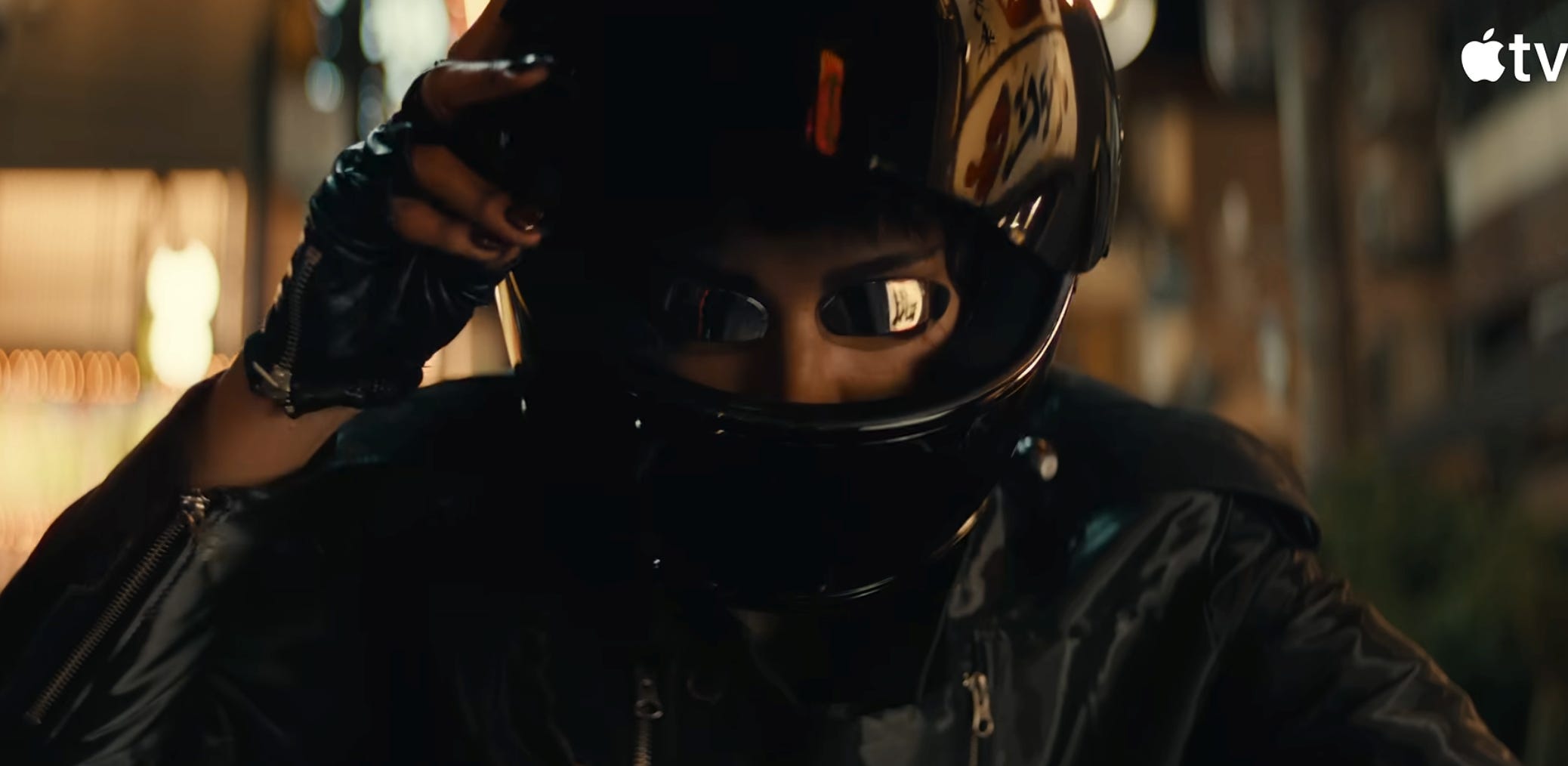
Apple TV’s Neuromancer dropped its first real trailer at San Diego Comic-Con this year, and the reaction split almost immediately into what social media was calling “cooking” versus “cooked.” William Gibson, who published the novel in 1984, came down firmly on one side. He shared the trailer on Bluesky and wrote: “Anyone who doesn’t see how very satisfied I’ve been throughout production doesn’t get what I most want out of an adaptation.” That’s about as clear an endorsement as an author who’s watched decades of failed attempts to film his own book can give.
And decades is the right word. Neuromancer has been called unfilmable for good reason, and not because the plot is complicated. Gibson’s prose is dense, internal, and noir-drenched, spending as much time inside Case’s drug-worn, self-destructive headspace as it does on actual plot mechanics, and its version of cyberspace, “a consensual hallucination,” in Gibson’s own famous phrase, exists almost entirely as an abstract, non-visual idea on the page. Translating that into something a camera can actually show, without turning it into either a literal light-grid simulation or an incoherent mess of jargon, has sunk multiple attempts before this one. Chris Cunningham, Chuck Russell, Vincenzo Natali, and Tim Miller all circled film adaptations at various points over the years, and none of them got a movie made. The closest prior attempt at Gibson on screen, 1995’s Johnny Mnemonic, based on a related Gibson short story, was critically panned and stands as the cautionary tale everyone in this new production surely knows by heart.
That history is exactly why the visual choices in this trailer matter so much, and why the comparisons to The Matrix write themselves. Gibson’s novel is widely credited as one of the foundational influences on the Wachowskis’ film, from the concept of a fully-realized digital reality overlaying the physical world to the entire visual language of green-tinted code and jacked-in hackers. A show that leans into those same aesthetics isn’t copying The Matrix so much as returning to the source The Matrix borrowed from in the first place, which makes the visual overlap feel earned rather than derivative.
Whether Apple can actually stick the landing is the open question, and there’s reason for caution alongside the optimism. Fan reaction on social media wasn’t uniformly positive: one commenter responding to Apple’s own announcement post pushed back specifically on the show “reimagining” the source material and pointed to Molly’s casting, noting Gibson “described her many times” in the books with pale skin, actress Briana Middleton doesn’t match that description. Gibson’s own public statement doesn’t address that specific complaint directly, so it’s worth being precise about what he actually endorsed versus what fans are separately debating.
What does inspire confidence is the scale Apple has clearly put behind this. Filming spanned Tokyo, Los Angeles, Istanbul, Canada, and London, the kind of multi-continent production budget that suggests Apple is treating this as a flagship series rather than a cautious, contained streaming drama. Showrunner Graham Roland (Jack Ryan, Dark Winds) and director J.D. Dillard (Devotion) are both experienced with grounded, character-driven genre work, which is arguably the harder skill this adaptation actually needs, since the novel’s challenge was always emotional and atmospheric rather than purely visual. Callum Turner leads as Case, alongside Briana Middleton as Molly, in a ten-episode first season that may or may not extend into Gibson’s Sprawl trilogy sequels, Count Zero and Mona Lisa Overdrive, depending on how this first outing lands.
Gibson signing off this early, and this warmly, on a novel that’s spent over three decades failing to reach the screen counts for something real. It doesn’t guarantee the finished show clears the bar the source material actually needs. Cautious optimism is the right posture here: money, creative pedigree, and the author’s blessing, against a novel that has broken every serious attempt to adapt it for forty years.
First contact with the Oridians was supposed to be humanity’s proudest moment. Instead, their chief engineer is dead, their ship is sabotaged, and an ancient alien technology is stealing souls. Book one of the Valiant Frontiers series delivers exploration, mystery, and the kind of crew you’ll want to follow across the galaxy. Read The Soul Catcher on Amazon and start the adventure.
I’m disappointed to hear that Gibson is on Bluesky.
“…pointed to Molly’s casting, noting Gibson ‘described her many times’ in the books with pale skin, actress Briana Middleton doesn’t match that description.”
Well, duh. Failure to race-swap out at least one white character is evil racist.