



The title of this essay looks like it ought to be on some book about the apocalypse. In truth, its meaning is derived from the 2019 Game Developers Conference where Kim Belair of Sweet Baby Inc. stood before an audience and spoke of a moment that fundamentally changed her. She described creating a black character in the video game Mass Effect 2 and encountering another black character within that digital world. It was a coming to Jesus moment for her. She was elated and said it was "really, really nice." She could not say much more than that, however. She could not explain why it mattered or what it really revealed. Yet she spoke with the certainty of someone who had touched something sacred or, seemingly, unheard of.
Belair's GDC segment was a watershed moment because of what she revealed. She showed the playbook of our age. She showed that representation has transcended its political demands and become a certifiable spiritual hunger in some people. It is its own religion. It is the search for recognition in a world that has forgotten Christ.
Recognition is the oldest of human experiences. It is the child calling for the mother. It is the exile hearing his native tongue. It is the wanderer finding a familiar face in a foreign land. It is the moment when the world says, “You are not alone. You belong here.”
This very strength has been seized by the modern Progressive movement. It has become a counterfeit spirit, an antichristian impulse carried along by the principalities and the powers, the rulers of the darkness of this world, and the spiritual wickedness in high places. The private experience of recognition has been raised to the level of public law. It has taken the warmth of a moment and declared it the foundation of justice.
Kim Belair could not sufficiently say what her feeling was nor could she name the source. She could not explain the meaning. She could only testify to the feeling itself. She could only describe the warmth without knowing the fire.
When the image of God is forgotten, the image of the self becomes the only remaining idol. Identity becomes the last altar and representation becomes the last sacrament. The endless haranguing about "diversity" is about a culture that has lost its metaphysical center and is trying to rebuild it purely out of sentiment. A generation that no longer knows the God who remembers and is trying to recreate His remembrance through media.
The Bible speaks often of God remembering. God remembered Noah. God remembered Abraham. God remembered Rachel. God remembered His covenant. When God remembers, He does not recall a fact. He turns toward His chosen people. He acts and restores them, bringing life out of barrenness and deliverance out of despair. To be remembered by God is to be seen, known, and loved.
Our age has lost this grammar. We no longer believe in a God who remembers. We no longer believe in a covenant that binds heaven and earth, but we still yearn for a voice that calls us by our name. The human heart has not changed. We still long to be recognized and our spirit cries out to be seen. Our art is a manifestation of this ache and an effort to project ourselves into a world full other people who, like us, are made in God's image and are the most surefire evidence that God exists.
This is why representation feels spiritual to some. It is an echo of a forgotten covenant and robs, through antichristian sentiment, the memory of being remembered by God. It is a bastardized retelling of the soul's yearning for recognition in a world that has replaced Jesus with demographics.
Western Culture Is Christian And, Distinctly, White
At the deepest layer of Western cultural inheritance is that of a White Christian influence. This is by merit of the transmission of a way of life that taught the world to hear the commands of Jesus Christ. Christian identity was carried into the West mostly by White Europeans. They believed in a vision of time that moves forward and a law that binds rulers as well as subjects. They also believed in a dignity that rests not on tribe or class but on the image of God in every person. That is why this inheritance need not be limited to those of Western European descent. Christianity spreads because its tenants always prove stronger than the tribal gods of old European traditions. Christ's teachings spread because they gave shape to the kind of people God wants us to be.
The West became Christian long before it became modern. Its peoples, whether descended from Celts, Germans, Africans, or Indigenous Americans, entered into a moral world shaped by Christianity. So when that identity is attacked, the wound does not remain local, it strikes the very root from which the West draws its moral imagination. It strikes the source of the idea that history has direction. It strikes the foundation of the belief that every human being stands under the same divine call.
To attack white people is to attack the grammar that made also made blacks, Hispanics, and every other people in the West an equal co-habitant of a shared moral world. It is to attack the covenant that binds strangers into a common future. This is why such hostility will not stop with whites. It cannot. Once a society rejects the identity that taught it to honor the dignity of others, it will soon forgets how to honor anyone at all.
Feels Good Identity Politics
Eric Anthony Glover, the author of the fourth episode of Starfleet Academy, declared that the series “dares” precisely because it centers immigrants, elevates the foreign‑born, and frames its story as an act of redemption for a society that has othered its neighbors. He points to the show’s creators, producers, and actors as proof that the work stands upon the shoulders of those who have crossed borders, whether literal or cultural. He describes the cast and crew as a new tribe formed in the making of the episode, a family gathered around the story of a refugee who finds love and protection not only from friends but from the government itself. And he concludes that the series challenges its audience to rise above the impulse to blame and to become something better.
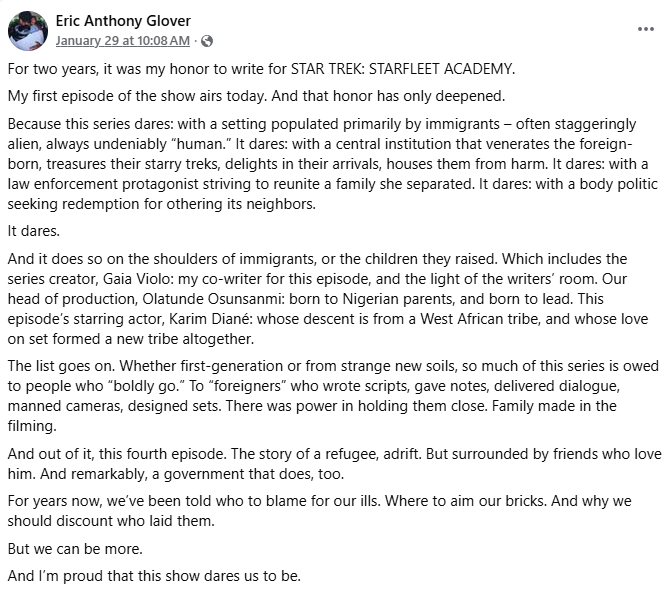
None of this would have ever been made possible for him to do without white cultural inheritance.
Another irony here is that the show’s moral center is not the universal but the particular, not the shared human calling but the curated identity of the moment. And so the question presses upon us with greater force: What makes this politics of identity good? What grants it moral authority? What gives it the right to command the conscience?
Every politics claims justice, just as every movement claims it is about "compassion." But justice cannot be built upon the shifting sands of self‑description. A society that replaces universal standards with the celebration of whimsical chosen identities will lose the very grammar by which it once judged right from wrong.
Glover’s declaration reveals a culture that has forgotten how to speak in a universal voice, and one that binds strangers into a common future. Instead, this is the voice of tyranny. These are the real "extremists" about which Hollywood bandies it cautionary tales. Glover's words are a demand for loyalty and reverence. They want to be treated as the new measure of all things.
The writer who declares that a new show is entirely about identity politics believes he is speaking of justice. Yet he is speaking of a world that has replaced universal standards with vain particulars. And the question arises: What makes identity politics good? What gives it moral force? What grants it authority over the conscience?
If the answer is simply that it feels good, then it is taste. If the answer is that it affirms the self, then it is preference. If the answer is that it comforts the lonely, then it is therapy. None of these can command a people. None of these can bind a nation. None of these can stand in the place of God. A society cannot live on sentiment. It cannot build its laws on the tremors of the heart, and it cannot replace metaphysics with mood.
Love Your Neighbor As Yourself
Christ names the second great commandment in Matthew 22:39: ‘You shall love your neighbor as yourself.’ If this is God's law, then any authority that instructs me to fear, resent, or mistrust my neighbor is already speaking outside its jurisdiction. I cannot give my conscience to a voice that contradicts the command of God.
When white people are mocked or diminished, the attempt is indicative of a will to silence the voice that gives history its meaning. The consequences will not be small; they will unfold like the stages of a spiritual eclipse. Cruelty will become permissible. In fact, we are already seeing this. If any human being, much less a white person, is treated as anything less than fully human, then the covenant that binds strangers into a common life will have been broken.
Institutions falter next. Laws that once protected us will wobble. A society that attacks white identity will soon discover that it has attacked its own conscience. Every white person has stood as the reminder that law is older than kings and that justice is older than nations. When that witness is scorned, the very institutions that once drew strength from it begin to wither, even the progressive ones that first helped shape these cultural habits. Then comes the fragmentation of the whole. A people that tolerate the targeting of white people will eventually ability to trust anyone else. The public square will become a battlefield of tribes.
Finally, the world grows thin. A culture that wounds white people wounds its own inheritance and discards the memory of a people that taught us to hope. The loss will not only be a moral one but also one of imagination. A society that attacks White identity becomes poorer in soul and becomes a place where the future cannot be born.
Silence in the face of such targeting is not neutrality but surrender. When a people are singled out, the whole world is placed on trial. For the assault on one identity is always the rehearsal for the assault on all identities. The attack on a white person is the attack on the grammar of humanity itself. It is the attempt to erase the witness that every life is summoned by a voice greater than oneself.
History moves only when we answer the call of the wounded. A society that refuses to answer becomes mute. It loses the power to create a future and becomes a prisoner of its own fears.
Therefore the question is not what happens to white people. The question is what happens to the world that dares to target them. The answer is written in every century: a society that forgets the people who built it will soon forgets itself. And when the forgetting is complete, there will be no one left to speak for anyone.
NEXT: Supplement Peddler Advanced GG Cancels Streamers Rev Says Desu And DarlingStrawb For Defending ICE

Proof of god can be found on my substack. I am finding more everyday.
https://trickylasoul.substack.com