


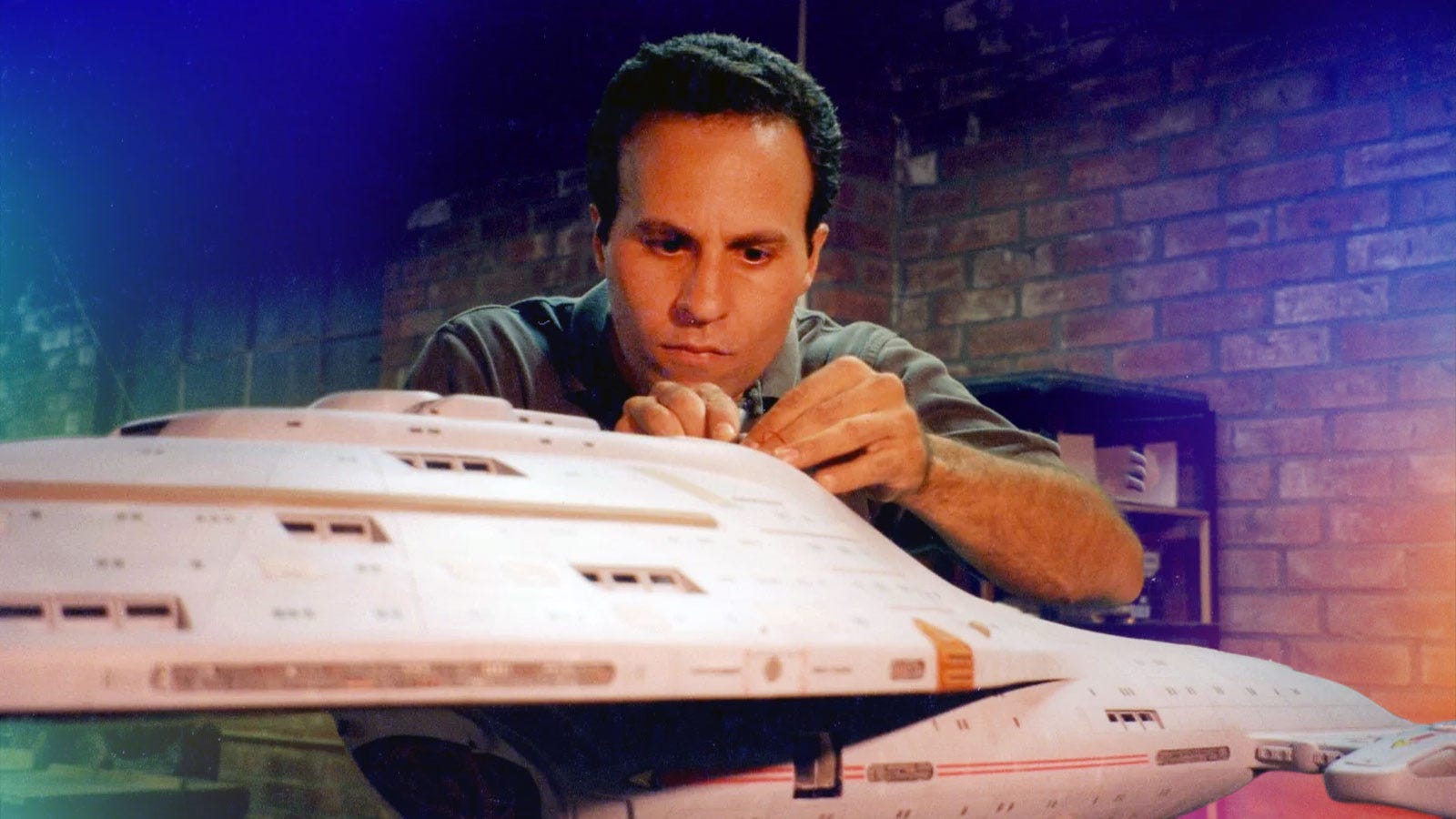
Jacobs/Brown Press released Trek Star: The Geek Life of Doug Drexler today, and the subtitle says everything you need to know about the tone: How Star Trek’s Legendary Designer Made All His Idiotic Adolescent Dreams Come True.
Drexler’s career trajectory is one of the better stories in Hollywood precisely because it should not have worked. He grew up in New York obsessing over the original Star Trek series, edited one of the first licensed Star Trek publications ever produced, wrote two Star Trek comics for Gold Key in the 1970s, and ran a Star Trek fan store in Manhattan called The Federation Trading Post. He was part of the original Save Star Trek letter-writing campaign in the 1960s that brought the show back for a third season. In 1979, he and a friend flew to Los Angeles and snuck onto the Paramount lot to visit the production of Star Trek: The Motion Picture, talked their way into conversations with the art department, and Drexler went home and told his family this was going to be his life.
They laughed. He was right.

His professional path into Hollywood started through makeup artist Dick Smith, who brought him on to work on The Hunger and Starman in the early 1980s. From there he built credits on C.H.U.D., Manhunter, Fatal Attraction, Poltergeist III, and Three Men and a Little Lady. He wanted to get onto The Next Generation’s makeup department in the late 1980s but California union rules blocked him. The solution arrived through an unlikely route: Warren Beatty, who was making Dick Tracy, used his considerable industry leverage to get Drexler into the Hollywood Makeup Union.
Dick Tracy won Drexler an Academy Award, a BAFTA, and a Saturn Award for his special makeup effects work, including Al Pacino’s Big Boy Caprice and Dustin Hoffman’s Mumbles. The moment the award landed, his cast on The Next Generation went wild. LeVar Burton reportedly could not resist whenever Drexler walked onto set: “Ladies and gentlemen, Academy Award-winning makeup artist Doug Drexler.” One day Burton spotted him walking down Ventura Boulevard, and shouted it from a car.
With his union card and his Oscar in hand, Drexler walked straight to Paramount and told makeup supervisor Michael Westmore he wanted onto The Next Generation. Westmore’s incredulous response: why would an Academy Award winner want a television makeup job at lower pay? Drexler’s answer was simple. He wanted Star Trek. Westmore hired him. His first assignment was transforming Patrick Stewart into Shakespeare for the episode “The Defector.” He aged Picard for “The Inner Light” and applied the Mark Twain makeup worn by Jerry Hardin in “Time’s Arrow.” Two Emmy nominations followed.
In 1992 he made a career pivot that would define the second half of his professional life, moving from the makeup department into design and visual effects on Deep Space Nine. He contributed to Voyager, to the TNG feature films Generations and First Contact, and to the Ships of the Line calendar that became a yearly institution for franchise fans. When Enterprise went into production in 2001, Drexler designed the ship that gave the series its name: the Enterprise NX-01. The design placed him, as Star Trek historian Marc Cushman notes in the book’s press materials, “alongside Matt Jefferies in the rarified stratosphere of Star Trek artists, as one of the very few who created a spaceship called Enterprise.” His NX-01 refit design with a secondary hull never made it to screen during Enterprise’s original run. It finally appeared in Star Trek: Picard, decades later.
When Enterprise ended, Drexler joined visual effects supervisor Gary Hutzel on the Battlestar Galactica reboot, working as CG supervisor across Galactica, Caprica, Blood and Chrome, and Defiance. Two Emmy wins and a Visual Effects Society Award followed. He later brought the same sensibility to The Orville.
The arc from fan store owner to Oscar winner to Enterprise designer is the kind of story the book’s subtitle promises and the career actually delivered. Drexler was a fan first, in the specific way that the original Star Trek generation produced fans: people who wrote letters to keep the show alive, who snuck onto studio lots, who edited the first publications the franchise produced. The professional career that followed was built on that foundation rather than replacing it.
Trek Star is available now. Additional material including videos of Drexler discussing his career is available at JacobsBrownMediaGroup.com.
First contact with the Oridians was supposed to be humanity’s proudest moment. Instead, their chief engineer is dead, their ship is sabotaged, and an ancient alien technology is stealing souls. Book one of the Valiant Frontiers series delivers exploration, mystery, and the kind of crew you’ll want to follow across the galaxy. Read The Soul Catcher on Amazon and start the adventure.

NEXT: Jim Shooter, One Year Gone: The Editor Who Rebuilt Marvel and Then Built Valiant From Nothing