


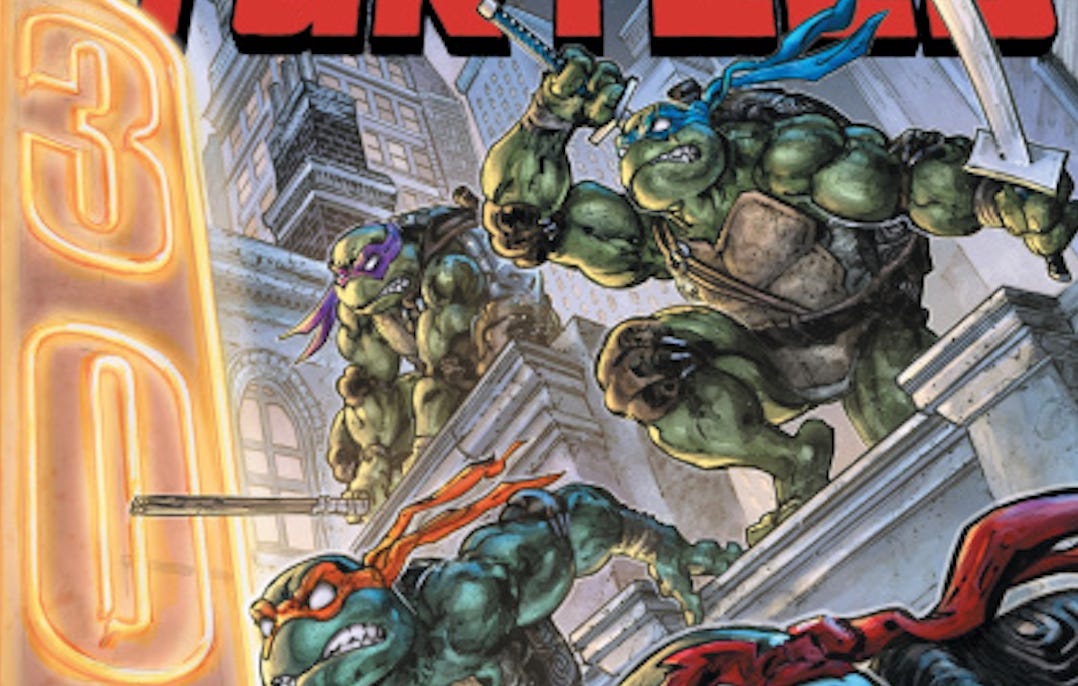
IDW Publishing announced this week that Teenage Mutant Ninja Turtles #300 has topped 200,000 pre-orders from comic book stores, alongside its blind bag cover program. It may be real, but that doesn’t mean there’s anywhere near 200K readers.
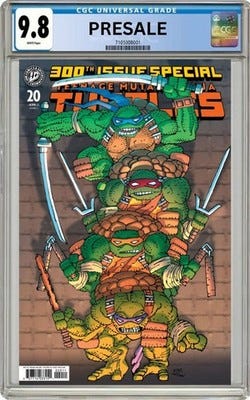
The Bleeding Cool headline reveals the mechanism: IDW describes it as “the upcoming Teenage Mutant Ninja Turtles #20, renumbered with its legacy issue number.” This is issue #20 of the current ongoing volume. It has been renumbered #300 by combining the issue counts of previous volumes that ran for years before the current series launched. The current TMNT ongoing began in 2024. It is not the 300th consecutive issue of an unbroken run. It is the twentieth issue of a new series wearing a legacy number calculated by adding up all the issues across decades of prior volumes, relaunches, and restarts.
This is standard direct market practice in 2026 and it has been standard for years. Marvel and DC do it routinely. A series launches at #1 to generate a first-issue sales spike. It runs for twenty or thirty issues until sales normalize. Then it is relaunched at #1 again for another spike. When a milestone anniversary number becomes commercially valuable, publishers combine volume counts to get there faster and generate a milestone issue.
The 200,000 pre-order figure for TMNT #300 reflects the blind bag program attached to it: rare covers by Kevin Eastman and Peter Laird in blind bags, plus variants by Frank Miller and J. Scott Campbell making their TMNT cover debuts, plus Ito and Juan Ferreyra exclusives. Blind bags are the direct market’s equivalent of trading card packs. Retailers and collectors order multiples chasing the rare variants. The pre-order number does not represent 200,000 individual readers who want to read the story. It represents the combined ordering of retailers, speculators, and collectors who want the covers. The Comic Book Club noted of the issue: “As for the actual interior of the book… Who cares!” — a joke, but one that accurately describes how the direct market processes milestone numbers.
The actual story inside TMNT #300 by Gene Luen Yang, Freddie E. Williams II, and Fero Pe will be read by far fewer people than ordered the issue. That gap is the direct market’s central unexamined problem. Publishers report the pre-order figures. Nobody reports how many copies are read.
IDW’s position in the market makes the TMNT numbers more significant because the franchise is essentially carrying the publisher. IDW’s other notable titles include the Star Trek line, and the GI Joe and Dungeons and Dragons licensed books. None of these are generating milestone pre-orders. Outside TMNT and a handful of Star Trek collectible editions, IDW is a company running on one franchise’s legacy appeal and the collector market’s appetite for variant covers.
It’s interesting that when one looks on eBay, one can already see that resellers are putting the book up graded for pre-sale. That means a person like this would have to be buying dozens of copies of this variant cover just to get the grade to guarantee it, which means again, there’s not that many readers up there fore these books.
DC does the same. Bleeding Cool noted that Absolute Batman #21 with Jae Lee topped the weekly bestseller list — but the surrounding context is that the Absolute line’s dominance comes partly from the variant cover and collector market the same way TMNT’s milestone numbers do. The difference is that Absolute Batman has genuine reader demand driving its numbers. Most books do not.
The 200,000 figure will be cited in press releases and industry reports as evidence that the direct market is healthy. It is evidence that the collector market, the variant cover program, and the blind bag speculation economy are healthy. Those are different things.
Are you buying TMNT #300 to read the story or to collect the covers? Let us know in the comments.
450 pages of classic superhero storytelling that puts character first. The Flying Sparks Omnibus collects the complete saga of Meta-Girl — the kind of cape comic the mainstream forgot how to make. Sign up to get your copy.

What is wrong with people? Seriously?
Blind bag comics with "collectible" covers is an incredibly cynical, greedy, customer-hating tactic. I can't fathom how the dwindling number of floppy readers didn't reject this nonsense outright.
Look at what gamers did when they rejected loot boxes in video games years ago. The industry was gearing up to pillage console gamers, it was denied, and they've never recovered. These massive flops of online multiplayer games are happening because there was this thought baked-in to the design that 200-300 million dollar budgets didn't matter--it was a selling point even of TRIIIPLEEE AAA--because micro transactions would make them billions.
Loot boxes do still exist, but nowhere near what the industry imagined.
The problem I think, is that comic READERS now buy collected editions: much less hassle, easier to read, far easier to store and sort, don't have to run down two dozen single issues.
Comic COLLECTORS, SPECULATORS, and HOARDERS buy the floppies, not to read, but as either some perverse investment or because they have a legitimate problem and can't help themselves. (That last one is sad, and a despicable indictment of the industry.)
The floppy fans didn't rise up and protest because they wanted this excrement show. They wanted this "investment opportunity," never realizing that the only ones buying are other speculators and that sooner or later, all bubbles burst.
Meanwhile, the rest of us stand to one side watching in some ratio of horror and bemusement as a once beloved medium circles the drain in ever-accelerating and tightening spirals.
Is there any comic book title left that has had an unbroken issue count?