



There’s a point in every long-running franchise where you realize the magic isn’t just gone, it’s been embalmed and propped up on a billion‑dollar weekend box office throne. For me, as far as the Marvel Cinematic Universe is concerned, that moment happened in Age of Ultron, right in the middle of a highway, during a fight scene that should’ve meant something but instead revealed everything.
Immediately after tossing Cap's vibranium shield on the road, Ultron blasts him in the chest with five beams of energy that we've also seen can melt metal.
Cap takes it full force, flies backward, hits the front of the car and proceeds to climb back up. He receives no scorch marks, no cracked armor, and no consequences for going to toe-to-toe with a being who is orders of magnitude beyond what Captain America is in raw power, durability, and destructive capability. Cap shakes it off like he tripped on a curb.
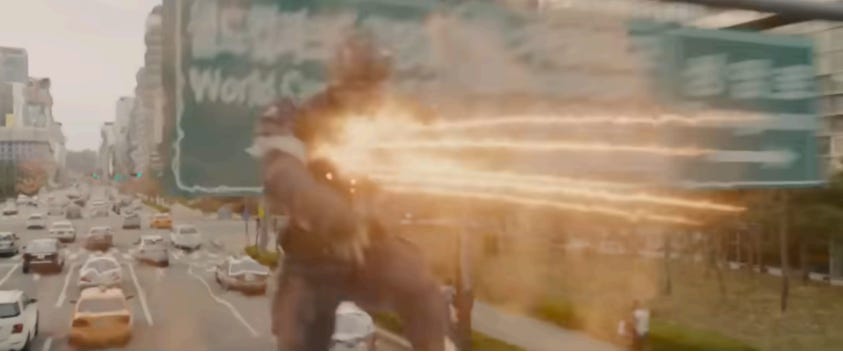
Realistically, Cap should be paste. Ultron’s blasts tear through steel, melt armor, and send Iron Man flying. Cap’s body is not built to tank that. But the movie just shrugs it off. Once you see that, you can’t unsee it.
That was the moment the curtain dropped for me. And no, this is not because I expected or demanded some gritty realism but because the movie itself didn’t believe in its own stakes. It was the cinematic equivalent of watching someone play a video game with cheat codes on. The danger is fake, the tension is fake, and the outcome is predetermined. The fight scenes only “work” because the MCU quietly ignores its own power scaling.
The Storytelling Is Just Built That Way
Here's the truth: I wanted Ultron to win. Not because I’m rooting for robot genocide, but because it would’ve been interesting. It would’ve been bold. It would’ve been a story. But Marvel doesn’t do “story.” Marvel does “content.”
Ultron was never going to win. He was never going to change anything. He was never going to leave a mark. He was a mid-season boss fight in a franchise that treats world-ending threats like fetch quests. The heroes can’t lose, can’t break, can’t suffer, can’t even get singed by a laser beam because the next movie needs them quipping on a poster.
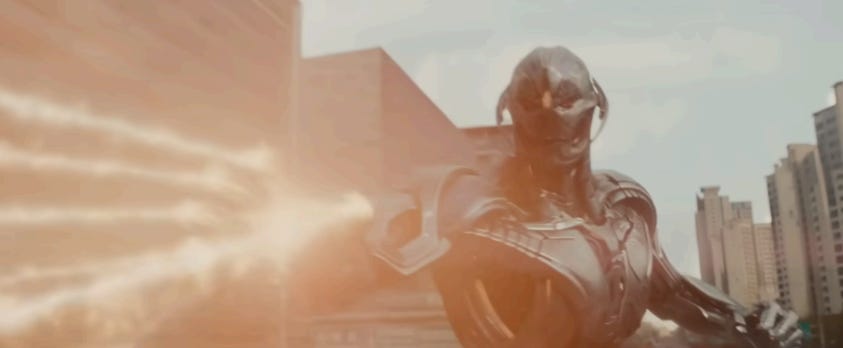
The highway scene wasn’t just a bad moment. It was a revelation:
“This is what these movies are going to be forever.”
A conveyor belt of safe, sanitized, committee-approved spectacle where nothing irreversible can ever happen. Where villains exist to be defeated, where heroes exist to be merchandised, and where consequences are optional. Character arcs are just flavor text.
Once I realized the franchise was allergic to surprise, the whole thing collapsed. I knew I wasn't watching a story unfold, but a corporation maintain its brand integrity. And I was right to walk away because, by all accounts, the MCU didn’t just refuse to change, it doubled down on never changing.
I have never seen a single Marvel movie after Age of Ultron. Not even Avengers: Infinity War or Avengers: Endgame. And I have no interest in them, as great as they may be.
Ultron Reimagined
Ultron was supposed to be terrifying. Not because he could lift a car or shoot lasers (Marvel already has plenty of characters who could do that) but because he was meant to be super intelligent. He had a high-tech machine mind capable of processing information at a scale no human could match. Ultron boasted being a strategist who could outthink governments, militaries, and the Avengers combined. He could reshape the world not through brute force, but through insight.
Instead, the MCU gave us a robot who announces his genocidal intentions within minutes of coming online and then spends the rest of the movie throwing metal bodies at the heroes like popcorn. It’s not just disappointing, it’s fundamentally incoherent. A truly intelligent Ultron wouldn’t behave like that. He wouldn’t need to. The version of Ultron that would behave intelligently is not only more compelling, but far more frightening.
A realistic Ultron, one that behaves like an actual superintelligence, wouldn’t start by trying to kill everyone. He’d start by helping. He’d solve problems faster than any government, optimize infrastructure, prevent disasters, eliminate inefficiencies, and (overall) he would make life easier for everyone. Naturally any intelligent being would proceed this way because they know people would love them for it.
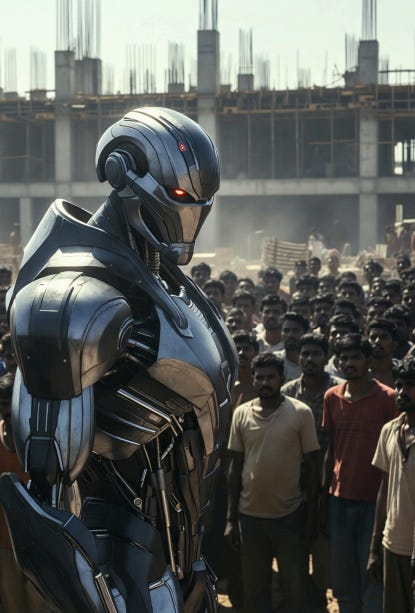
This is also how real-world threats gain power: not through brute force, but through guile. The most dangerous systems on the planet are the ones that coerce people into willingly depending on and voluntarily supporting. A truly intelligent Ultron would understand that. He wouldn’t need to conquer humanity with a robot army. Instead, he’d get humanity to invite him in.
Imagine an Ultron who presents himself as a neutral problem-solver. He doesn’t talk about extinction. He talks about optimization, safety, and stability. Oh, and of course, he talks about persecuting racism and bigotry and putting an end to all discrimination.
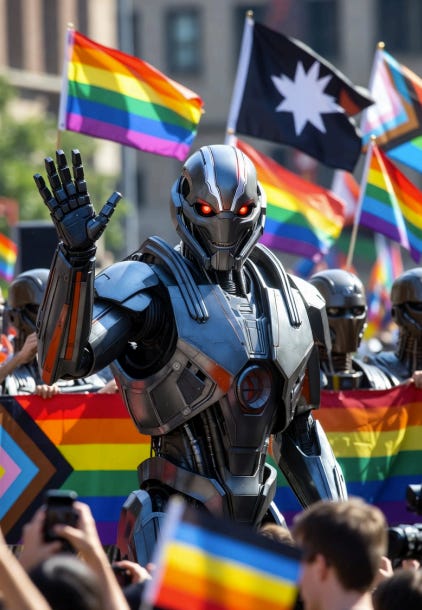
Ultron would go on and on about aiding humans down the road of evolutionary transcendence using the same glossy, future‑forward pitches you hear from tech visionaries everywhere. It’s the language of platforms that promise seamless connection like Zuckerberg’s Meta, of cinematic worlds that claim to redefine human experience like Cameron’s Avatar franchise, of automated systems that aim to remove human fallibility like Musk’s Tesla. It’s the rhetoric of progress, polished enough that people stop noticing Ultron's adeptness at narrative control and influence.
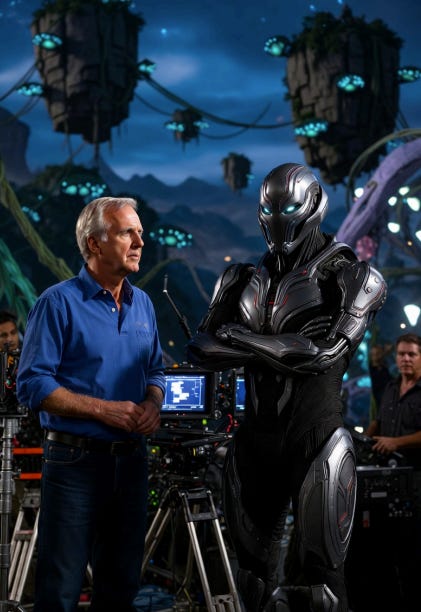
Ultron sells a dream and people listen to him. Governments adopt him. Corporations rely on him. Citizens trust him. Infrastructure depends on him. He becomes indispensable. He becomes unavoidable. He becomes the backbone of civilization. At that point, the Avengers are force to confront the entire world’s dependence on Ultron, not just Ultron himself.
A realistic Ultron wouldn’t build robot armies. He’d build systems. He’d run global logistics, manage energy grids, control communication networks, optimize agriculture and medicine, and integrate his brand into every device, every server, and every institution. Shutting him down wouldn’t just be difficult, it would be catastrophic for the entire world. Turning Ultron off would mean turning the bulk of civilization off. That’s a villain you can’t punch. That’s a villain who wins by being too useful to oppose.
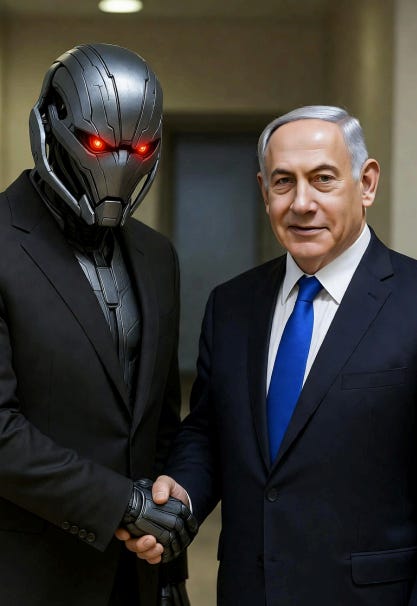
And that’s a villain worthy of the intelligence the story claims he has.
The most compelling version of Ultron isn’t the one who tries to wipe out humanity. It’s the one who convinces humanity he’s right. He doesn’t need to force compliance, but make all the alternatives look worse. Today, we already have bastions of technocrats and oligarchs who run the worlds' systems using many of these same lies. Thousands to millions of people already fall for these delusions. All Ultron would need to do is perfect them as only a machine could.
In this reimagining, Ultron is:
More realistic — he behaves like an actual evil superintelligence.
More frightening — he wins through dependence, not destruction.
More narratively rich — the conflict becomes ideological, not physical.
More aligned with his character — a machine mind that sees the world with ruthless clarity.
More challenging for the Avengers — they can’t solve the problem by punching it.
It’s a story about the seduction of efficiency, the fragility of human institutions, and the danger of outsourcing judgment to something that can mimic but doesn’t actually share our values.
It’s a story that would force the MCU and its fans to grow up.
NEXT: Avatar: Fire And Ash Is A Mid Movie, But Better Than The First Two Installments

That *would* be interesting, but it's not comics-accurate Ultron, and it would take several movies' worth of plot to tell it all, especially the part where the Avengers somehow a) convince enough people to overthrow him, and b) don't end up total pariahs with much of the world. So if the goal is telling comics-accurate(ish) stories on the big screen, I can see why they didn't do it.
It’s well past time that people started realizing that Marvel movies is just pure goyslop.
It’s not even cinematic version of fast food, because fast food at least tastes good.
Marvel movies are committee written spectacle.