


Asimov’s Science Fiction has not shipped its March/April 2026 issue yet. The issue is in blue line approval as of this writing, which means it is almost printed but not in subscribers’ hands. The magazine’s cover date will be replaced with a volume and issue number when it does ship, because if the month appeared on the cover, Barnes and Noble would refuse to stock it.
This is where the oldest and most storied science fiction magazine in continuous publication finds itself in 2026.
In February 2025 we reported on the acquisition of Asimov’s, Analog Science Fiction and Fact, and The Magazine of Fantasy and Science Fiction by Must Read Magazines, a division of 1 Paragraph Inc., led by Steven Salpeter, a former Curtis Brown literary agent and IP developer, alongside investor and arts patron Michael Khandelwal. In July 2025 we covered the contract crisis that erupted when SFWA threatened to delist Analog from its market report over Must Read’s new contract language demanding moral rights waivers, merchandising clauses, and unfavorable rights reversion terms. Must Read eventually backed down, removing the moral rights clause after sustained pressure from SFWA, Writer Beware, and individual authors.
The moral rights fight consumed the magazine’s first five months under new ownership. Writer Scott Edelman documented his experience in detail: after selling a story to F&SF on July 17, 2025, his 85th submission to the magazine across 54 years of trying, he spent 23 back-and-forth emails with Must Read’s staff trying to get acceptable contract language before giving up entirely.
By January 2026, Must Read had incorporated revised contract language addressing the three areas SFWA had flagged: moral rights, merchandising rights, and author termination and rights reversion clauses. The one remaining dispute was a single phrase in the warranties and indemnities paragraph required by their insurance carrier. The contract war ended in a draw. Must Read kept the magazines. SFWA claimed a partial victory. The writers who walked away from sales during the dispute did not get their stories back.
Then January 12, 2026, brought the next crisis. Must Read Books announced that Sheila Williams, Asimov’s editor since 2004 and a Hugo Award winner for Best Editor Short Form in 2012, had been hospitalized after suffering a brain aneurysm. Senior managing editor Emily Hockaday stepped in as interim editor.

Williams is the institutional continuity of the magazine and that loss hits hard. Isaac Asimov himself referred to her as “Sweet Sheila Williams.” She has been friends with authors across the field for over four decades. She co-founded the Dell Magazines Award for Undergraduate Excellence in Science Fiction and Fantasy Writing. She became editor in 2004 on the retirement of Gardner Dozois and has run the magazine for over twenty years. When Must Read acquired Asimov’s, group publisher P.L. Stevens said publicly: “Sheila has been our rock since the acquisition.” As of March 2026, she remained hospitalized but recovering, with family posting occasional updates.
Hockaday has handled the editorial responsibilities with evident commitment. She is acquiring stories, approving blue lines, and communicating with subscribers on Facebook with a transparency that reflects someone who cares about the magazine. Her April update noted that the previous printer, the same printer used under the Penny/Dell ownership, had become unreliable, forcing a switch mid-production. “We found a new printer, because the previous one had unacceptable delays as well as declining print quality,” she wrote. “The magazines will be late, but they are coming.”
A month later, a high school library media specialist named Young posted a public question confirming what many subscribers already suspected: as of May 2026, only one issue of The Magazine of Fantasy and Science Fiction had shipped under Must Read’s ownership, a 2025 Volume 1 issue. Nearly twelve months under new ownership. One issue.
Hockaday responded that Volume 2 of F&SF would print alongside the March/April Analog and Asimov’s, and added that blue line approval for those issues had already been given. She also addressed the Barnes and Noble problem directly: the March/April, May/June, and July/August issues will appear with volume and issue numbers rather than month/year dating, because shipping a March/April issue in June would result in the magazine being refused by major retail chains that pull titles once their cover date has passed.
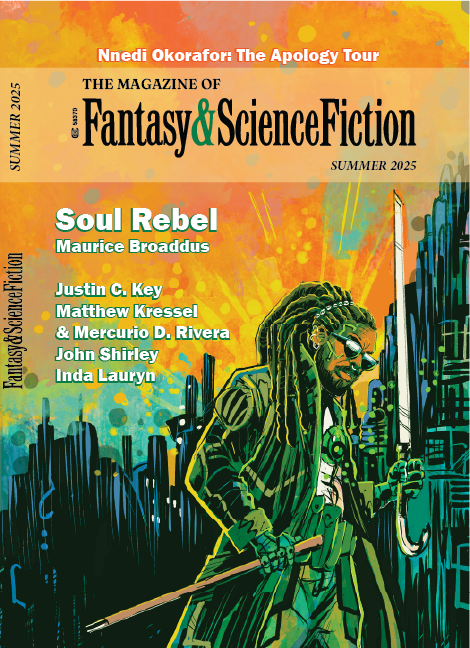
This is the operational reality of science fiction’s legacy print magazines in 2026. The printer who served them for years became unreliable. The founding editor of the flagship title is recovering from a brain aneurysm. The new owner spent its first months in a contract war with the professional writer organization. F&SF shipped one issue in its first year under new ownership. Issues are being dated by volume number because the cover month would be a lie.
The broader picture is grim. Circulation at all three magazines has been declining for years. F&SF experienced significant difficulties under its previous ownership including delayed author contracts and large gaps between published issues. The new owners came in with enthusiasm. Salpeter is by all accounts a real SF fan, and Khandelwal co-founded a writing nonprofit, but enthusiasm does not fix a printer that stopped being reliable or a key editor hospitalized with a serious illness.
The short fiction magazine market built the careers of nearly every significant science fiction and fantasy author of the 20th century. Asimov, Clarke, Heinlein, Le Guin, Ellison, Tiptree, Willis, Gaiman, Martin — all of them appeared in these pages. The magazines function as the farm system for the novel market, providing writers a place to develop craft and build audience before graduating to books. When the magazines struggle, the talent pipeline for the entire genre narrows.
Must Read Magazines is trying. The evidence suggests they are genuinely trying. The evidence also suggests they are undercapitalized, understaffed, dealing with a printer crisis, managing a medical emergency, and still working through the trust deficit created by the contract controversy. A small investment group that acquired five legacy magazines simultaneously does not have the operational infrastructure that Dell Magazines, a subsidiary of a major media company, maintained for thirty years.
Hockaday’s update that she is “already buying stories for the March/April 2027 issue” is the most encouraging line in any of these communications. The editorial work is happening. The magazines are not dead. They are in the hands of someone who cares enough to be buying content nine months ahead while simultaneously approving blue lines and negotiating with a new printer.
What do you think the future of print science fiction short fiction looks like? Let us know in the comments.
When genetic engineering nearly doomed the species, humanity made a desperate bargain: let the frontier do what nature intended. In a harsh universe, these cadets have to make impossible decisions. Read Space Fleet Academy today.
NEXT: The Forgotten Heir of Heinlein: A Spider Robinson Retrospective
As much as I hate to say it, I think the days of print editions of Analog, Asimov's and F&SF are numbered. I believe the biggest problem (pure supposition on my part) is the magazine's readership is getting older and dying off, and fewer newer, and younger, readers are taking their place. That explains the dropping number of subscribers. If younger readers are subscribing, it's most likely to digital copies they can read on their phones or e-readers.
And the delay in sending out the print copy of the March/April issues of Analog and Asimov's doesn't help matters. Plus, the May/June issues are already being promoted on the magazine's web sites. When can they be expected? A time frame is not given.
And it's a shame as the magazines are each coming up to major milestones. Asimov's 50th anniversary is next year. Analog's 100th anniversary (as Astounding/Analog) is less than four years away F&SF's 80th anniversary is less than three years away. I'd like to see all three achieve those milestones, but I just don't feel confident they will.