


YouTuber Greg Owen has identified the core problem plaguing modern television in his viral video “The 7 Deadly Sins of Millennial Writing.” Owen’s analysis, using Star Trek: Starfleet Academy as his primary example, explains why contemporary shows feel exhausting, emotionally hollow, and instantly forgettable. These aren’t isolated problems—they’re a collection of interconnected failures that compound into the creative wasteland currently dominating streaming platforms.
Owen clarifies upfront that “millennial writing” isn’t about the writer’s age, it’s a style anyone can adopt. Alex Kurtzman, creator of Starfleet Academy, is 52. “It’s never too late, baby,” Owen quips. The seven sins represent a spectrum of possible issues, with shows exhibiting one or two being tolerable, three to four raising red flags, and five or more constituting “a full-on Ugg-wearing, bopping, pog-slamming millennial nightmare.” Starfleet Academy scores a perfect seven out of seven.
Sin #1: Constant Meta Awareness and Irony as Default
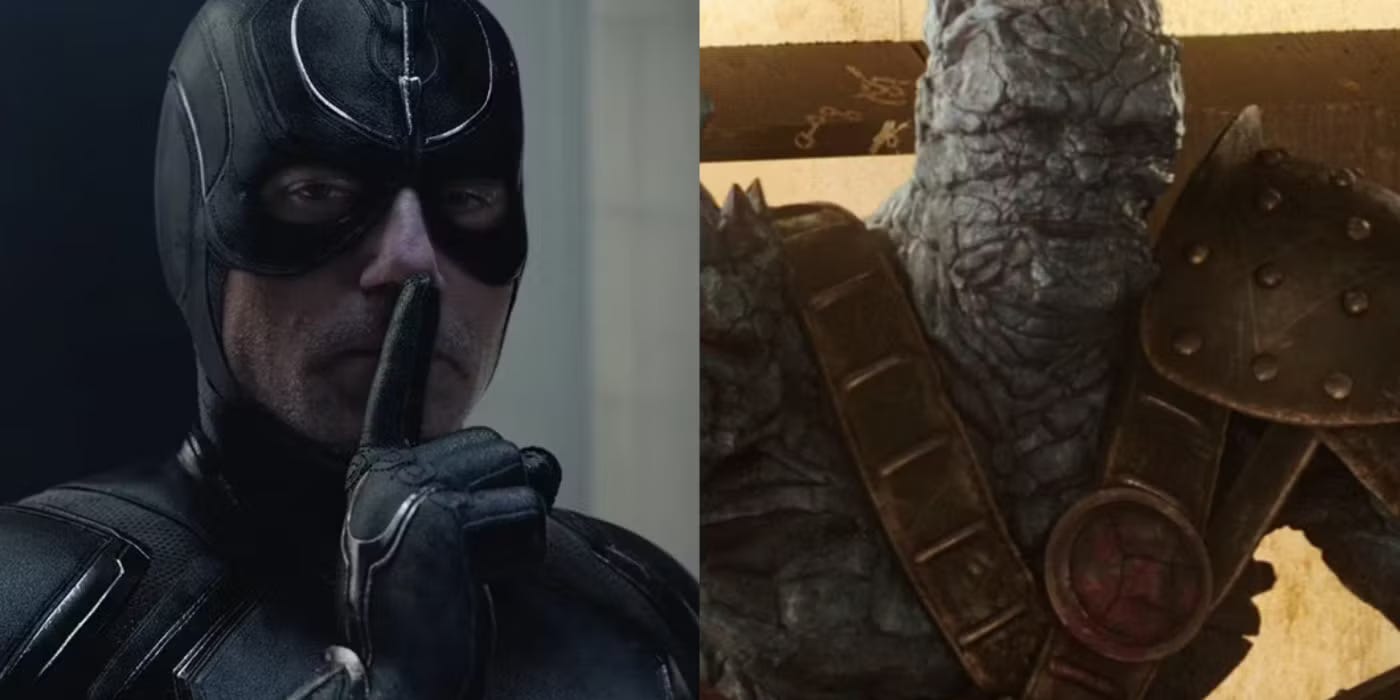
Modern shows refuse to let sincere moments breathe for more than three seconds before undercutting them with quips. Owen identifies this as the MCU humor problem, where “dialogue is dead, gang. Now there is only banter.” Every emotional beat gets immediately deflated with self-aware jokes or meta commentary.
This irony poisoning stems from millennials’ defense mechanism against sincerity. “It’s like people my age have this defense mechanism against being sincere. We use meme cut-ins to express emotion,” Owen explains. Shows like Velma exemplify this failure, with Mandy Kaling learning “all the wrong lessons from Dunder Mifflin” and creating a show that “couldn’t stop being ironically edgy and meta in every scene.” One scene features Shaggy explicitly stating he would never do drugs, then turning to face the camera and blinking several times with audible blink noises. Later, Shaggy observes that “if this were a teen drama, I would...” before trailing off. “It’s crap like that over and over,” Owen notes.
The constant irony destroys emotional investment. “Stories stay with us because of emotion,” Owen argues. “Stories have always been how we communicate the most important parts of culture and humanity. Constant pointless irony destroys that.” When everything is a joke, nothing matters.
Sin #2: Open Contempt for the Audience
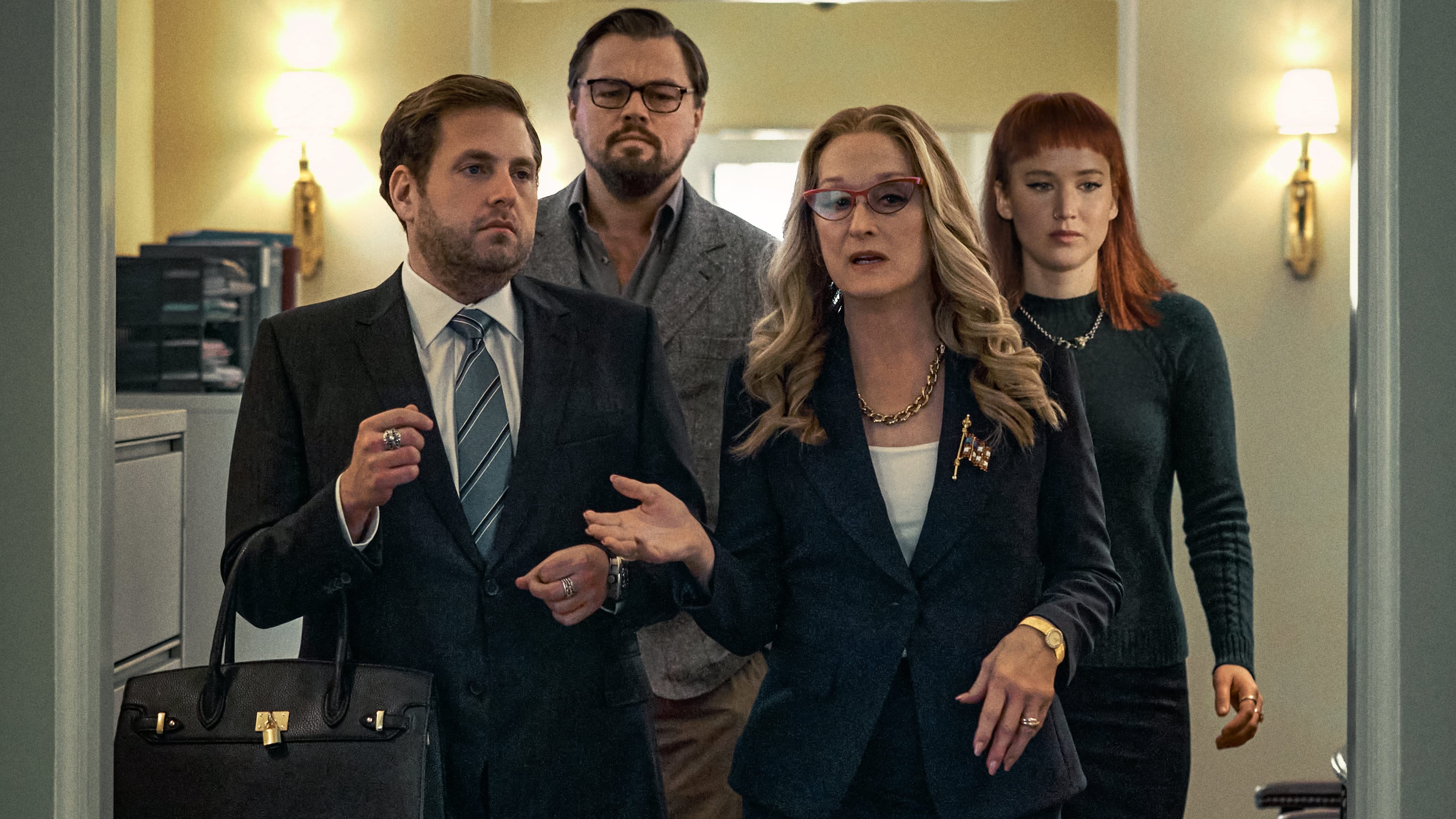
Many productions actively hate their viewers and pass off this sneering as depth. Owen points to Don’t Look Up as a prime example—a film that “hates you for watching a movie instead of, you know, doing something. Why aren’t you morons fighting climate change or injustice of some sort, anything? This thing is insufferably smug.”
This contempt manifests as coastal elitism, where LA and New York writers view the rest of America as backwards simpletons. Owen references Superman’s portrayal of the Kents as “aw shucks bumpkins who can’t work a phone,” then cuts to the classic Blazing Saddles line: “You got to remember that these are just simple farmers, you know, morons.”
The “not for you” refrain has become standard when niche productions fail. Owen cites Billy Eichner’s Bros, a gay romcom about New York’s gay dating scene that bombed at the box office. Rather than acknowledging the film’s narrow appeal, Eichner blamed straight people for not showing up. “I wonder, does Starfleet Academy fit here? Of course it does,” Owen observes. The show “thinks it’s clever to insult the Federation that Trek fans love, making it out to be a pitiless, incompetent organization that employs thug guards and tears families apart for no reason.”
This audience hostility serves no narrative purpose—it simply alienates viewers while the writers congratulate themselves for being provocative. Long-term, it’s destroying the entire industry as audiences tune out not just specific shows but entire genres.
Sin #3: Every Character Sounds Identical
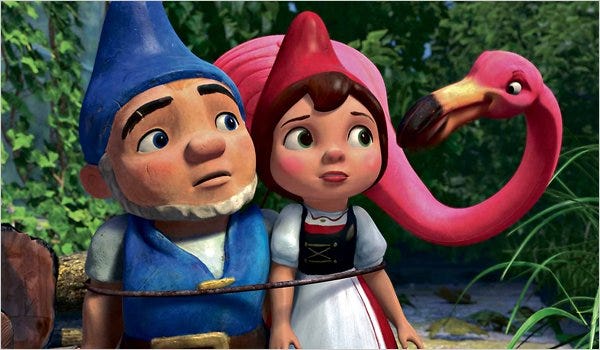
Characters across different ages, backgrounds, and time periods all speak with the same cadence, inflection, and vocabulary—specifically, the ironic late-90s grunge variety of modern millennials. Owen notes that even when adapting existing stories, writers impose this sameness. He quotes the Gnomeo and Juliet narrator: “Then Romeo saw Juliet and he was all like, ‘Bro, she fire.’”
This problem extends beyond screens. Owen delves into Sarah J. Maas’s Crescent City, which “contains characters ranging from 22 through 400, and every one of them sounds like they’re 22.” The main character has a 200-year-old brother who “lives in a frat house with his frat bros.” Her bestie lives with her police squad “also frat house style, except there are some girls in that one.” Despite one being fae and the other a werewolf, “they all speak and behave identically.”
Starfleet Academy exemplifies this failure. In a show set in the optimistic future where humanity has transcended petty conflicts, characters discuss hookups like college students: “Also, with the roommate, how does anyone hook up? Don’t hook up with anyone for like the first six months.”
The root cause is “writers who write for plot, not for character,” Owen explains. “They don’t get in the mind of the character, partly because characters aren’t fully fleshed out to begin with. They’re simply vehicles to at best get to the next scene and at worst voice the writer’s social or political ideas.” He contrasts this with Aaron Sorkin’s The West Wing, where “each character has a unique and distinct voice. I could read you a scene and cut the names. I could read it to you in monotone and you would still be able to tell the difference between CJ’s sarcastic wit, Sam’s argumentative digging, and Toby’s stupid bleeding heart.”
Sin #4: Modernisms Destroying Immersion
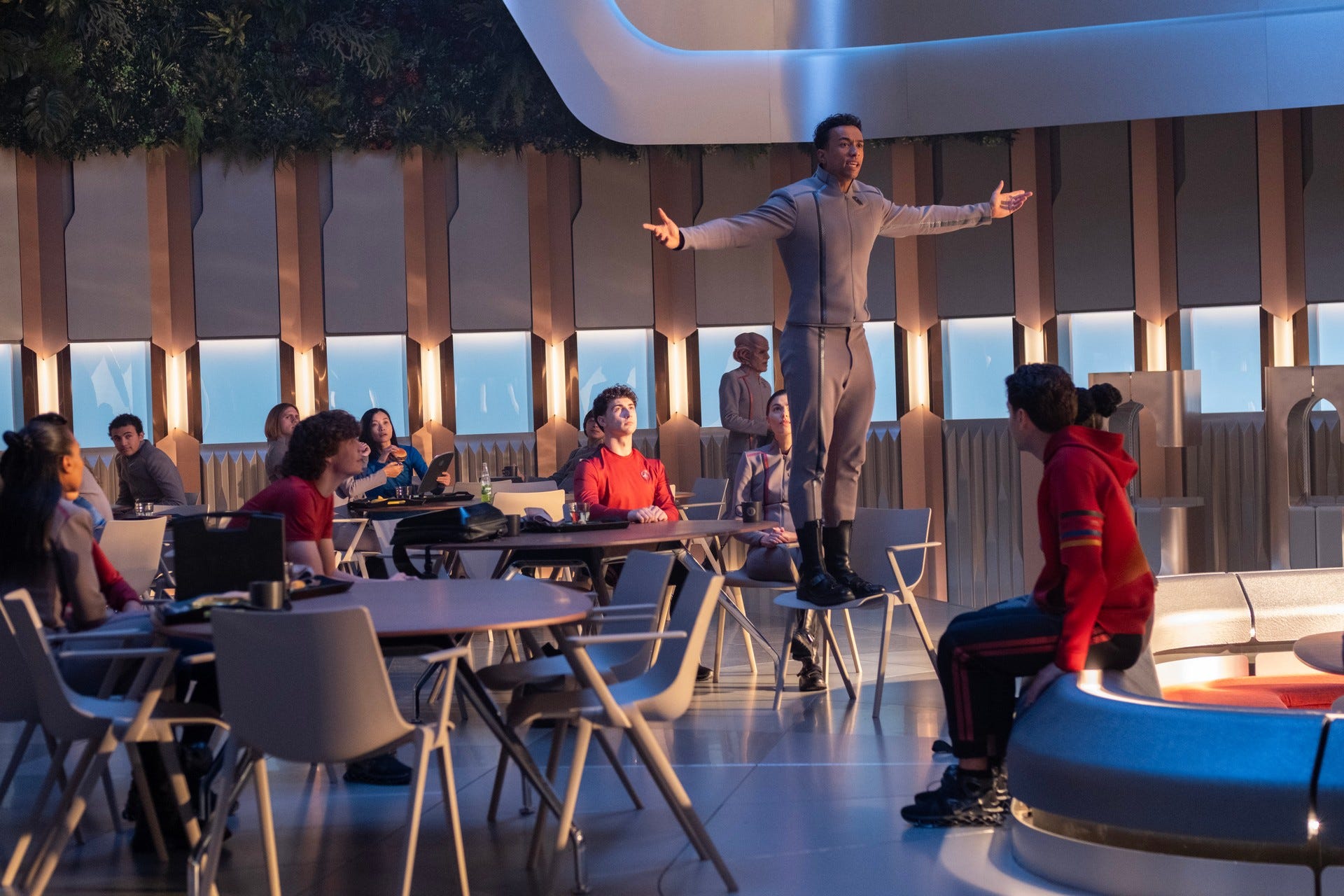
Fiction set in different times or settings is filled with people who sound like they’re living in America in the 2020s. Owen expresses particular frustration with this: “Your show takes place in the year 3000, but people are still saying ‘bitch’ to each other. You couldn’t be bothered to invent any new invectives or interjections, stars and stones. That is pure storming laziness.”
Starfleet Academy features rampant swearing in a franchise that Gene Roddenberry designed as optimistic and transcendent. “This is a future where humanity has transcended beyond cultural and geographic boundaries,” Owen explains. “Sickness has been defeated. Now we are amongst the stars on missions of diplomacy and learning. This CW drama with its petty jibes and swearing do not fit that tone at all.”
Owen pulls examples from books as well. Rebecca Yarros’s Fourth Wing, set in a semi-medieval world with dragons and magic, “contains the phrase ‘for the win’ multiple times. This is a story about magic dragons and griffins. It is a semi-medieval setting. Swords and shields, no guns or electricity, that kind of thing. Yet, we say ‘for the win,’ like it’s 2001 and I just pwned some noobs with my boomstick in Quake 3 Arena.”
Beyond language, modernisms include inserting contemporary social problems into settings where they don’t belong. Animated Lara Croft “was on a mission to rob museums because the artifacts inside belong to indigenous persons because making fun of the British Museum is cool and trendy and memeable.” The Witcher show “demolished the female characters in order to insert talking points about the patriarchy,” despite the source material already featuring powerful women.
Sin #5: Lazy Identity-Based Characterization
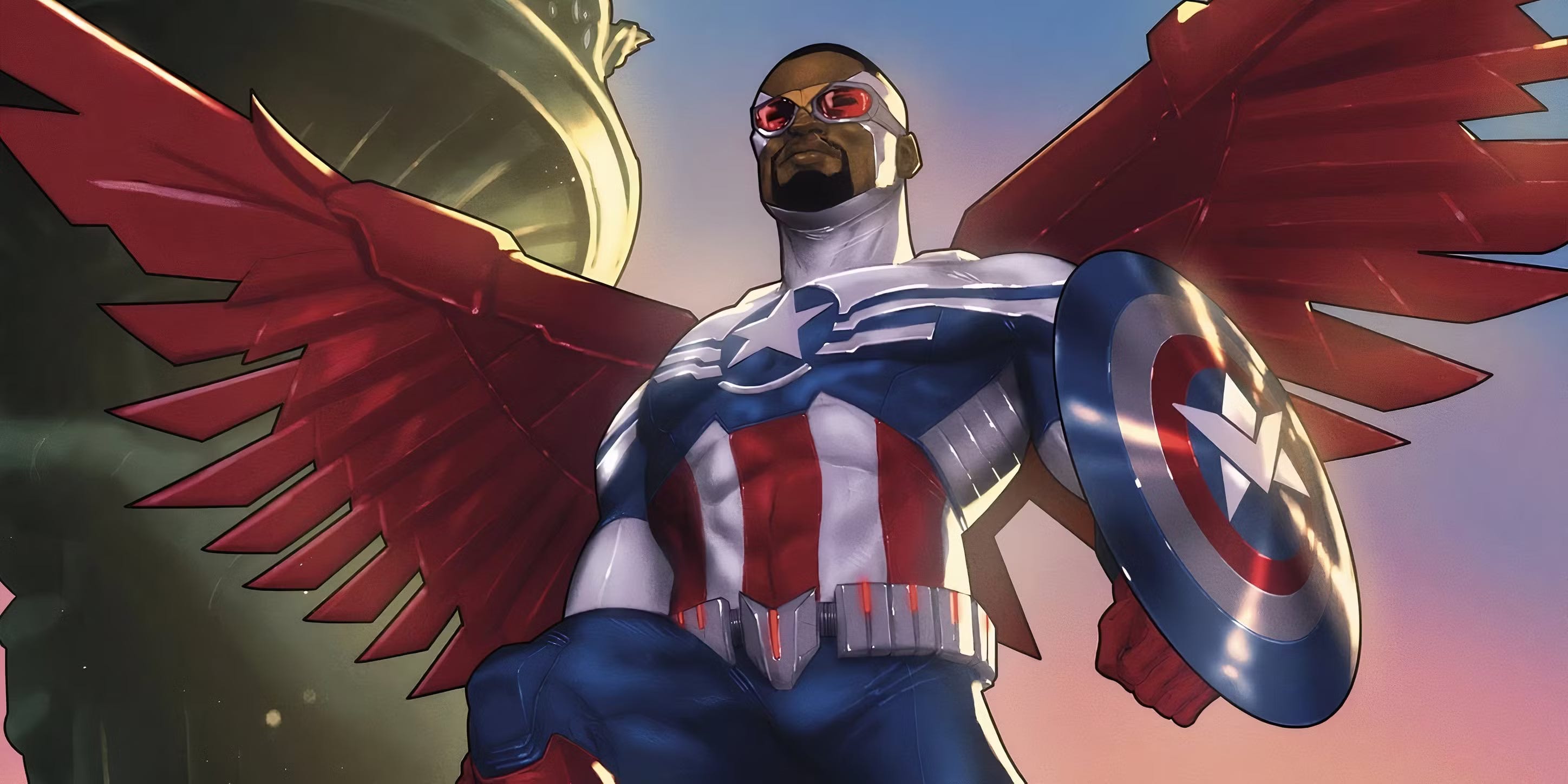
Rather than developing actual characters, writers use identity as a shortcut. “When writers have a black man character, so they don’t bother to actually write him. He simply has struggles like every other black man. That’s his entire arc,” Owen explains. “Rich guy, evil. No reason. He just is.”
Sam Wilson in The Falcon and the Winter Soldier exemplifies this failure. Owen lists the potential character arcs available: “How to handle leadership when you’re not ready. The impact of suddenly going pro when you’ve always been triple or double A. Having a new title thrust on you when you want to be your own person. Sam had so much possibility. But what did we get? We got arrested for being black on a Friday night.”
The show ignored Sam’s established characterization “in favor of flattening Sam into current thing, man.” Owen notes it’s not even that they chose a race plot—”it’s that they ignored all previous characterization in favor of flattening Sam into current thing, man. It’s that they insulted the audience by throwing out his established qualities that they tuned in to see get developed.”
This extends to all identity categories. “Why bother treating a character like a real person when you could simply make them gay and have everything revolve around their gayness?” Owen asks. Starfleet Academy features a Klingon character “whose whole story was about feeling different from other Klingons in society because he’s gay. That would be so silly.”
The overlap with other sins compounds the problem. Because characters all sound identical, “the only way to tell them apart is when they basically announce their archetype and motivation.” Owen shows clips from Rebel Moon, Jurassic World, and Ant-Man where characters explicitly state their defining traits: “Hey, much soy comic relief fast talking Mexican guy. Yeah, sup yo, I’m black thug guy. I am Russian hacker guy.”
Sin #6: Therapy Language as Moral Framework

Millennial writers replaced traditional moral frameworks with therapy language and relatability as markers of good and bad. Owen explains: “The issue with leaving behind a firm moral rubric, however, is that you still need signals to the audience so they know what’s going on between characters. The millennial solution to this has been to use therapy language and relatability as markers of good and bad.”
This created the “victim Olympics” where “the good guys are the ones who have received the most trauma points, the ones who have been the most historically unrepresented. The bad guys are the ones who can be reframed as the oppressors.” Owen notes this is “how Riri Williams can be shown as the hero of her own story when she is objectively a terrible person.”
The Acolyte wanted to paint the Jedi as villains “because they’re intolerant of poor innocent witches who are minding their own business, just using the force to create life.” The show’s murderer “is not the bad guy. He’s just misunderstood. He’s countercultural like the original rebels. According to the showrunner, it’s the Jedi who are the real bad guys because they don’t want him to exist.”
Starfleet Academy follows this pattern, with a character who “has a huge rap sheet. But it’s okay because the Federation are actually the bad guys.” The show explicitly states: “Because you still remember how the Federation used to be and felt we weren’t living up to our principles. A lot of people agreed with you.”
Relatability lessens evil in modern storytelling. “If a villainous act is understandable, so many villains now are being recast as morally ambiguous because their motives are understandable. Often a direct result of the traditional hero.” Spider-Man: No Way Home features “an extended scene where they all realize Spider-Man is really the problem. It’s all his fault.” Civil War tried “blaming heroes for the existence of villains” with the line “Our very strength invites challenge. Challenge incites conflict and conflict breeds catastrophe.”
Owen points out the absurdity: “Guys, evil exists. It just does. Heroes rise to defeat evil. This new idea that villains rise to challenge heroes. That is insane.”
Sin #7: Subversion Without Reconstruction

The final sin involves using subversion as a sledgehammer to destroy established properties without building anything to replace them. Owen explains this overlaps with postmodernism, “which popularized subversion as a tool to deconstruct and expose their perceived flaws in modernism. Trouble with millennial writing is that it just stops right there and makes subversion the whole goal.”
The Acolyte wanted to show “your beloved Jedi were really terrible and problematic. The Federation, they’re heartless and cruel.” Starfleet Academy claims hope comes from “the children” who are “our ambassadors to now”—a line Owen can barely believe made it into the show.
Writers use subversion to tear down what audiences love, then “accuse you of not being smart enough to see their resplendent new clothing” when audiences reject it. “Your fiction that you thought contained ideals like your fellowship of the ring who fought against evil, they’re actually patriarchal and wrong. Not a woman amongst them.”
This represents “the root of the audience hatred coming from so many writer rooms. They hate you plebs for not understanding the genius of blowing something up and then standing next to the rubble with jazz hands.” Owen notes that’s “why characters all sound the same and speak in modernisms. Old equals bad. That’s why we had to deconstruct it.”
Subversion can work “for a fun twist, something to give the audience a fresh experience. It can also be a great tool to shed light on the ruts that our thinking patterns get into and provide a launch pad for a new perspective. Millennial writers don’t do any of that, though. They just tear down the old and established and hope that something new will rise from the wreckage to post-justify their destruction.”
The Compound Effect
These seven sins don’t operate independently—they reinforce each other into a death spiral of terrible storytelling. Constant irony prevents emotional investment. Audience contempt ensures viewers don’t care about characters. Identical dialogue makes characters indistinguishable. Modernisms destroy immersion. Identity shortcuts replace characterization. Therapy language eliminates moral clarity. Subversion tears down without rebuilding.
The result is shows that feel exhausting, hollow, and instantly forgettable. Owen describes them as “adult Cocomelon videos to keep you occupied for a minute.” They’re “plot-driven movies, also known as ‘and then’ stories. And then this happens and then this happens. There’s no emotion in those. They’re instantly forgettable.”
This is “even more damaging to the entertainment industry than open hostilities because it results in audience apathy which is far more dangerous than anger or bitterness.” Audiences aren’t just rejecting specific shows—they’re abandoning entire platforms and genres.
Owen’s analysis explains why Hollywood feels incapable of producing quality content anymore. These aren’t random failures—they’re systematic problems embedded in how an entire generation of writers approaches storytelling. Until the industry recognizes these patterns and actively works to eliminate them, expect more Starfleet Academies: expensive productions that check every box on the millennial writing disaster checklist while wondering why nobody watches.
What do you think about Owen’s seven deadly sins of millennial writing?
Three free books. No spam. Just new releases, deals, and the occasional update from the front lines of independent publishing. Sign up for the Jon Del Arroz newsletter and start reading today.
NEXT: Sam Witwer Claims Darth Maul Now Respects Jedi Principles In ‘Maul: Shadow Lord’
Excellent article. I dislike it when characters in pre-modern settings use late 20th Century or 21st Century slang. I once started reading a fantasy short story in a Medieval setting where a guardsman said “Cool it!”, a phrase I associate with the 1960s Counter Culture. Totally knocked me out of immersion and I put the story down.
One red flag for me is “Daddy Issues”. I always look at how a writer treats fathers and other male authority figures. Whenever you see Daddy Issues, you can assume the writer has loaded lots of other emotional baggage into the story as well.
Great video! Also see an absolute banger of a video about this same thing:
https://youtu.be/8ynCVmw5AWk?si=B6xP05h6hPHiOmEj
This was the one where I fully realized that Hollywood was well and truly in a death spiral.