


Every Sunday at 7:00 PM Eastern, on an IRC network with a Discord bridge, Katherine Kurtz shows up to talk with her readers. She has been doing this, in one form or another, for close to twenty-five years. She is eighty-one years old. Her community, gathered at rhemuthcastle.com under the banner “The Worlds of Katherine Kurtz,” calls it KKChat. The community’s conduct rule, posted on the front page, is five words long: Be excellent to each other.
This is the same author who published Deryni Rising in 1970, which was among the earliest historical fantasy novels ever written, essentially inventing a subgenre that includes Guy Gavriel Kay, Lois McMaster Bujold, and, arguably, George R.R. Martin. She wrote sixteen Deryni novels across five trilogies spanning more than four decades of publication. She founded her own crypto-history subgenre with novels about the Battle of Britain, the American Revolution, and the Knights Templar. She lived twenty years in a haunted gothic revival mansion in Ireland, next door to Anne McCaffrey. She was cited in Dragon Magazine issue #78 as the model for adapting psionics to Advanced Dungeons & Dragons. She has an entire tabletop RPG published in her honor.

She has been, by the standards of the current SF/F prestige conversation, largely forgotten. She almost certainly should not have been.
The Chemist Who Became a Medievalist
Katherine Irene Kurtz was born in Coral Gables, Florida, on October 18, 1944, during a hurricane. She grew up in Florida. She won a four-year science scholarship to the University of Miami and graduated with a bachelor of science in chemistry. She started medical school. After a year she decided she would rather write about medicine than practice it, an instinct that has served her career well.
She moved to Los Angeles for graduate work in medieval English history at UCLA. While completing her master’s, she worked as an instructional designer for the Los Angeles Police Department, writing training curriculum. She was already deep in fandom and became an early member of the Society for Creative Anachronism, adopting the persona Bevan Fraser of Stirling and eventually rising to the rank of Countess.
She had also, at some point during those years, had a vivid dream. It was about a young king, a poisoned father, a treacherous court, and a persecuted people with psychic powers who were the only ones who could defend the boy on the throne. She started writing it down. She sold the first three novels to Ballantine Books on her first submission attempt. Deryni Rising appeared in 1970 as part of Lin Carter’s Ballantine Adult Fantasy series, the same imprint that was bringing E.R. Eddison and William Morris back into print. Kurtz was twenty-five years old.
Why the Deryni Novels Are Still great
We ran a review of Deryni Rising two weeks ago, so this is not the place to relitigate the individual book. What this retrospective can do is explain what Kurtz was building across the entire sequence, which is where her real achievement lives.
The Deryni novels are set in the kingdom of Gwynedd, one of the fictional Eleven Kingdoms, on a world whose culture, geography, and political structure closely parallel the British Isles of the twelfth century. The court dresses like Plantagenet England. The armor is right for the period. The saints have Welsh names. The language, the food, the ecclesiastical vestments, the coronation rites, the heraldry: all of it is drawn from Kurtz’s actual medieval history training, and all of it holds up under scrutiny. Kari Sperring, writing for Strange Horizons, called Kurtz “the first writer of secondary-world historical fantasy,” and the description sticks. Before Kurtz, secondary-world fantasy was mostly Tolkien-influenced high fantasy or Howard-descended sword and sorcery. Kurtz wrote fantasy the way Dorothy Dunnett and Maurice Druon wrote historical novels. Nobody had done that before.
The Deryni themselves are a persecuted minority within Gwynedd, humans with hereditary psychic abilities, treated by the majority population and by significant factions within the Church as either heretics or demons. The magic is not casual. It requires training, ritual preparation, and cost. The abilities are close to what science fiction of the 1940s and 1950s called psionics: telepathy, telekinesis, healing, energy manipulation, dream-sharing. Kurtz built her magic system on the same intellectual scaffolding that A.E. van Vogt, John W. Campbell, and Alfred Bester had used, then dropped it into a medieval Christianized society and let the friction generate the story.
The friction is the point. Deryni magic is not neutral. It is theologically dangerous. Some Deryni have used their powers to commit atrocities. Some priests believe all Deryni powers are inherently evil. Some Deryni, including the sainted Camber MacRorie, believe the powers are gifts from God to be used in service. The political and religious debates across the sequence are as substantive as anything in The Name of the Rose, and they matter to the plot because the characters take their own religious convictions seriously.
Which brings up the point that probably explains why Kurtz has been quietly forgotten by the mainstream fantasy establishment.
The Church Taken Seriously
Kurtz’s Church is not a straw man. The Holy Church of Gwynedd is a Catholic church in all but name, complete with an Archbishop, a College of Bishops, a monastic tradition, and a full liturgical year. The prayers are real prayers, adapted from actual medieval Latin sources. The Mass is a real Mass. When a character crosses himself, it means something. When a character makes confession, the theology is worked out. When the Bishops meet in council to debate whether Deryni magic is intrinsically evil, they argue in the vocabulary of actual medieval scholastic theology.
Kurtz shows corrupt bishops. She also shows saints. She shows the Church at its worst, used by ambitious men as an instrument of political power against minorities. She also shows the Church at its best, offering sacramental grace and hard moral clarity to characters who are trying to live rightly under impossible circumstances. King Kelson goes to Mass. He believes what he confesses. His faith is a working part of the story, not decoration.
Fantasy that takes Christianity seriously, as a real intellectual and spiritual tradition worthy of representation, is thin on the ground in the current genre. Kurtz was doing it in 1970. That fact is worth stating outright. The mainstream conversation moved past her in part because it had less and less room for fantasy that treated the historical Church as anything other than an oppressor, and Kurtz kept insisting that the Church contained saints as well as villains.
The Five Trilogies
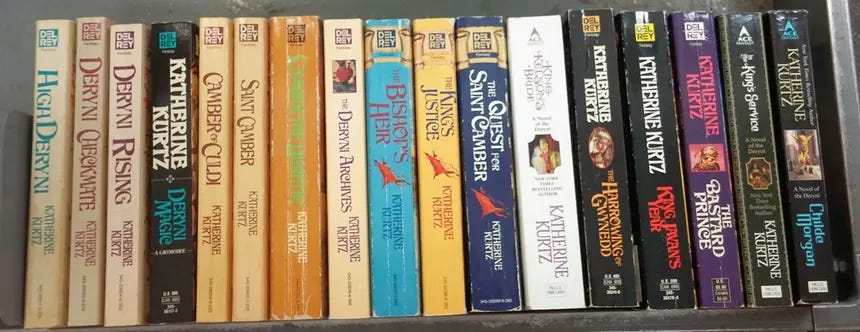
The Deryni catalog is structured as five interlocking trilogies plus supplementary material, and the timeline hops around across roughly 250 years of Gwynedd’s history. The internal chronology is intricate. The publication order does not match the story order. Newcomers often find it disorienting until they realize the whole point is that Kurtz built a real history and wrote across different centuries as the mood took her, exactly the way a working historian moves back and forth across the record.

The Chronicles of the Deryni (1970-1973), consisting of Deryni Rising, Deryni Checkmate, and High Deryni, is the original trilogy, set around 1120 in Gwynedd’s internal calendar. King Kelson Haldane takes the throne at fourteen after his father is poisoned. His half-Deryni protector Duke Alaric Morgan holds off both the political fallout and the accusations of witchcraft. This is the entry point for most readers.

The Legends of Camber of Culdi (1976-1979), consisting of Camber of Culdi, Saint Camber, and Camber the Heretic, jumps back two centuries to the story of the Deryni saint whose legacy shapes everything in the later books. Camber MacRorie leads the restoration of the human Haldane dynasty during a period of Deryni tyranny, then dies and is canonized, then is posthumously declared a heretic when the political winds shift. It is the darkest trilogy in the sequence.

The Histories of King Kelson (1984-1986), consisting of The Bishop’s Heir, The King’s Justice, and The Quest for Saint Camber, picks up where the original trilogy left off, following Kelson through his young adulthood, his political consolidation of Gwynedd, and his attempts to marry and produce an heir. There’s also a fourth book to this trilogy in King Kelson’s Bride that sometimes gets overlooked.

The Heirs of Saint Camber (1989-1994), consisting of The Harrowing of Gwynedd, King Javan’s Year, and The Bastard Prince, returns to the period immediately after Camber’s death, chronicling the anti-Deryni persecutions and the reigns of the young Haldane kings who inherited the mess. These books are brutal in ways that reward the reader with real emotional payoff, and they contain some of Kurtz’s finest writing on power, faith, and legitimate authority.

The Childe Morgan Trilogy (2006-2014), consisting of In the King’s Service, Childe Morgan, and The King’s Deryni, is the most recent addition, set in the generation before Deryni Rising, following Alaric Morgan’s father Kenneth and Alaric’s own boyhood. It fills in the backstory that the original trilogy assumed.
There is also Deryni Magic (1990), a companion volume explaining the magic system in scholarly detail, and Codex Derynianus (1998), a comprehensive encyclopedia of the Deryni universe cowritten with Robert Reginald. Both are still cited by the fan community as reference texts.
Ireland, Holybrooke Hall, and the McCaffrey Connection
In 1983 Kurtz married Scott MacMillan, an Australian who worked in film and later as a herald in the Office of the Chief Herald of Ireland. They had a son, Cameron. Within a couple of years they moved to Ireland, and both eventually took Irish citizenship. From 1987 to 2007 they lived at Holybrooke Hall, a gothic revival mansion in County Wicklow, between the villages of Kilmacanogue and Bray. Twelve Tudor chimney stacks. A twenty-foot vaulted great hall with a stained glass window. Crenelated battlements. Ghosts, which Kurtz has written about openly and with affection.
The house was less than an hour from Anne McCaffrey’s Dragonhold-Underhill, also in County Wicklow. The two writers were neighbors for the better part of two decades. McCaffrey blurbed the Deryni novels with a line that has been reprinted on every subsequent edition: “an incredible historical tapestry of a world that never was and of immensely vital people who ought to be.” McCaffrey died in 2011, and Kurtz’s husband Scott MacMillan passed in 2019. Kurtz since returned to America at the historic house in Staunton, Virginia, that she and MacMillan bought in 2007.
The Crypto-History Novels
Alongside the Deryni sequence, Kurtz built a second body of work she calls “crypto-history,” in which the hidden magical history behind real historical events drives the plot. These books are freestanding and use the same rigorous research technique she brought to the Deryni novels, applied to actual periods of Earth history.
Lammas Night (1983) is her most respected crypto-history novel and arguably her most polished single book. It builds on the widely circulated but historically unproven story that English witches met on the eve of Lammas 1940 to raise magical resistance against a Nazi invasion of Britain. The novel handles the occult material with dignity, gives the Battle of Britain the weight it deserves, and treats faith and sacrifice as serious matters. It is a book Kurtz herself has named as one of her favorites of her own catalog.
Two Crowns for America (1996) applies the same technique to the American Revolution, weaving Masonic and mystical elements through the actual historical events. The Adept series, cowritten with Deborah Turner Harris, sets a similar framework in contemporary Scotland. She also produced two Knights Templar novels with Harris and edited three Templar anthologies. St. Patrick’s Gargoyle (2001) is a stand-alone light urban fantasy set in Dublin. She wrote what she wanted to write.
The George R.R. Martin Question
The Deryni novels prefigure A Song of Ice and Fire to a degree that any reader picking up both series will notice. A medieval kingdom loosely based on the British Isles. Intricate court intrigue driven by the deaths of major characters. A powerful Church whose politics matter to the plot. Multiple noble houses with real historical detail. Cousin marriages, contested successions, poisoned kings. Detailed heraldry. Winter as a background threat. Even the tendency to kill off characters the reader has come to love.
Martin has been careful in his cited influences and has publicly named Tad Williams as his primary modern fantasy influence for A Song of Ice and Fire. He has not, so far as the public record goes, explicitly cited Kurtz. But critics in the SF/F conversation have made the connection repeatedly. Reactor ran an essay in 2024 arguing directly that A Game of Thrones is legible as a response to Deryni Rising, with Martin deliberately deconstructing the Romantic assumptions of Kurtz’s work. Black Gate, Cora Buhlert’s blog, and Strange Horizons have all pointed at the parallels. Whether or not Martin sat down and read the Deryni novels, he was working in a subgenre Kurtz had built, using tools she had invented, and the family resemblance is impossible to miss.
The difference in tone is the tell. Martin writes toward despair. Kurtz writes toward hard-won hope. Kelson wants to be a good and wise king and mostly succeeds. Camber sacrifices himself for the right reasons. The best characters are trying to live morally under conditions that make morality expensive. If ASoIaF is where fantasy went when it lost its faith in the possibility of virtuous power, the Deryni novels are what fantasy looked like before the loss happened.
The RPG Legacy
Kurtz has a substantial second life in tabletop RPG circles that mainstream literary fans do not know about.
Dragon Magazine issue #78, published in October 1983, was the psionics issue for Advanced Dungeons & Dragons first edition. One of the featured articles adapted the Deryni universe as a psionics campaign framework, effectively presenting Kurtz’s magic system as the model for how ESP-based abilities should work in a fantasy RPG. For a generation of AD&D players, that Dragon issue was how they discovered Kurtz’s novels in the first place. Multiple working writers and game designers have credited it as their entry point.
Mayfair Games’ Witches supplement in 1990 included a full “Deryni Witches” section as one of six templates for AD&D witch characters. Grey Ghost Games released The Deryni Adventure Game in 2005, a complete tabletop RPG using the FUDGE system, designed by Aaron S. Rosenberg with Kurtz’s cooperation. It remains in print. The Deryni universe is one of a small number of major fantasy IPs that has generated a serious independent RPG rather than a licensed sourcebook slotted into an existing system.
The Fan Community Is The Best Part
The community around Katherine Kurtz’s work is one of the more charming corners of the internet, and it functions the way SF/F fandom did before social media flattened everything.
The hub is rhemuthcastle.com, named for the capital city of Gwynedd. It hosts a full phpBB-style forum with discussion boards for every trilogy, an active fan fiction section, an ongoing play-by-post role-playing campaign called Forgotten Shadows, a recipe exchange for medieval Gwynedd-appropriate dishes, and archives going back to the site’s founding around 2001. The community is older, respectful, deeply committed to the source material, and small enough that regulars know each other by handle.
The forum is the front door. The core of the community is KKChat, held every Sunday at 7:00 PM Eastern on the Communiti Chat IRC Network with a Discord bridge for the newer contingent. On the first Sunday of each month, the chat shifts to a Members-Only Zoom call at 3:00 PM Eastern. Kurtz herself attends. She takes questions. She talks about her current writing. She engages with the fan fiction. She is eighty-one and she still shows up every week to talk to the readers who have stayed with her for fifty-five years.
The fan fiction community deserves its own paragraph. The forum’s Deryni Archives Fan E-Zine, named in tribute to the print magazine Kurtz herself edited in the 1980s, hosts a rolling body of fan-written novels, novellas, and short stories set in Gwynedd. Regular contributors have produced multi-volume epics. Kurtz reads it. She comments. She encourages new writers. There have been ongoing conversations about assembling the best of the fan fiction into an authorized print anthology, a project Kurtz has indicated she would like to see happen. The 25th anniversary chat happened in January 2026. The community is not going anywhere.
This is what a healthy small fandom looks like. Direct author engagement. Craft-oriented discussion. A conduct rule short enough to fit in a tweet. No performative fighting. The people who found Kurtz thirty years ago through Dragon Magazine or a battered used-bookstore copy of Deryni Rising are still there, and they have made room for anyone who wants to join.
Why She’s Important Now
The current recovery of Christian-friendly fantasy in the indie and crowdfunded space has almost nobody to point to as a model at Kurtz’s level. She was writing intricate, faith-serious, historically grounded fantasy at the peak of the New Age fantasy wave. She was doing it decades before the current genre conversation had the vocabulary to describe why it worked. She wrote adult political drama with children in it, real religious conviction without either sneering or apologetics, women characters who were formidable without being modern, and courts full of grown-up men whose loyalties and disloyalties cost them something.
She is also a working example of how a writer can stay in productive relationship with her readers across five decades without either burning out or letting the mainstream conversation dictate her values. The Sunday chats matter. The fan fiction blessing matters. The fact that the community organized itself around the actual work rather than around a personality cult matters.
If you have never read Kurtz, Deryni Rising remains the entry point Fandom Pulse recently recommended, and the argument for it stands. If you want to see what she can do at full length and full ambition, Camber the Heretic is the darkest and finest single book in the Camber trilogy. If you want the standalone crypto-history, Lammas Night is where to go. If you want the reference volume that maps the whole world, Codex Derynianus is still cited in the fan community every week.
She is one of the great overlooked builders of modern fantasy. The catalog is largely still in print. The community is still meeting on Sundays. The author is still showing up.
Which faith-serious fantasy writer do you think the mainstream conversation has ignored the longest, and which book of theirs would you put in every reader’s hands?
Six books. One unforgettable world. The Adventures of Baron Von Monocle is steampunk adventure with the kind of worldbuilding and heart that made you fall in love with fantasy in the first place. Start the series on Amazon.
NEXT: Dragonsteel Fixed The Wheel Of Time Leatherbound Cover, But Isn’t Addressing The Interior Issues
Not longest by any stretch since he is a contemporary but Vox Days Epic Fantasy books take Christianity very seriously. He is ignored because to the culturally dominant left he is radioactive.
Looks like my local library has all of Kurtz's Deryni stories, so I got the first three books in one volume.
Oddly, I have in my personal collection some old "Tournaments Illuminated" (an SCA publication) of Katherine's from when she lived in Los Angeles and later Sunland, CA. A friend of mine, who was a roommate of hers, gave them to me to settle a debt. Wonder if they're worth anything?