


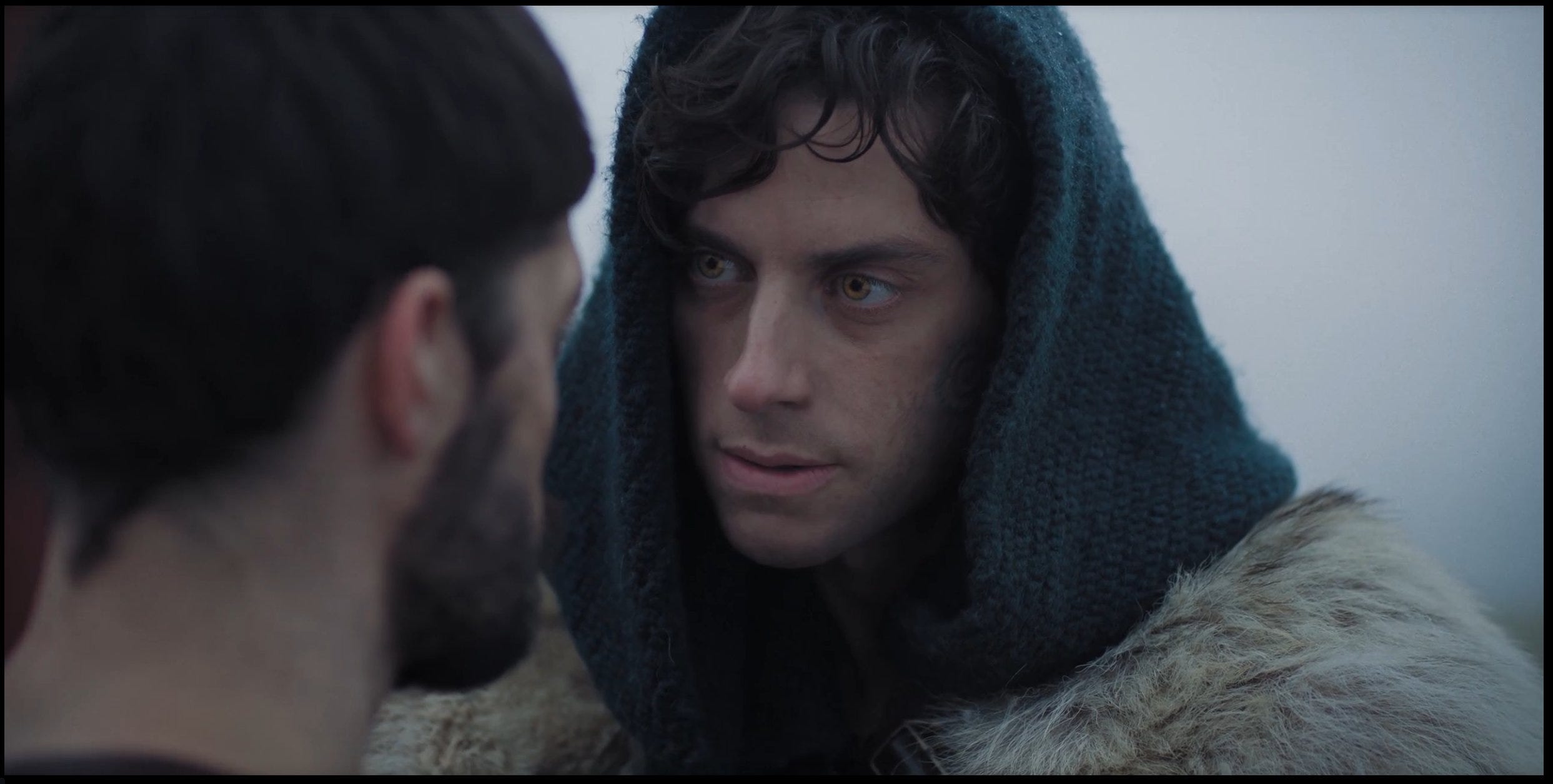
Episode four of The Pendragon Cycle continues immediately from the previous installment, with Aurelius attempting to garner support for his claim as High King of the Britons. Merlin remains at his side, using wisdom and strategy where Aurelius relies on honor and martial prowess. The episode brings them to Castle Ynys Avallach (Avalon), where Merlin was raised by Charis, and where the former Atlanteans extend their hospitality to Aurelius and his brother Uther.
This is where the adaptation begins to deviate more noticeably from Stephen R. Lawhead’s source material.
Structural Changes from the Novel
In Lawhead’s Merlin, the gathering of support for Aurelius reads like a historical chronicle. The Saecsen threat exists, but it’s presented as background context rather than immediate crisis. Kings meet, alliances are discussed, and the narrative moves with the measured pace of political negotiation.
The show takes a different approach. The Saecsen threat is immediate, visceral, and overwhelming. Aurelius isn’t just seeking allies—he’s trying to unite fractured kingdoms before they’re all destroyed individually. The urgency transforms what was a relatively passive sequence in the novel into something dramatically propulsive.
This is smart adaptation. Television requires momentum that prose can achieve through internal reflection and historical context. By foregrounding the Saecsen threat, the show gives every political conversation stakes. Every kingdom that refuses to join Aurelius is one more that will fall when the Saecsens arrive.
Merlin’s Return Home
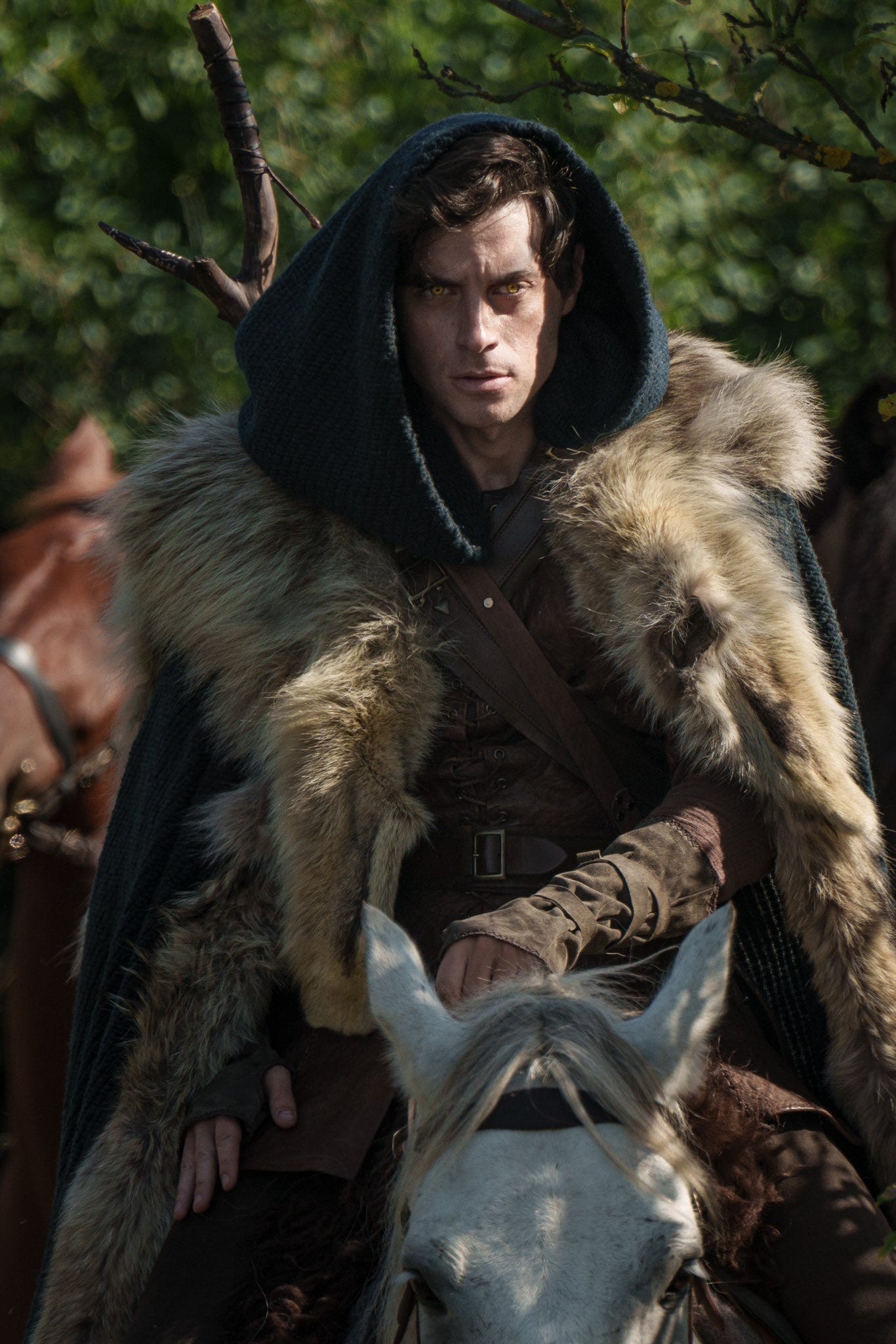
Merlin returns to Dyfed, the kingdom where he once ruled and where Taliesin and Charis took refuge. The homecoming is complicated by Uther’s distrust. Where Aurelius sees Merlin as an invaluable advisor, Uther sees a manipulator with unclear motives. The tension between them builds throughout the episode, with Uther plotting against Merlin even as they work toward the same goal.
Tom Sharp continues to excel as Merlin, playing the character with quiet authority and strategic intelligence. When Uther’s distrust comes to a head, Merlin doesn’t respond with anger or power, he responds with honor. It’s a character moment that defines who this version of Merlin is: not a wizard who relies on magic to solve problems, but a leader who understands people and knows how to navigate conflict without escalating it.
The episode’s best sequence comes when they confront a neighboring kingdom that’s been raiding. Merlin, recognizing they’re outnumbered, uses strategy instead of force. He ensures the enemy king knows that Uther—brother to Aurelius—is fighting as a regular soldier in the army. If Uther is killed, Aurelius will bring his full wrath down upon them. The threat is enough to stop the battle before it begins.
It’s clever, tense, and showcases exactly what makes Merlin valuable. He wins without fighting. He solves crises through wit and persuasion rather than brute force. The contrast with Uther, who explicitly states that “brute force is how you win battles,” couldn’t be clearer.
Morgian’s Dark Path
The episode also expands Morgian’s role beyond what Lawhead’s novel presents. In the books, Morgian’s evil is mentioned historically, glossed over as something that happened rather than shown in detail. The show takes a different approach, giving her scenes that establish her as an active threat.
Morgian is shown at a kingdom with her children and husband, performing another animal sacrifice. This one escalates beyond what we’ve seen before, ending with Morgian kissing her son in a way that clearly signals incestuous intent.
This is a departure from Lawhead’s tone. His Merlin is relatively restrained, keeping the darker elements of Arthurian legend at a distance. The show leans into them, drawing from the broader tradition where Morgian is an incestuous witch whose evil is both magical and moral.
The scene is uncomfortable by design. It’s meant to be. The show frames the behavior as unambiguously evil, a consequence of Morgian’s corruption and her willingness to embrace darkness for power. But it does push the content rating into territory the first three episodes largely avoided.
Up to this point, The Pendragon Cycle has been family-friendly aside from battle violence. This episode crosses into PG-13 territory. It doesn’t go full Game of Thrones—there’s no nudity, no explicit incest—but the implication is clear enough that parents with younger viewers should take note.
Content Warnings
The violence also escalates. The Saecsens are presented as barbarically brutal, and the show doesn’t shy away from depicting that. A man is burned alive on screen—a stunt the production seems to enjoy, as someone was also set on fire in the previous episode. This time, the burning is foregrounded rather than happening in the background.
There’s also profanity for the first time in the series. One line of it, which feels out of place given how clean the first three episodes were. It’s a minor criticism, but noticeable. The show had established a tone that didn’t require that language, and its inclusion here feels like an unnecessary concession to “edginess.”
These elements don’t ruin the episode, but they do shift the audience it’s appropriate for. The first three episodes could be watched by most families. This one requires more discretion.
Aurelius and Honor
The B-plot follows Aurelius as he attempts to win favor with the Atlantean realm by defending them against raiders. He goes off alone to fight—not the smartest decision for a king, but one that demonstrates his personal honor above all else. He’s not asking others to do what he won’t do himself.
This is consistent with Lawhead’s characterization. Aurelius is someone everyone loves, someone everyone can follow. He’s noble, brave, and selfless. The show is building him up deliberately, which makes sense given what’s coming in the storyline. Anyone familiar with Arthurian legend knows Aurelius’ time is limited, and the show is ensuring his death will carry emotional weight.
Production Quality
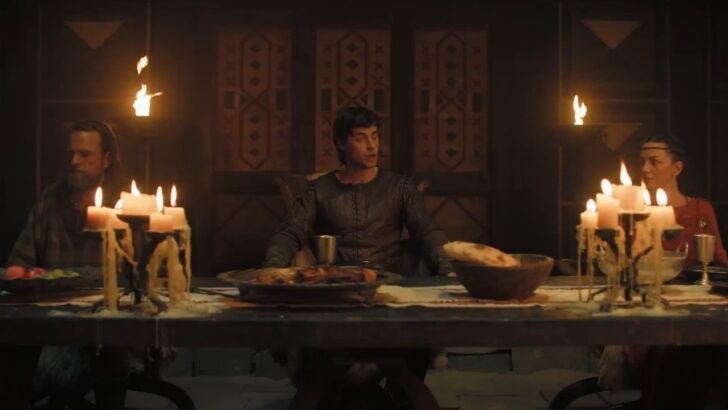
The episode continues the series’ strong production values. There are sweeping aerial shots of the countryside, beautiful sequences of horseback riding across open fields, and well-choreographed battle scenes. The show looks expensive in the right ways—not through excessive CGI, but through location shooting, practical effects, and strong cinematography.
The action is well-staged and easy to follow. The political maneuvering is clear without being simplistic. The pacing is the fastest yet, with multiple plotlines advancing simultaneously without feeling rushed.
Deviation and Improvement
The changes from Lawhead’s novel are mostly successful. The book’s historical tone works on the page, but television requires dramatization. By making the Saecsen threat immediate, by giving Morgian active scenes rather than historical references, by creating conflict between Uther and Merlin, the show transforms what could have been a slow political drama into something propulsive.
The trade-off is that some of the restraint and family-friendly tone is lost. The Morgian scenes and the increased violence push the content rating higher than the first three episodes. Whether that’s an improvement or a misstep depends on what you value in the adaptation.
For viewers who want a more mature, grounded take on Arthurian legend, these changes work. For families who appreciated the cleaner tone of the early episodes, this shift may be disappointing.
Final Thoughts
Episode four is the fastest-paced installment yet, with strong character work for Merlin and Aurelius, escalating political tension, and well-executed action sequences. The deviations from Lawhead’s novel are mostly smart adaptations for the medium, though the increased mature content may alienate some of the audience the first three episodes cultivated.
Tom Sharp remains excellent as Merlin, playing the character with intelligence and quiet authority. The supporting cast continues to deliver strong performances. The production values are impressive, with beautiful location shooting and practical effects that give the show a grounded, tactile quality.
The content warnings are real. This episode is more violent, more explicit in its depiction of evil, and less family-friendly than what came before. That’s not necessarily a flaw, but it is a shift viewers should be aware of.
Overall, this is a strong episode that accelerates the narrative and sets up major events to come. It’s not quite as excellent as episode three—the increased mature content feels slightly at odds with the tone the show established—but it’s still compelling television and a solid adaptation of challenging source material.
Rating: 8.5/10
NEXT: ‘Masters Of The Universe’ Director Says Property Has “Inherent Silliness” That Is “Woven Into The Script”