


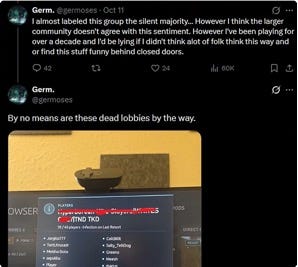
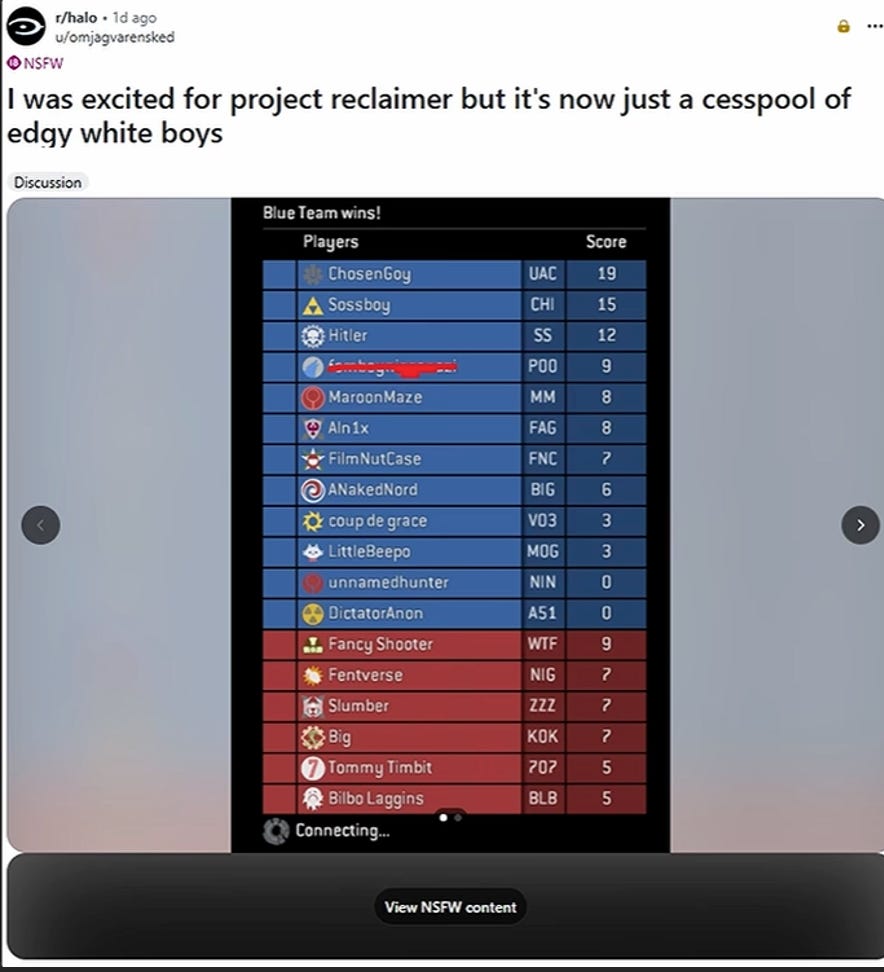
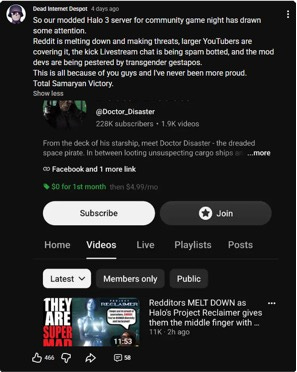
On 11 October 2026, the X account @germoses posted a screenshot of player names from Project Reclaimer and described the community as disgusting and racist on the grounds that vote-kicks were failing to remove the users associated with those names. The post received hundreds of replies. The same screenshots subsequently circulated on Reddit. Discussion threads presented the launcher as evidence that multiplayer had become unusable after the removal of studio filters. Reaction videos characterized the response as originating from users who had expected automatic moderation and encountered none, a condition consistent with the unfiltered multiplayer environment that characterized Halo lobbies on Xbox Live in earlier years.
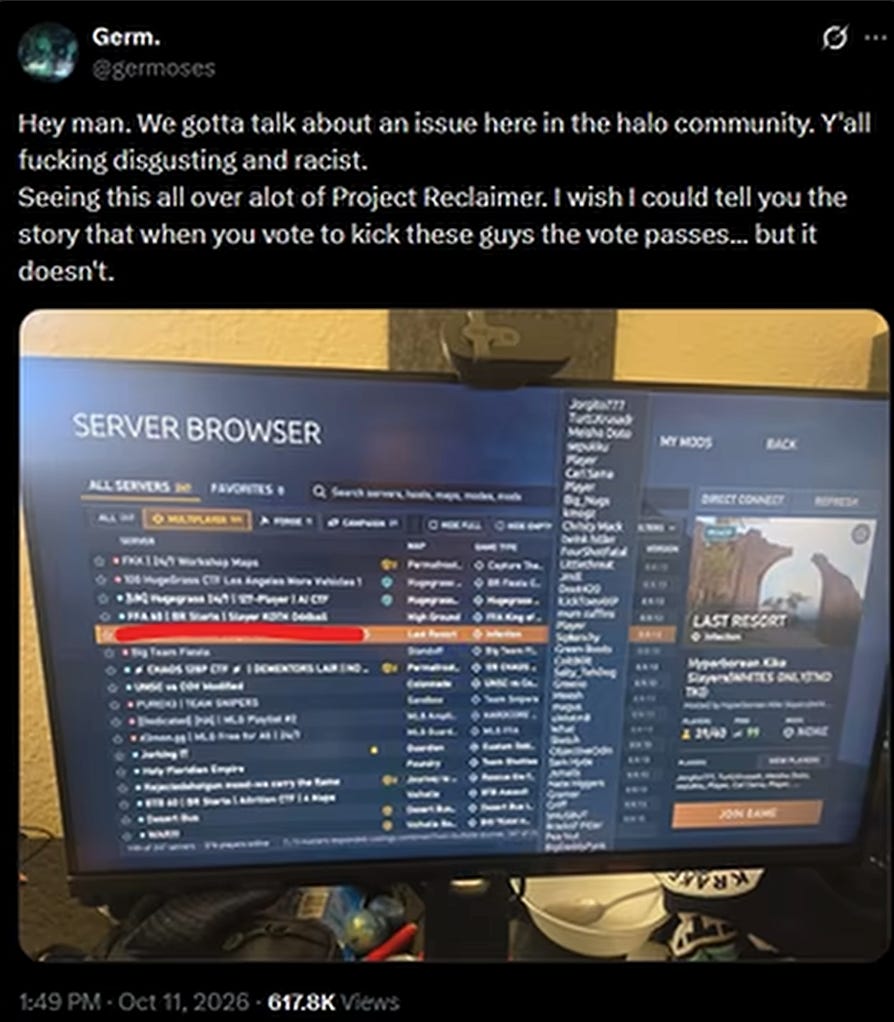
The post comes from a now-suspended account named @germoses on 11 October 2026 reads:
“Hey man. We gotta talk about an issue here in the halo community. Y’all fucking disgusting and racist. Seeing this all over alot of Project Reclaimer. I wish I could tell you the story that when you vote to kick these guys the vote passes... but it doesn’t.”
For those unaware, Project Reclaimer is a free, standalone fan-made launcher for Halo 3 on PC. It runs the game directly from a legitimate Steam copy of the Master Chief Collection (it contains no game files itself) and adds:
A server browser and community-hosted dedicated servers
Expanded multiplayer (up to 128 players)
Larger campaign co-op (up to 16 players)
Restored original Halo 3 menus and expanded Forge tools
Optional client-side name/chat filtering (off by default)
Host-controlled kicks and bans
It functions as a modern community multiplayer platform built around the 2007 game.
Halo fans created a community space that still runs the kind of unfiltered multiplayer experience that those same ordinary gamers treated as normal on Xbox Live Halo a decade ago. This is the dream come to life. Gamers are winning! So, why the silence? Why aren’t more people talking about this? Free speech wins, and... nothing?
Sadly, if you’re too caught up in the mainstream, then you have probably never heard of Project Reclaimer--even from larger accounts that usually cover every gaming controversy under the sun. Asmongold, Grummz, and similar commentators have yet to say anything about the launcher or this complaint that called the community “disgusting” and “racist” for failing to kick people over their player names and the name of their server.
Project Reclaimer might be the most important thing to happen for gamers this year simply because of what it represents symbolically. Halo Studios, the developer of the Halo franchise following the rebranding of 343 Industries, underwent significant staff reductions after the commercial performance of Halo: Campaign Evolved. Indeed, the same studio that had, for several years, treated its core audience as disposable conducted a large-scale staff reduction following the remake’s failure to achieve expected sales figures. Comparable reductions occurred at other publishers during the same period. Meanwhile, community-developed tools and spaces that maintain earlier multiplayer conventions and design priorities continued to operate and give players what they really, truly wanted.
The Fallout Example
Classic Fallout shows a parallel movement. In a recent video titled “Deep Dive Into Classic Fallout Mods,” former game developer Craftian examined several total-conversion projects built on the 1990s isometric games: Fallout 1.5: Resurrection, Fallout Nevada, Olympus 2207, and Fallout Sonora. The video records mixed results across the individual projects. Resurrection draws particular criticism for tonal inconsistency, dialogue that fails to match the restraint of the original games, and an overreliance on feverish or cartoonish exchanges. Other entries fare better in Craftian’s assessment. Across the set, the video still places the body of classic Fallout total conversions ahead of the output Bethesda has released under Emil Pagliarulo across the last two decades. The description states the conclusion directly: mixed results, yet still better than anything Emil and Bethesda have done in twenty years
The mods restore or expand the original turn-based systems and dialogue-heavy structure. They do not replace those systems with newer real-time combat loops. Players who want the form of play the 1997 and 1998 games provided continue to find versions of it inside those conversions. Official development under Bethesda moved away from that structure. Fan labor filled the gap that remained. The same pattern of audience demand meeting parallel production appears in both the classic Fallout conversions and the Project Reclaimer launcher.
The End of an Era?
Debra Wilson’s comments supply a smaller, personal marker of the same shift and mark the end of an era. In a podcast appearance from earlier this year that resurfaced in mid-October, she stated that designers, rather than the performer, decide when her face is scanned onto a character. She called the decision to make the character Callisto look like her in Marvel’s Wolverine a mistake and said she prefers roles in which the character looks nothing like her. The same preference applied to her work as Amanda Waller in Suicide Squad: Kill the Justice League.
In an earlier Fandom Pulse piece, I examined the long pattern of face scanning that accompanied race-baiting and identity-politics framing inside development. The repeated capture of Wilson’s likeness was one visible instrument of the iron fist those developers held for years. Her roles as Grace Walker in Wolfenstein II: The New Colossus and as Amanda Waller, both of which placed her face inside projects that carried explicit political framing.
Bethesda’s marketing for The New Colossus used the slogan “Make America Nazi-Free Again,” the hashtag “NoMoreNazis,” and imagery of punching Nazis. The current statement from Wilson reads as a symbolic capitulation of that hold. We have gone from the “punch a Nazi” framing that defined Bethesda’s Wolfenstein II: The New Colossus to a private Halo lobby that now displays the server name “Hyperborean Kike Slayers|Whites Only|TND TKD” without automatic removal. The interval between those two developments corresponds to a measurable change in industry conditions, commercial outcomes, and the surrounding cultural atmosphere in which ordinary gamer norms have been allowed to reappear outside official channels.
Taken together, the fan launcher, the Fallout conversions, and Wilson’s statement describe a single direction. Official channels that had treated the core audience as replaceable subsequently underwent extensive staff reductions. In parallel, spaces and tools that preserve earlier multiplayer norms and design priorities continued to operate, producing a reversal in which the audiences previously set aside retained functioning venues while the pipelines that had sidelined them contracted. If the culture war is one of attrition, then true gamers have surely won it.

The answer to authoritarian overreach is, as it has ever been, in the hands of grassroots communities tech-savvy enough to organize and field free alternatives.
May AAA fail to create the modern audience, and their old audience find alternatives like these.
If your conclusion is the wild Wild West nature of old school gaming lobbies beat the “sanitized” mainstream, it overlooks the formers niche status. No one wants extreme toxicity & edgyness in the mainstream games.