


There is a common belief in contemporary discourse that there exists a unified front against what is often labeled “wokeness.” This belief does not hold up to closer scrutiny. In reality, very few people are opposed to the ideology itself. That ideology being, definitively, Cultural Marxism.
What people generally oppose are the most aggressive and obvious manifestations of it. They are willing to accept tokenism, the routine inclusion of sexual subplots, caricatures of Christianity, and the broader assumptions of a globalized cultural project, provided that all elements remain subtle. When confronted about this accommodation, one often encounters what R. R. Reno has called the Law of Merited Impossibility:
It isn't happening, it's good that it is happening and you bigots deserve it.
The formula allows people to both deny and affirm the same reality at once. They resent anyone who notices, because noticing breaks the fragile illusion of subtlety. Their defense of moderation is, in fact, a defense of denial. They want the agenda to remain hidden so that they need not acknowledge it.
Why do they do this? Read Romans 1:18-32.
Now, for many, what counts as “in your face” is entirely subjective. One person may perceive propaganda as intrusive, while another may pass over the very same scene without noticing that it is central to the plot.
The contradictions are not difficult to see. Some of the loudest voices against woke ideology also embrace the very tropes they condemn. Lesbian storylines, when embedded in a franchise they already enjoy, are received not as ideological intrusions but as entertainment. Others champion the Kingdom Come series for its supposed “historical accuracy,” even though the second game inserted a black Muslim character into fifteenth-century Bohemia and allowed the player to pursue a homosexual relationship with a documented figure from that period. The studio’s own figurehead, Daniel Vávra, has acquiesced to investor demands for greater representation and has publicly aligned himself with the same cultural trends his defenders claim to resist.
What makes the contradiction even more striking, and illustrative of the Law of Merited Impossibility, is that many of these same players openly mock Daniel Vávra for comments he has made, while simultaneously consuming his games with enthusiasm. It is akin to being told that the chef vomited in one’s soup and then insisting that the meal is still delightful, even while professing to find the act itself revolting. The posture is one of denial. They want to believe that the offense has not really touched them, or that it remains subtle enough to ignore, even as they go on enjoying what they claim to reject.
Bethesda provides another illustration. For years, its games have been ridiculed for technical failures and for oddities such as the infamous “town of children” in Fallout 3. Yet when the Fallout television adaptation appeared, much of the same audience greeted it with enthusiasm. That it emerged from the same industrial machine that produced The Rings of Power seemed to trouble few. The ideological framework remained largely invisible to those who had already determined to view the show as entertainment rather than propaganda.
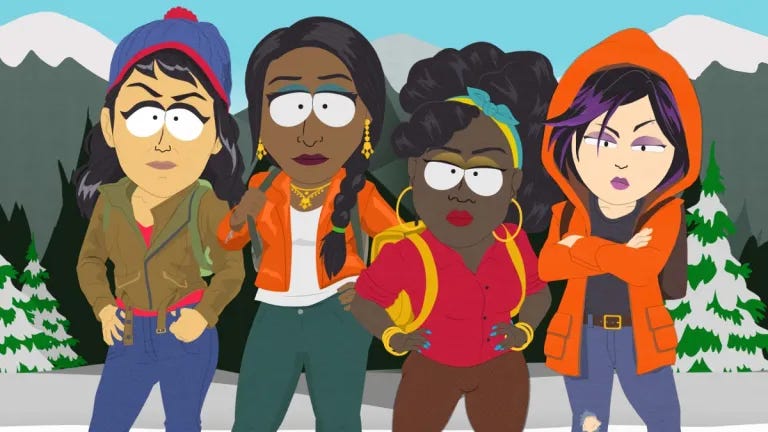
The case of South Park is perhaps the most revealing. Viewers frequently cite isolated jokes about tokenism or about particular Hollywood producers as evidence that the show is on their side. In reality, the series has aligned with mainstream narratives for well over a decade.
For example, the 2023 special “South Park: Joining the Panderverse” episode is often cited for how it skewers token representation. Yet, in the same episode, Cartman is also made to concede, saying, “Maybe getting mad at woke stuff all the time is pretty lazy too.” This would convince me that more people watched isolated clips of the episode rather than the episode itself because, even after the writers mock woke overreach, they also mock the backlash.
It is misleading to say that the program only became woke in its treatment of recent political figures. The larger record demonstrates a steady accommodation to the dominant cultural consensus, punctuated only occasionally by gestures of resistance. What I mean, is, South Park is often only recognized when it goes against the grain. But here are examples of where it has aligned itself with the cultural consensus rather than resisting it:
Trans Athlete Episode ("Board Girls," 2019) – The show depicts a trans athlete as a Randy Savage parody, but the core message ends up reinforcing the mainstream liberal position: “trans women are women” and those who object are treated as backward or ridiculous. What could have been biting satire of contradictions in gender ideology softened into a safe joke.
COVID and Vaccines (2020–21 Specials) – Instead of lampooning the hysteria, restrictions, or government overreach (classic South Park targets), the specials mostly mocked vaccine skeptics and presented compliance with mandates as the sensible, inevitable norm.
Climate Change (Al Gore / ManBearPig Reversal, 2018) – After years of mocking Al Gore as a paranoid crank with the “ManBearPig” gag, the show later made a point of apologizing to Gore and framing him as vindicated. This wasn’t satire, it was an explicit concession to mainstream environmental orthodoxy.
Trump Years (2016–2020) – The show initially tried parodying Trump but quickly abandoned it, with Parker and Stone admitting the real-life news cycle was too absurd to satirize. Instead of skewering both sides as they once did, they let cultural narratives about Trump dominate unchallenged.
Taken together, these examples show that the supposed resistance to wokeness is fragile and compromised. It does not amount to a rejection of the ideology itself but only of its most blatant expressions. People may protest when the agenda is too obvious, but they quickly make peace with it when it appears in more familiar or palatable forms. They mock the symptoms but remain unwilling to confront the system that produces them.
At the root of this problem lies a deeper cultural issue. As Nicholas Carr has argued in The Shallows, culture depends upon memory. When people encounter a book, a film, or a work of art, they must carry it with them for it to remain vital. Memory renews culture across generations. If memory is outsourced, culture withers. In the age of the internet, memory is increasingly shallow, fragmented, and externalized. Distraction ensures that few works are remembered with depth, and the constant outsourcing of recall to devices erodes the cultural imagination itself.
The consequence is that media is no longer received as a lasting inheritance but as a disposable event. When people revisit games or films, they rarely remember them as they truly were. They experience only what distraction allowed them to register in the moment, which is why so much media quickly becomes forgettable. Culture that was never allowed to sink into memory cannot endure.
Tolkien once described imagination as a “leaf mold,” a compost heap of experiences, stories, and forgotten impressions that enrich the soil of the mind and allow new creations to grow. A distracted and outsourced memory leaves no such fertile ground. The same is true of a culture. If we lose our memories, we lose our particularity, and what remains is generic, shallow, and replaceable. This explains why so much contemporary media feels disposable, and why resistance to wokeness often amounts to little more than momentary irritation.
Cultural renewal cannot occur without memory. To remember is not simply to recall details but to cultivate depth and distinctiveness. Without this, both art and opposition become hollow. The problem is not only that the ideology persists but that we have forgotten what it means to hold on to something enduring.
NEXT: Author Lee Strobel Explains Why Satan Targets Hollywood

Excellent article, Sigma.
I'll add a touch. People watch these compromises because they're funny. Laughter in movies and comedy (sitcoms) is a science as much as lighting (I was in H-wood over 50 years ago). Laugh-moments are specifically timed to a strict cadence to produce a constant start-stop stream of laughter.
Why? Laughter eases the brain. Laughter also eases ideas. So if gays become funny, we begin to see gays as happy and fun to be around because... everyone loves to laugh. Laughter is thus a tool to promote ideology not congenial to a society.
In the case of South Park and Theory of Evolution and other cartoons or sitcoms, ideas are wrapped in laughter to be unpacked later in the brain as sympathetic.
And people watch these to feel the levity in a world that has turned against them. When ever South Park has something anti-woke, the watcher no longer feels guilty or bad about laughing at something that would otherwise sicken him. "Hey, look everyone! South Park ripped the woke!" And it goes viral. Guilt assuaged. Relief that South Park has some anti-woke in it.
As you said, sort of like eating what the chef vomited in but claiming it's still good enough to eat. Spot on.
I stopped consuming the crap long ago. As responsible, moral people, we need to stop consuming this garbage. Another way to look at it is that every time you watch these for laughs, you're supporting the trafficking, rape, and murder of children. Seriously. Very seriously.
Trey Parker and Matt Stone said that, going back to their time in film school, they "couldn't wait to start selling out" in Hollywood. They have done exactly what they set out to do.