


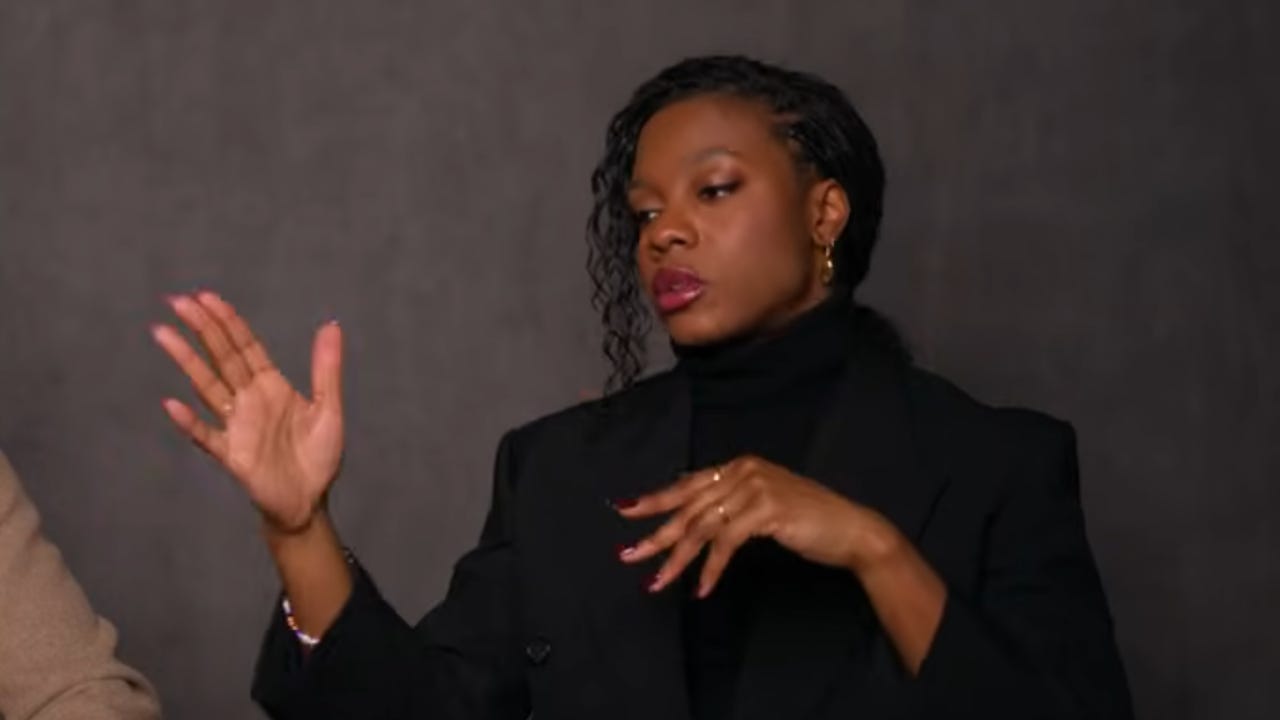
Nia DaCosta, the director of The Marvels and the recently released 28 Years Later: The Bone Temple, praised Rian Johnson’s Star Wars: The Last Jedi including most of the objectively bad moments in the film.
DaCosta brought up Star Wars in the interview after describing how she’s a humanist and how she relates to the 28 Years Later: The Bone Temple character Dr. Kelson. She says, “Kelson’s like a real humanist. And I think that’s really beautiful. And I think him basically being like there’s no devil, there’s no god, but there’s us. And that’s beautiful. It’s stunning. And I think that’s a beautiful message. So despite all the horrors you have to get through to get it, I think about that a lot.”
“And everything I love, like when you think about like a Star Wars, for example, which I love, similar thing,” she continued. “It’s like, ‘Okay, we defeated the big bad, now what? How do make a life up?’”
The host then claims that’s why he likes The Last Jedi, and DaCosta concurs, “Let me tell you something about that movie. It’s amazing. We all just need to relax. We need to take a breath because the movie is great. Holdo Maneuver is amazing. I don’t care. It looks amazing. Poe should have shut his mouth and taken orders.”
The Holdo Maneuver is a glorified kamikaze attack and such maneuvers are condemned as immoral. The Catechism of the Catholic Church states, “Suicide contradicts the natural inclination of the human being to preserve and perpetuate his life. It is gravely contrary to the just love of self. It likewise offends love of neighbor because it unjustly breaks the ties of solidarity with family, nation, and other human societies to which we continue to have obligations. Suicide is contrary to love for the living God.”
If that didn’t make it clear already, DaCosta again showed her own deeply flawed moral character when she claimed it was debatable on whether or not Luke Skywalker made a mistake when at the last second he chose not to murder his own nephew.
The host said, “Luke, like he dealt with decades of trying to be the guy and he’s a human. He’s crushed under the weight of all that and made one bad decision.”
DaCosta replied, “Well, we can debate that. We can debate. Because I will say Kylo Ren, ‘Girl, relax. Kylo, take it down a notch, you know?’ He’s at like an 11 all the time. I’m like, ‘Kylo, your blood pressure has to be so high.’”
Comments like this are not surprising from DaCosta. Back in November in 2021, DaCosta blamed Captain America for Thanos’ victory in Avengers: Infinity War. She was asked by Inverse, “When you were doing press for Candyman, you noted that racism tends to make people unwilling martyrs, which is so very true. We see it all the time. And superheroes are often unwilling martyrs, though under vastly different circumstances. Do you see a connection there?”
She replied, “Oh wow. I didn’t think about it in that sense, but I think Candyman, especially in the way we shifted his lore bit in my film, is a hero.”
Next, she blamed Captain America for not sacrificing Vision, “Something I like to say a bit flippantly about Captain America is that the Snap is all his fault because he was trying to do his best, trying to do the right thing. There is a world in which he’s a villain because, at the end of the day, he should have just sacrificed Vision. He chose one robot’s life, albeit a sentient one, over literally the entire universe. There’s a sort of anti-hero in that if you want to look at it through that lens.”
“He chose one robot’s life, albeit a sentient one, over literally the entire universe. There’s a sort of anti-hero in that if you want to look at it through that lens,” she explained. “People would say I’m crazy for thinking that way, but there’s something connected to the journey of the anti-hero and the hero. The hero’s pain is something that spurs them to martyr themselves, and an anti-hero’s pain is a thing that kind of starts their journey as opposed to ending it.”
This type of thinking is immoral. Pope Paul VI teaches in Humanae Vitae, “Though it is true that sometimes it is lawful to tolerate a lesser moral evil in order to avoid a greater evil or in order to promote a greater good, it is never lawful, even for the gravest reasons, to do evil that good may come of it (cf. Rom 3:8) — in other words, to intend directly something which of its very nature contradicts the moral order, and which must therefore be judged unworthy of man, even though the intention is to protect or promote the welfare of an individual, of a family or of society in general”.
However, what actually plays out in the movie where Vision offers to sacrifice himself is morally acceptable and fits within the principle of double effect.
As explained by Fr. Charles Grondin on Catholic Answers, the principle of double effect “states that an action that has two effects (one good, one bad is permissible if:
The act itself is not intrinsically wrong
The person acting intends only the good effect, and would avoid the bad effect if possible
The good effect cannot be caused because of the bad effect
The good effect must be in proportion to the bad effect”
In this case, the act is not the death of Vision, but rather the Mind Stone. This distinction is made clear when Bruce Banner describes how it would be possible for Vision to still survive even with the Mind Stone destroyed.
As for the second point, the intention is to destroy the Stone and prevent Thanos for murdering half of all living life in the universe. The intent is not to murder Vision. Now, it’s possible he might die, but it is only tolerated, not desired.
Regarding the third point, Vision’s death may be a consequence of the destruction of the Mind Stone, but it’s not the tool or mechanism that makes the good possible.
Finally, the proportionality should be self-explanatory, but clearly billions of people are not killed.
This type of choice was presented to St. Gianna Molla when she was pregnant with her fourth child. Doctors discovered a tumor pressing on her unborn baby. She rejected options presented to her that would outright kill her daughter. Instead, she opted for a surgery to remove the tumor. The tumor was removed and her daughter was born healthy in 1962. Tragically, she suffered an infection and died a week later.
In both cases the agents (St. Gianna, Vision and Wanda) do not use evil (direct killing) as a means to good ends. Instead, they accept foreseen harm as the cost of a proportionate, good-directed act in a dire crisis.
In short: Just as Wanda’s attempt to destroy the Stone would hypothetically save the universe, with Vision’s foreseen death as the inseparable but not instrumental cost, St. Gianna removes the fibroma to save her child, with her own foreseen death as the inseparable but not causal means to that good. Both embody sacrificial love that upholds dignity without crossing into prohibited consequentialism.
NEXT: Sydney Sweeney Responds To Bond Girl Casting Rumors: "I Think I'd Have More Fun As James Bond"
Has this woman had even one successful film? The Bone Temple is another flop.
Take a hard look at that picture of that…. woman.
Next, ask yourself, why was this type of person anywhere near a property that only appeals to white guys? Should that chick even be anywhere near a star wars property? Of course not. bob iger’s disney, everyone.