


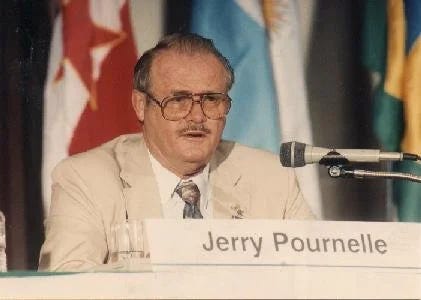
When Ronald Reagan gave the 1983 speech announcing what became the Strategic Defense Initiative, much of the policy framework behind it had been worked out at a science fiction writer’s house in Studio City, California. The man hosting those meetings was Jerry Pournelle. The Citizens’ Advisory Council on National Space Policy, which he chaired from 1980 to 1994, drafted the reports that became the Reagan transition team’s space policy papers. The Council’s third report was quoted in the Star Wars speech itself.
A military SF writer with two PhDs and a roomful of astronauts, aerospace engineers, and Air Force generals helped produce the technical case for space-based missile defense.
The mainstream science fiction conversation has been quietly letting him drift from view for the last decade. He died in September 2017. The Baen authors and the milSF community marked the passing. SFWA published a respectful obituary. The wider genre noted it and moved on. The catalog he left behind, which includes some of the most consequential military and political science fiction of the past fifty years, has not gotten the sustained revisiting it should have.
This is the case for reading Jerry Pournelle now, because the genre that built him has been content to leave him alone, and the catalog he left behind is the model the indie and crowdfunded SF space is currently rebuilding in his image.
The Heinlein Competent Man
Pournelle was born in Shreveport, Louisiana, on August 7, 1933. He served as an artilleryman in the Army during the Korean War. He earned three master’s degrees in history, experimental statistics, and systems engineering, then two doctorates in psychology and political science from the University of Washington. His wife Roberta reportedly joked at family gatherings that people kept asking whether Jerry was still in school. He quoted Heinlein on the subject: specialization is for insects.
His professional life before fiction is the part most retrospectives skip past. He worked at Boeing as Director of the Human Performance Laboratory, where his team did pioneer research on astronaut heat tolerance and certified the passenger oxygen system for the Boeing 707. At Avco Everett Research Laboratory he worked on lasers and fluid dynamics. He conceived Project Thor at Boeing in the late 1950s, the orbital tungsten-rod kinetic bombardment concept now widely known as “Rods from God.” He edited Project 75, a 1964 Boeing study of 1975 defense requirements. He ran political campaign research for Los Angeles Mayor Sam Yorty and served as Deputy Mayor of Los Angeles. He held a professorship at Pepperdine and was the founding president of the Pepperdine Research Institute.
He published his first fiction in the early 1970s under the pseudonym Wade Curtis. A Spaceship for the King was serialized in Analog starting December 1971 and published in book form by DAW in 1973. That same year he won the inaugural John W. Campbell Award for Best New Writer, the first ever given.

He was nearly forty when his fiction career took off under his own name. He had already lived three other careers.
The Strategy of Technology
In 1970, two years before he wrote his first novel under his own name, Pournelle coauthored The Strategy of Technology with Stefan Possony and Francis X. Kane. The book argued that the Cold War would be won or lost on technological superiority and that the United States should organize its defense posture around outpacing Soviet innovation across multiple fronts at once. It was used as a textbook at the United States Military Academy at West Point, the United States Air Force Academy, the Air War College, and the National War College throughout the latter half of the Cold War.
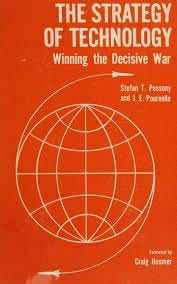
A military SF writer wrote the doctrine taught to American officers about how to think about technological warfare. Then he helped pitch that doctrine to the Reagan administration. Then he wrote novels about what would happen if the strategy failed.
The Citizens’ Advisory Council met first at Larry Niven’s house in Tarzana and later at Pournelle’s home, which he called Chaos Manor. About fifty people attended each meeting, sometimes as many as ninety. The roster included Buzz Aldrin, Pete Conrad, Fred Haise, Gerald Carr, Phil Chapman, aerospace executives from Rockwell and McDonnell Douglas, Lieutenant General Daniel O. Graham, Lowell Wood from Lawrence Livermore, and Poul Anderson. The Council’s first report became the Reagan transition team’s space policy paper. The third report shaped SDI. In 1989, Pournelle, Max Hunter, and General Graham presented to Vice President Dan Quayle to lobby for the DC-X reusable rocket prototype, which flew in 1993 and laid groundwork for everything that followed.
Pournelle was careful about the SDI authorship question. When critic Norman Spinrad wrote in 1997 that Pournelle had personally written the SDI portion of Reagan’s address, Pournelle clarified that the Council “wrote parts of Reagan’s 1983 SDI speech, and provided much of the background for the policy, we certainly did not write the speech.” He added that the Council’s aim was not to boost space exploration but to win the Cold War.
This is not a man who wrote science fiction about space policy. This is a man who helped make space policy and also wrote science fiction.
The CoDominium and the Falkenberg Stories
Pournelle’s central future-history project is the CoDominium sequence, which begins in the 1990s with a political union between the United States and the Soviet Union and ends three thousand years later with the First and Second Empires of Man. The framework is bleak. The CoDominium is corrupt to its core, ships dissidents and ethnic minorities to barely-survivable colony worlds, and is winding down toward nuclear war. The protagonists, particularly Colonel John Christian Falkenberg of the 42nd CoDominium Marines, are men trying to preserve enough civilization to outlast the collapse.

The Falkenberg novels, including The Mercenary, West of Honor, Prince of Mercenaries, Go Tell the Spartans, and Prince of Sparta (the last three coauthored with S.M. Stirling), are foundational texts of modern military science fiction. David Drake, David Weber, John Ringo, and every serious milSF writer working in the indie space today is operating downstream of the tradition Pournelle built. Falkenberg’s Legion does what Roman legions did. The novels take seriously the questions Roman writers took seriously: when does a soldier owe loyalty to the state, when does the state forfeit that loyalty, and what does a professional officer do when civilization is collapsing around him.
After the CoDominium falls, the sequence opens up into the Empire of Man novels, which is where the Niven collaborations live. The Mote in God’s Eye (1974), coauthored with Larry Niven, is widely considered one of the finest first-contact novels ever written. Heinlein called it “possibly the finest science fiction novel I have ever read.” The Moties, an alien species locked in a cycle of population explosion and collapse, are one of SF’s great alien designs. The sequel, The Gripping Hand (1993), reopened the question two decades later. Outies (2010), by Pournelle’s daughter Jennifer R. Pournelle, continues the universe.

The War World stories, set on the brutal colony planet Haven, anchor the third leg of the future history. Pournelle edited the shared-universe anthologies and contributed to most of them.
The Niven Partnership
The Niven-Pournelle collaborations are their own subgenre. Inferno (1976), a science fictional reworking of Dante’s Inferno in which a deceased SF writer named Allen Carpentier is led through Hell by a guide who turns out to be Benito Mussolini, is one of the strangest and most theologically serious novels either man ever wrote. Lucifer’s Hammer (1977) is the great American comet-strike disaster novel and hit number two on the New York Times bestseller list. Footfall (1985), in which elephantine aliens called the Fithp invade Earth and a team of science fiction writers gets drafted to advise the government, hit number one. Robert A. Heinlein appears as a thinly veiled character. Oath of Fealty (1981) is about an arcology in Los Angeles and a corporate civilization that functions better than the democracy surrounding it. The Legacy of Heorot (1987) and Beowulf’s Children (1995), with Steven Barnes, retell the Beowulf story on a colony planet.

Escape from Hell (2009) is the Inferno sequel. It came out thirty-three years after the original.
Janissaries and the Standalones
Janissaries (1979) is the novel that introduces the Galactic Confederacy abducting Earth military units to fight on a feudal planet whose populations were seeded from various points in Earth’s history. Roman legionaries, medieval knights, and modern American soldiers all show up. Pournelle wrote two sequels with Roland Green. David Weber and Phillip Pournelle eventually returned to the series. Goddard Film Group acquired the adaptation rights in 2013. Nothing has come of it.
Birth of Fire (1976) is the Mars colonization novel. Higher Education (1996), with Charles Sheffield, is the asteroid-mining Heinlein-juvenile homage. Starswarm (1998) is the solo juvenile Pournelle wrote at the end of his career. The There Will Be War anthologies, which Pournelle edited across nine volumes from 1983 through 1990, anchored the unapologetically pro-military, pro-Western tradition in SF short fiction throughout the late Cold War. Castalia House revived the series in 2015 with Pournelle’s blessing.
Chaos Manor
Pournelle was also one of the most influential technology journalists of the personal computing era. His column began in BYTE Magazine in June 1980 as “The User’s Column,” became “Computing at Chaos Manor,” and ran through BYTE’s print demise in 1998. It continued on BYTE.com, then on his own site at jerrypournelle.com, where it eventually became one of the earliest serious blogs on the internet. The column followed a simple structure. Pournelle bought every piece of consumer technology he could find, ran it in his actual home office, broke it in interesting ways, and reported what worked and what did not. The format was imitated by every tech reviewer who followed.
His earlier column, “A Step Farther Out” in Galaxy, ran from 1974 through 1978 and made the technical case for space industrialization across years of monthly essays. The essays were collected in a 1979 book of the same title. Reading them now is uncanny. Pournelle was right about consumer computing, right about the Soviet collapse, right about commercial space, and wrong about almost nothing he committed himself to in print.
In 1980 he predicted that by the year 2000, anyone in Western Civilization would be able to get an answer to any question that could be answered. He missed the date by about five years.
The Final Years
Pournelle survived a brain tumor and a stroke in his later years. He kept writing through both. He kept blogging. He attended DragonCon in Atlanta the weekend before he died. His final blog post, written on Thursday, September 7, 2017, complained of cold and flu symptoms. He died in his sleep the next afternoon at his Studio City home. He was eighty-four years old.
He had described his politics, on more than one occasion, as somewhere to the right of Genghis Khan. He also opposed both Gulf Wars, arguing the money would be better spent on domestic energy independence. He was a paleoconservative in a genre that has fewer paleoconservatives every year. He was also, by every available account, generous with younger writers, available to fans, and incapable of refusing a serious conversation about engineering or history with anyone who showed up at his door.
The Heinlein Society awarded him and Niven their Heinlein Award in 2005 for outstanding lifetime body of work. SFWA never made him a Grand Master.
Why He Matters Now
The current state of military and political SF in the indie and crowdfunded space is built directly on the model Pournelle established. The serious soldier protagonist, the morally grey universe in which civilization itself is the prize worth fighting for, the engineer-hero who solves problems with technology and competence rather than feelings, the willingness to engage real political questions without flinching: this is all Pournelle. David Weber’s Honor Harrington owes a debt to Falkenberg. John Ringo writes in Pournelle’s voice on alternate weekends. Larry Correia, Tom Kratman, and every serious milSF writer at Baen is operating in the tradition the CoDominium series codified.
He also did something almost no other major SF writer did. He spent his life inside the American military-industrial complex, used his fiction to dramatize the questions he was working on professionally, and produced policy work that shaped the end of the Cold War. The man who wrote the textbook on technological warfare for West Point also wrote one of the finest first-contact novels in the genre. There is no parallel for that in modern SF.
His catalog is large. The Mote in God’s Eye is the obvious entry point and remains his single greatest novel. Lucifer’s Hammer is the bestseller that holds up. The Mercenary is the place to start the Falkenberg sequence. Inferno is the theological strangeness for readers who want to see what he was capable of when he stopped writing about politics. A Step Farther Out is the nonfiction collection that explains where everything else came from.
He is the kind of writer the mainstream genre conversation has been content to leave on the shelf for the past decade. He is also the kind of writer the indie SF space is steadily rebuilding in his image, whether or not anyone says his name out loud. Reading him now is partly an act of recovery and partly an act of mapping the present.
Which conservative or paleoconservative SF writer do you think deserves a real revival treatment, and which book of theirs would you put in every reader’s hands?
First contact with the Oridians was supposed to be humanity’s proudest moment. Instead, their chief engineer is dead, their ship is sabotaged, and an ancient alien technology is stealing souls. Book one of the Valiant Frontiers series delivers exploration, mystery, and the kind of crew you’ll want to follow across the galaxy. Read The Soul Catcher on Amazon and start the adventure.

Societies that know what to do with the Jerry Pournelles of the world gain a big, consistent advantage over those that don't.
That, too, is a key takeaway as we face a Clown World system that hasn't the faintest idea.
These in-depth articles on writers are well written and fascinating to read.
I've read some of these books, but never realized that Pournelle was in the Aerospace/Defense industry. I certainly didn't know he wrote the technical part of the SDI speech.
I wonder if you could an in-depth of David Weber?