


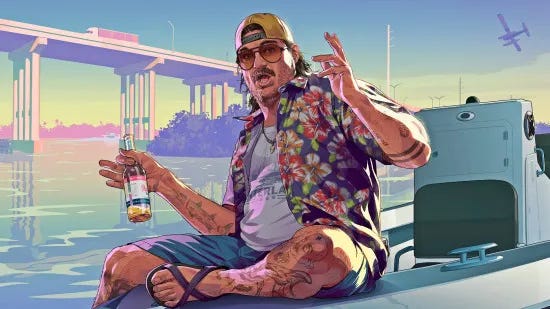
Grand Theft Auto VI has leaked before. In 2022, a teenager broke into an internal Slack channel and posted more than 90 clips of unfinished development footage. This time is different. This time the leaker has a manifesto, a countdown clock, and a cryptocurrency token trading on Solana.
The leaks started August 18, when a website calling itself Cyberleek posted two gameplay clips and a claimed full map of Leonida, GTA VI’s setting, nine days ahead of Rockstar’s own Netflix reveal. Domain researchers on Reddit found the site’s infrastructure registered as early as August 14, four days before the first clip went public. That is not the behavior of someone who stumbled onto a leaked build. That is a launch plan.
The clips kept coming. A basketball animation. A hypercar chase. A scene where the player shoots the word “LEEK” into a wall with gunfire, proof to fans that whoever holds this footage has hands-on access to a playable build, not just stolen video files. Fourteen leaks landed in eight days, some routine, one explicit enough that outlets covering it had to warn readers before the embed. Each one carried a watermark pointing back to a website selling a $CYBERLEEK token. Six hours after the group’s most attention-grabbing clip went live, that same website added a “Contact” page offering paid advertising slots and footage requests, with a starting price of 400 XMR to open the conversation, close to $160,000 in Monero.
That detail matters more than the manifesto does. Cyberleek’s “Edict,” the document accompanying the leaks, lists three “commandments” for the industry: no digital pre-orders, no single-player content locked behind a paid edition when it already exists in the base game’s files, and mandatory offline access for single-player games when a publisher shuts down its servers. “Preorders were not created for gamers,” the manifesto reads. “They were created because physical discs had manufacturing limits... A digital copy cannot sell out.” It closes with a threat to the rest of the industry: “If CYBERLEEK can reach Rockstar, no one is safe.”
Whoever wrote that also wants you to buy a memecoin to fund an unspecified “secret project.” PC Gamer called the irony of preaching consumer rights while running a crypto pump “perhaps unintentional.” It reads more like the point.
Rockstar and parent company Take-Two responded through the courts. A New York federal judge approved subpoenas against Microsoft and Discord on August 20, ordering both companies to hand over account records tied to suspected Cyberleek identities, with a September 4 deadline attached. Cyberleek answered by posting two more leaks. The identity behind the account remains unconfirmed.
None of this happens in a vacuum, and that’s what gives the manifesto its audience even with the crypto grift attached. GTA VI ships November 19 after two delays, the first from Fall 2025 to May 2026, the second from May to November, both explained by Rockstar as necessary polish time. The base game costs $80. The Ultimate Edition costs $100, and Sensor Tower estimates 89% of pre-orders are for the pricier version, a figure Take-Two hasn’t confirmed but hasn’t disputed either. The “physical” edition contains no disc. Buyers get a box with a printed code inside, redeemable once and then locked to a single PlayStation or Xbox account. Two independent retailers, including the Canadian chain Video Games Plus, announced they won’t stock it at all. Rockstar has hinted a real disc release might follow “months” after launch. Sony, separately, confirmed in July it will stop producing PlayStation discs for new games entirely starting in 2028, a decision that landed one week after the GTA VI disc backlash peaked and that fans immediately connected to it.
Add up the pieces and Cyberleek’s commandments describe a real set of grievances even if the messenger is running a coin scheme on top of them. Publishers have spent years training players to pre-order digital goods that can never sell out. Rockstar is charging more for content that fans suspect already exists in the base game’s data. And the industry’s disc-based ownership model is ending in real time, with GTA VI as one of the last major releases to even pretend otherwise.
Rockstar’s Extended Look premieres on Netflix Thursday, the marketing moment the studio has been building toward for months. It now arrives after eight days of unauthorized footage, a federal subpoena fight with no resolution, and a consumer-rights manifesto wrapped around a crypto token, all competing for the same headline space Rockstar wanted for itself.
How does a studio that delayed its own game twice for “polish” end up here, watching someone else control the story nine days before its biggest reveal?
NEXT: Naughty Dog Is Sitting on a Time Bomb, and Yellowflash Is Calling It
Coporatization ruins gaming.
Every single time.
The grift isn't in memecoin guy, it is in an industry poised to ensure they no longer have to pay a to press discs or distribute their title and, thus, they can maintain prices longer at whatever level they want for as long as they want.
For example: I recently checked out Star Wars Monopoly. Digitally, the game has been our for a long time.
Playstation store? $30
Nintendo Digital Store? $30
Xbox? $30 (though it is part of Game Pass)
A physical copy of the Switch 1 version? $5 if you want to risk Facebook Marketplace. Or $15 on Amazon. The Switch 2 version is one of those tricksy cards (which etches the license but has no content) but even that was only $25 on Amazon.
No competition = prices never have to be competitive.
Also, and I don't want to get off on a rant here but...
What follows is a long essay you don't need to read and is only tangentially related to the article in that it shows some specific ways the BIG game and platform shysters perform their magic trick of not increasing prices (till recently) and why, all of a sudden, they can't have discs.
People keep saying that game prices haven't kept up with inflation, but that is only if you look at sticker price compared to inflation. But that's because even without increasing prices companies have found ways to multiply the revenue from any particular product.
While pretending to be angels who only marginally raised prices, they're printing dollars at the expense of the customer; and most don't even know or care.
1) Digital distribution - No middleman
We all know this one.
Not having to pay a cut to a manufacturer, distributor, and retailer has put big $$$$ back into the pockets of companies. Even after paying a licensing fee to the platform holder most companies are still making 20% more off every digital title.
As an aside, this is one reason Sony is retreating from Steam: they didn't like having to pay a cut to Sir Gabe.
2) Pre-order incentives - They've locked you in!
Guaranteed revenue from the moment of announcement, which some companies slosh around in their accounting department depending on how the books are looking and how soon they have to report earnings...
If this is for a physical product the company can extrapolate how many discs they may need to press and prevent too many copies from gathering dust in warehouses. Not full proof math but a ballpark is better than grossly over printing.
And the pre-order incentives or digital incentives for deluxe collectors editions are BANK. It is almost as good as free money. It takes a Sr Artist almost no time to whip up a new texture for a different weapon or character skin. Maybe a little longer if they have to wait for some modeler to change geometry.
A digital soundtrack? You've already got them you just need to get the MP3s on the platform so they can be downloaded and played.
The digital artbook? Every studio and pretty much every team member has some scrap of something hanging around. Just collect those into a "book" and you are done.
This could take a week of effort by an intern, production coordinator, or associate producer.
In exchange for a one time investment into a minimal amount of labor the company gets to charge a 25% or so premium for the "Deluxe" edition. Those extras quickly amortizes those costs and starts turning into its own profit center.
And let's not even talk about Microtransaction cosmetics. Good lord, I know of a game that made almost as much revenue on weapon and character skins as the revenue from the actual game.
3) The 25 year campaign to turn "Expansions" into "Paid DLC", or "PDLC", or "$DLC", especially as it relates to season passes, or content that is promised in the future. For a HIGH premium, usually $30 - $50, players who pre-order with the season pass or the collector's edition are given extra content. Usually, the earlier you buy it the better the "deal" (though wait a few years and the deals look a lot better).
In the oughts, the big players starting looking at game play telemetry and found that popular games usually had double, triple, or greater numbers of unique players than the number of game copies sold. The culprit was identified as low expansion attach rates along with used game sales.
Attach on expansions was always pretty low, like 15% on average with 30% being exceptional. So the companies tried to solve the problem on how to fudge the attach rate numbers, to make themselves and the product seem more popular than it was, while also converting these phantom players into revenue producers.
Enter the Season Pass which slowly displaced the official concept of an "Expansions" in favor of some form of DLC. This has three main benefits:
a. The content is usually incredibly cheap to produce. Usually a rounding error for the revenue from a AAA or AA game.
Not only does this save a ton of money on the marketing and distribution side of things, but it also obligates the player to keep that copy of the game and not trade it in or loan it out. And since used copies can't be sold "complete" since DLC sticks with the first player, the new owner would have to purchase the DLC, disincentivizing used game sales.
So, no only do the companies lock in the initial player for what is usually a 30-60-90 cycle, long enough to get past peak sales territory, but they potentially get to double dip and profit when someone opts for a used copy instead of a sealed box.
So game companies have been raking in the money all the while crying out "We are still the same price we were 20 years ago so we need a huge price increase!"
What a joke.