


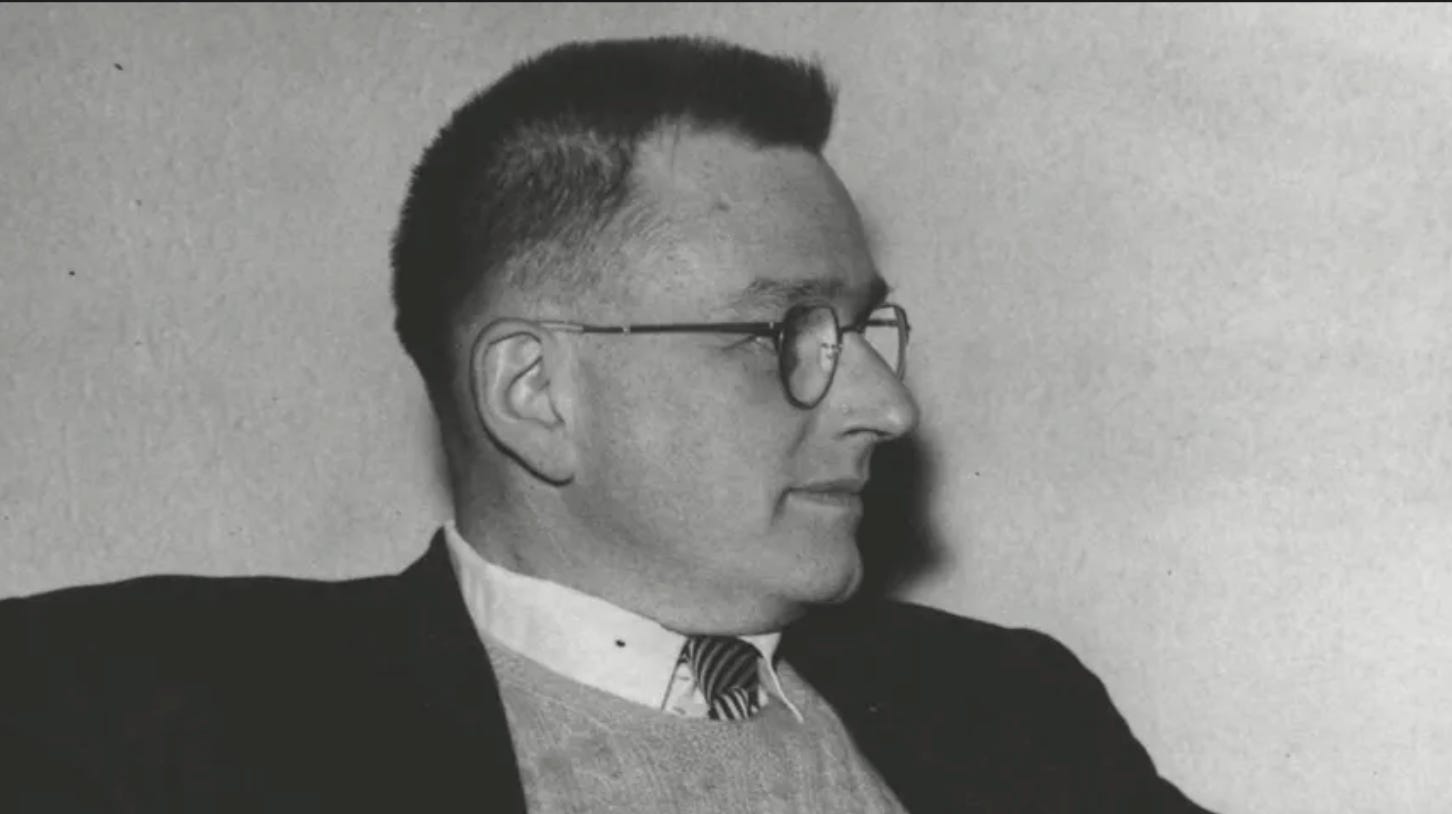
The John W. Campbell Letters, Volume I gathers the correspondence of John W. Campbell, Jr., who edited Astounding Science Fiction, later renamed Analog, from late 1937 until his death in 1971. Editors Perry A. Chapdelaine, Sr., Tony Chapdelaine, and George Hay assembled the 610-page paperback in 1985 from letters Campbell wrote to or about 283 science fiction writers and scientists across four decades. A second volume followed in 1993, focused specifically on his exchanges with Isaac Asimov and A.E. van Vogt.
Campbell is generally credited with building the Golden Age of Science Fiction almost single-handedly. Isaac Asimov, in his autobiography, credited Campbell as the dominant force in the field for the first decade of his editorship. Before he became an editor, Campbell wrote his own fiction, first under his own name and later under the pen name Don A. Stuart, including “Who Goes There?”, the 1938 novella that became the basis for John Carpenter’s The Thing. Once he took over Astounding, he largely stopped writing and turned his attention to the writers who would define the field for the next thirty years. Robert Heinlein, Isaac Asimov, L. Sprague de Camp, Theodore Sturgeon, A.E. van Vogt, and Hal Clement all passed through his door, and in many cases through his editorial red pen, on their way to becoming the names science fiction still measures itself against.

One letter shows exactly what that editorial pressure looked like at full force. In March 1959, Campbell wrote to Robert Heinlein’s agent, Lurton Blassingame, rejecting an early draft called “Starship Soldier,” the manuscript that would later become Starship Troopers. Campbell’s objection was not political squeamishness about the book’s militarism. It was a craft argument, rooted in a rule he considered a founding principle of the kind of science fiction he had spent two decades building: “Don’t tell the reader about the background; let him gather it from what happens.” Heinlein’s draft violated that rule directly, laying out its politics in what Campbell called direct, multi-page “preachments” rather than letting the reader arrive at the ideas through the story itself. Campbell went further, arguing that fiction persuades precisely because it never announces its conclusions, comparing the technique to parables, and noting that a skilled author could make a reader feel genuine sympathy for a committed Nazi if the story stayed inside that character’s head without editorializing. He then spent several more paragraphs disputing Heinlein’s actual thesis, that any two living organisms sharing a universe are doomed to physical combat, arguing instead that higher forms of competition had already replaced war as the most efficient way species out-compete one another. It is a strange letter to read today, an editor best remembered by his critics for a right-leaning editorial stance arguing at length that humanity was outgrowing warfare, on craft grounds, while rejecting the novel that became one of science fiction’s most famous defenses of the military.
The correspondence with A.E. van Vogt reveals a different habit. In a 1942 letter, Campbell laid out a full theory he called “socio-technical pressure,” an attempt to explain when and why civilizations expand into new territory, using the Viking failure to colonize North America around 1000 A.D. and the later success of European colonization as data points, and predicting a lunar landing by 1965 and a Mars landing by 1970. Campbell built the theory entirely on his own authority, addressed to one of his writers as a working assumption for future stories rather than a hypothesis to be tested. It is the same instinct that made his hard science arguments so sharp turned loose on a subject with no hard data to constrain it, and it captures why his forays into psychology and sociology struck contemporaries and later reviewers alike as confident well past what the evidence supported.
Campbell’s rejection letters could be shorter than his theorizing. One begins, in full: “Sorry, you can’t write this story. Neither can anyone else.” Isaac Asimov later described arguing with him as something like meeting a stranger who, on learning that the person he is speaking to is the world’s leading expert in a given field, proceeds to lecture that expert on the subject for five hours, getting every fact wrong, and somehow leaving the expert unable to win the argument anyway.
Campbell’s confidence in his own theorizing extended past editorial notes and into causes with no scientific backing at all. He spent years promoting Dianetics after publishing L. Ron Hubbard’s original 1950 article on the subject, and one letter in the collection has Campbell claiming credit for suggesting to Hubbard that Dianetics “should be dropped as a psychotherapy, and reconstituted as a religion.” He gave the same enthusiasm to psionics, a term he coined himself, and to a supposed reactionless propulsion device called the Dean Drive that never worked. Campbell wanted a hard science answer to the mind the same way he wanted one for faster-than-light travel, and when actual science could not supply it, he built his own.
The Heinlein relationship cooled over exactly this kind of friction. In a 1963 letter ranking the field’s most consistent writers, Campbell judged Heinlein’s pre-1955 fiction brilliant and everything after distinctly weaker. Heinlein, writing to his own agent that same year, described submitting to Campbell as an exercise in absorbing pages of blunt insult explaining what was wrong with a manuscript, and said he found other magazines more pleasant to deal with by comparison. The two men had been close collaborators in the early 1940s. By the 1960s they were trading complaints through third parties.
The collection asks something of its reader that most anthologies do not. The Starship Troopers letter means little without knowing Heinlein, the novel, and the argument over war it eventually became famous for. The same holds for exchanges touching on Dune, on Asimov’s Foundation stories, or on any of the dozens of other writers scattered through 283 names. A reader unfamiliar with the field’s history will find a stack of old letters. A reader who already knows the writers and the books will find the working notes behind half the science fiction canon, in the words of the man who edited it into existence.
Campbell did not just publish the Golden Age. He argued it into being one letter at a time, badgering, correcting, and provoking writers who went on to define modern science fiction, in many cases before those writers had proven they could carry the weight he put on them. How much of that credit belongs to Campbell rather than to the writers themselves is a debate that has run since he was alive to argue his own side of it. What does the record in these letters settle, and what does it leave open?
First contact with the Oridians was supposed to be humanity’s proudest moment. Instead, their chief engineer is dead, their ship is sabotaged, and an ancient alien technology is stealing souls. Book one of the Valiant Frontiers series delivers exploration, mystery, and the kind of crew you’ll want to follow across the galaxy. Read The Soul Catcher on Amazon and start the adventure.
This is a really illuminating glance at an important SF figure. The books sound well worth reading. His posthumous cancellation by the freakshow brigade is truly outrageous.