



Most science fiction readers know one thing about James Blish. If they came up in the 1970s, they know he wrote the Star Trek books. Every episode of the original series adapted as a short story, twelve mass-market paperback volumes from Bantam, sold in every airport and drugstore for a decade. For an entire generation of fans, Blish’s adaptations were how Star Trek existed between reruns.
Almost nobody remembers the other things.
James Blish won the Hugo Award for Best Novel in 1959. He wrote one of the foundational Catholic-themed SF novels of the twentieth century, taught alongside A Canticle for Leibowitz whenever anyone teaches the subject seriously. He wrote a four-book future history, the Cities in Flight sequence, that stands as one of the great pessimistic space epics of the mid-century. He coined the term “gas giant.” He was one of the two or three most influential SF critics of his generation. He helped found the Milford Science Fiction Writers’ Conference, SFWA, and the UK’s Science Fiction Foundation. He did all of this while working a day job in advertising copy and then dying at fifty-four.
Then he mostly vanished from the conversation. The Star Trek books drifted out of print. The Hugo winner became a footnote. The catalog is still there. Almost nobody talks about it.
The Futurian and the Zoologist
Blish was born James Benjamin Blish in East Orange, New Jersey, on May 23, 1921. He was a science fiction fan first. In high school he self-published a fanzine called The Planeteer on a hectograph, running it for six issues, and joined the Futurians in New York City, the seminal fan group that also produced Isaac Asimov, Frederik Pohl, Judith Merril, Damon Knight, and Cyril Kornbluth. His first published story, “Emergency Refueling,” appeared in Super Science Stories in 1940. He sold it to fellow Futurian Frederik Pohl, who was then the editor.
Blish trained as a biologist. He took his bachelor’s in zoology from Rutgers University in 1942, served in the U.S. Army from 1942 to 1944 as a medical laboratory technician (discharged, according to at least one source, for refusing an order to clean out a grease trap), then went to Columbia University for graduate work in zoology. He left in 1946 without a degree. The science background matters. Blish’s fiction is rigorously biological in ways that most 1950s SF was not. His pantropy stories, his aliens, his invented physiologies all reflect a man who understood how living systems actually work.
After Columbia he went into public relations. He worked as science editor for Pfizer, the pharmaceutical company, and later wrote advertising copy for various pharmaceutical and tobacco accounts. He did not become a full-time writer until 1968. Most of his major work was produced in the margins of a day job.
His first marriage was to fellow Futurian Virginia Kidd, the writer and literary agent, from 1947 until their divorce in 1963. His second marriage, to the artist Judith Ann Lawrence, lasted from 1964 until his death.
The Cities in Flight Sequence
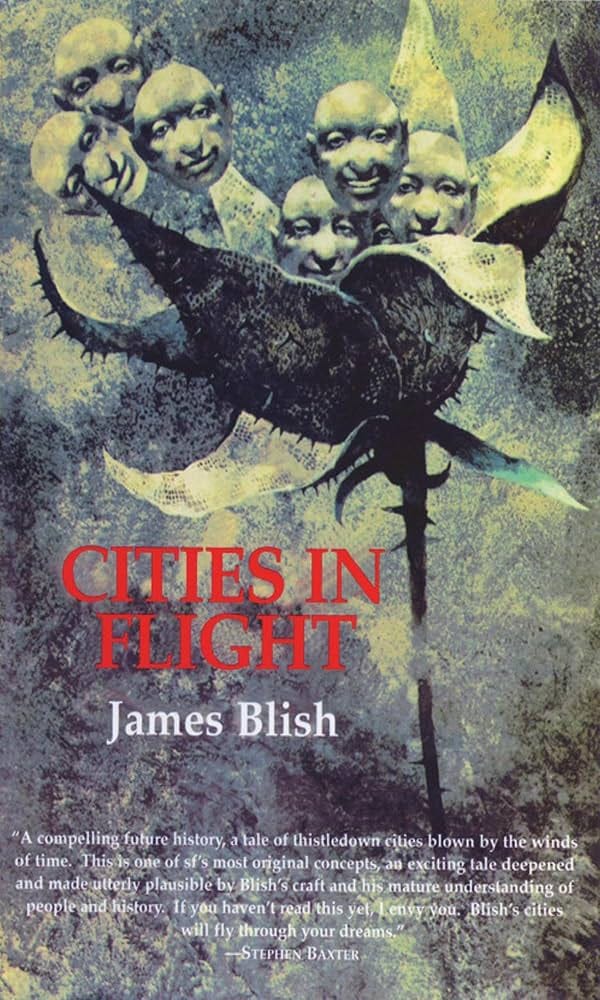
Blish’s first significant sustained work was the Okie stories, which began appearing in Astounding in 1950. The framework, powered by an antigravity engine called the “spindizzy,” involves entire Earth cities lifted whole from the planet and sent roving through the galaxy looking for work, the way Dust Bowl migrants of the 1930s wandered the American West looking for jobs. Manhattan is one of the cities. The mayor, John Amalfi, is the protagonist across most of the sequence.
The four novels that make up the sequence — They Shall Have Stars (1956), A Life for the Stars (1962), Earthman, Come Home (1955), and The Triumph of Time (1958) — were finally collected as Cities in Flight (1970) in internal chronological order. The premise sounds like space opera. The substance is not. Blish was reading Oswald Spengler’s The Decline of the West throughout the composition, and the whole sequence is a working out of Spengler’s thesis that civilizations rise, mature, calcify, and die in observable cycles. The Cities in Flight books track that arc across cosmic scale. The Triumph of Time ends with the death of the universe in the year 4004 and the birth of the next one, with Amalfi himself becoming the underlying structure of the new cosmos.
Nothing else in 1950s American SF ends quite that way. Blish’s pessimism was real, his historical reading was serious, and his willingness to follow the logic of his premises to their end without flinching produced fiction that treats the reader as an adult. The pulp-adventure surface of the Cities in Flight books hides a genuinely bleak philosophy of history underneath, and the tension between the two is what makes them last.
A Case of Conscience

The novel most worth revisiting is A Case of Conscience (1958), which won the Hugo Award for Best Novel in 1959. The original novella version, published in If in 1953, later took a Retrospective Hugo for Best Novella in 2004.
The premise is precise. In 2049, a four-man team of scientists is sent to the planet Lithia to determine whether it should be opened to human contact. The team includes Father Ramón Ruiz-Sánchez, a Peruvian Jesuit who is also a biologist and biochemist. Lithia is inhabited by intelligent bipedal reptilian beings who have built a utopian society. No crime. No conflict. No poverty. No dishonesty. No word in their language for war, or lie, or theft. And no religion of any kind. The Lithians have arrived at Christian ethics without Christ, at moral behavior without moral theology, at virtue without grace.
Ruiz-Sánchez concludes that Lithia is a work of the Devil. His reasoning is careful and, from a Catholic perspective, deeply troubling. If a society can produce peace, logic, and understanding in the complete absence of God, then it stands as a living argument that human beings do not need God to be good. Ruiz-Sánchez lists his objections point by point. He calls for maximum quarantine of the planet. The other scientists reach different conclusions. The physicist Cleaver wants to strip-mine Lithia for lithium to build nuclear weapons. The team returns to Earth divided.
What makes the novel remarkable is not the setup, which many first-contact novels have used since. What makes it remarkable is that Blish takes the theological problem seriously. Ruiz-Sánchez’s Catholic worldview is not a straw man to be knocked down. His faith is not treated as embarrassment or as ideology. It is presented as the operating framework of a genuinely intelligent man doing his best to make sense of something the Church’s existing categories were not built for. Blish drew a foreword into later editions in which he mentions he received the actual Vatican policy on contact with extraterrestrial intelligences (the policy addressed the questions of whether such beings might lack immortal souls, or possess them and be fallen, or possess them and remain in a state of grace).
The novel’s title is itself a Catholic theological term. A “case of conscience” is a technical term in moral theology, meaning a difficult ethical situation requiring the exercise of prudential judgment. The novel is asking the reader to make one alongside the priest.
Blish himself was not a Catholic. He was, at best, an agnostic humanist who had studied biology and Jung and Spengler and was skeptical of institutional religion. That fact makes the achievement of A Case of Conscience more interesting, not less. Blish did the reading. He treated the material with the seriousness a Catholic novelist would have brought to it. Br. Guy Consolmagno, S.J., the current director of the Vatican Observatory, has argued that the theology in the novel is not actually Jesuit theology, and that Ruiz-Sánchez’s conclusion (that Lithia was created by the Devil) is itself the Manichaean heresy, which any Jesuit would recognize and reject. Blish anticipated this criticism. His response was that the theology is that of a future Church, not the present one, and that he set out to write about “a man, not a body of faith.”
Reasonable Catholic readers will disagree about how well the theology works. What is beyond dispute is that A Case of Conscience takes Catholic thought seriously as an intellectual framework capable of engaging science fiction’s largest questions. In 1958 that was almost unprecedented in the genre. It sits on the short shelf of foundational Catholic-themed SF alongside Walter M. Miller Jr.’s A Canticle for Leibowitz (1959) and Anthony Boucher’s short fiction. Mary Doria Russell’s The Sparrow (1996) is unimaginable without it.
The novel is also the first book of Blish’s After Such Knowledge trilogy, a thematic sequence unified by (as Blish put it) “a questioning of the ethical validity of secular knowledge.” Doctor Mirabilis (1964) is a historical novel about the thirteenth-century English philosopher and Franciscan friar Roger Bacon. Black Easter (1968) and its sequel The Day After Judgment (1971), which Blish considered a single work, treat black magic and the end of the world with the same theological seriousness. Together these books make up one of the strangest and most substantive religious sequences in modern SF.
The Star Trek Adaptations

In 1967, Bantam Books commissioned Blish to adapt individual Star Trek episodes into short-story form. He had never seen the show. He was not particularly enthusiastic about the assignment. He took it because the money was steady and he needed the income.
Across the next decade he adapted every original series episode into a short story with only a handful of exceptions (”Shore Leave,” “And the Children Shall Lead,” and the Harry Mudd episodes which he was holding back to adapt as a novel that his cancer never let him finish). The stories were collected into twelve mass-market paperbacks published from 1967 to 1977. His declining health during the late run meant that Judith Ann Lawrence quietly wrote or completed several of them uncredited. She received her first cover credit on Star Trek 12, published two years after Blish’s death. She later completed the Harry Mudd adaptations as Mudd’s Angels (1978).
The adaptations were based on early draft scripts rather than the aired episodes. That is why longtime fans notice small differences from what appeared on screen. “The City on the Edge of Forever” reads closer to Harlan Ellison’s original teleplay than to the aired version. Kirk’s dialogue in several early stories runs sharper than what NBC eventually broadcast. For fans who read the paperbacks before ever seeing the episodes (as many did in the pre-VHS era), Blish’s versions are the definitive ones.
He also wrote Spock Must Die! (1970), the first original adult Star Trek novel. It launched a publishing franchise that runs to this day, several hundred novels deep. Every Star Trek novelist since is working in a market Blish opened. He credited his late-career financial stability to the Star Trek commission.
The tragedy of the arrangement is that many casual readers came to think of Blish as the Star Trek guy. That designation is not wrong. It is also not the whole story, and it is not even the interesting part.
William Atheling Jr. and the Critical Work
Under the pen name William Atheling Jr. (an homage to Ezra Pound, who had used the name for his own music criticism), Blish wrote some of the most influential science fiction criticism of the mid-century. His two major collections, The Issue at Hand (1964) and More Issues at Hand (1970), are still consulted by anyone serious about the history of the field. He judged SF by the standards applied to literary fiction. He took writers to task for bad grammar, sloppy scientific reasoning, and lazy plotting. He named names.
Along with Damon Knight, Blish essentially invented modern SF criticism as a discipline. Both men understood that the genre would never be taken seriously by anyone outside it until its practitioners started taking their own craft seriously. Blish’s essays are direct, well-argued, and often unsparing. They made him enemies and cost him nothing.
He was also a working institution builder. He helped found the Milford Science Fiction Writers’ Conference with Damon Knight, Judith Merril, and Virginia Kidd in 1956, which became the model for every subsequent SF writers’ workshop including Clarion. He helped found SFWA. He helped found the UK’s Science Fiction Foundation after his move to England in 1968. The genre’s professional infrastructure has his fingerprints on it.
The Final Years
Blish moved to Henley-on-Thames, Oxfordshire, England, in 1968, partly because he had grown weary of American publishing and partly because Judith Ann Lawrence’s roots were in the UK. He continued to write. Doctor Mirabilis, Black Easter, and The Day After Judgment all appeared during this period, as did the bulk of the Star Trek adaptations, several new novels, and a substantial critical output. A special issue of The Magazine of Fantasy and Science Fiction was devoted to him in 1972.
He had already survived a diagnosis of tongue cancer in the early 1960s. In the mid-1970s he was diagnosed with lung cancer. He kept working. According to the Science Fiction Encyclopedia, his final essay, written on his deathbed, was on Spengler and science fiction. He died on July 30, 1975, at fifty-four years old. He is buried in Holywell Cemetery, Oxford, not far from Kenneth Grahame, the author of The Wind in the Willows.
He was inducted posthumously into the Science Fiction and Fantasy Hall of Fame in 2002.
Why He Matters Now
Blish is the writer’s writer nobody quite knows how to place. He was too intellectually serious for pulp readers, too intertwined with mass-market Star Trek for the literary crowd, too pessimistic for the space-opera fans, too demanding for the beach-read market. The pieces of his career fit awkwardly together, which is part of why the mainstream conversation has never quite figured out what to do with him.
But look at what he did. He wrote the Catholic first-contact novel that everyone since has been either building on or arguing with. He wrote a four-book future history driven by Spengler’s philosophy of history that still reads as a serious work of cosmological pessimism. He invented, along with Damon Knight, the practice of taking science fiction seriously as literature. He opened the door for the entire Star Trek publishing industry. He helped build the professional institutions that every working SF writer in the English-speaking world benefits from.
The indie and crowdfunded SF space rebuilding the intellectually serious end of the genre has been reaching back to writers like Blish for its models, even when it does not name him. The Catholic SF renaissance quietly underway in the past decade has A Case of Conscience as its taproot, whether the current wave of writers know it or not. Mary Doria Russell reached back to him. John C. Wright has cited him. Every priest who shows up in a first-contact novel written since 1958 owes a debt to Ramón Ruiz-Sánchez.
If you have never read A Case of Conscience, that is where to start. The theology is arguable. The moral seriousness is not. If you have read the Star Trek books and never gone further, Cities in Flight is the next stop, and The Seedling Stars after that. If you want to see how a serious critic worked in the field, The Issue at Hand is still in print in various forms.
He died at fifty four years old, robbing the field of a legend before his time.
First contact with the Oridians was supposed to be humanity’s proudest moment. Instead, their chief engineer is dead, their ship is sabotaged, and an ancient alien technology is stealing souls. Book one of the Valiant Frontiers series delivers exploration, mystery, and the kind of crew you’ll want to follow across the galaxy. Read The Soul Catcher on Amazon and start the adventure.

NEXT: Larry Correia Says George R.R. Martin Killed an Entire Generation of Epic Fantasy Authors
Great piece. Thank you!
"Remember Talos IV-!"
As a kid in the 70s, I enjoyed the Star Trek adaptions. Cities in Flight blew my mind.