



The allegation has haunted Star Trek: Deep Space 9 since its 1993 premiere. Did Paramount steal J. Michael Straczynski’s concept for Babylon 5 and produce a competing series designed to kneecap his show before it launched? Three decades of internet arguments, forum wars, and YouTube videos have treated this accusation as settled fact. YouTuber Razorfist, in a characteristically aggressive deep-dive, systematically destroys every pillar supporting the plagiarism claim.
“I’ve been covering Star Trek Deep Space 9 longer than the show is on the air,” Razorfist opens. “But even before all that, one narrative remained pervasive in the most noxious, nerdy tracts of the interwebs. Did you know DS9 ripped off Babylon 5?”
The allegation runs as follows: in or around 1989, Straczynski approached Paramount with a pitch for a sci-fi show set on a space station, submitting a pilot script and series bible. Paramount passed. Twenty-four months later, Deep Space 9 entered development. Straczynski noticed similarities and went public with his suspicions, suggesting an unnamed executive had accessed his materials and quietly guided DS9’s development without informing producers Michael Piller and Rick Berman.
Straczynski himself has been careful to avoid directly accusing Piller and Berman. His own website states he didn’t believe the producers “had stolen the idea outright.” His speculation focused on executive-level interference: “Okay, open the file drawer. Let’s take a peek at what they’re going to do. We won’t copy it exactly, but knowing what they’re doing will allow us to co-opt a little of their franchise, enough to cut them off at the knees in the marketplace. We won’t tell Burman or Pillar about this because they would never go along with it, but we’ll just guide them here and there.”
Razorfist identifies the named executive as Brandon Tartikoff, one of Hollywood’s most celebrated television executives, responsible for greenlighting Seinfeld, Miami Vice, Cheers, Saved by the Bell, Knight Rider, and The Cosby Show. Tartikoff’s first move upon becoming CEO of CBS and Paramount was pitching an all-new Star Trek show to his creative staff. The problem with Straczynski’s conspiracy theory becomes immediately apparent when you examine the timeline.
“When Babylon 5 was being pitched to Paramount in 1989, Brandon Tartikoff didn’t work for them,” Razorfist notes. “In fact, at the only time he might have been made aware of the existence of a Babylon 5 bible, he was at that very moment working for Paramount CBS’s direct competition NBC, not becoming chairman of Paramount until July of 1991, over a year and a half after J. Michael Straczynski admits his series bible had been returned to him already.”
This single fact collapses the conspiracy’s architecture. For Straczynski’s version of events to hold, outgoing Paramount chairman Frank Mancuso would have needed to photocopy a series he rejected and pass it to Tartikoff—who was simultaneously working for NBC, Paramount’s direct competitor—on his way out the door to sue Paramount for breach of contract. “Would outgoing chairman Frank Manuso have photo copies made of a series he didn’t think was good enough to produce to begin with?” Razorfist asks.
The plagiarism case received apparent confirmation in 2013 when IO9 published a Babylon 5 retrospective. A commenter identifying himself as former Warner Brothers publicity employee Steven Hopstaken claimed Warner Brothers and Paramount had been planning a joint television network, that both companies agreed DS9 would launch the network, and that “I was told they purposely took what they like from the B5 script and put it in the DS9 script.”
Straczynski linked to the comment with the word “Interesting,” effectively endorsing the accusation. The story spread across IGN, Newsarama, and dozens of other outlets.
Razorfist identifies the fatal flaw immediately. “J. Michael Straczynski’s entire claim hinges on the idea that Paramount and Warner Brothers were in the process of collaborating on launching a new television network together.” Not only did this joint network never exist—Warner and Paramount launched competing networks within two years of DS9’s premiere—it would have been illegal. “Those laws, the ones that would have even allowed UPN and WB to exist at all, didn’t get voted on and passed until 1993, several months after DS9 debuted. So either two Titanic networks were working on a joint venture federal law forbade, pissing away millions in the process on a TV channel that never launched, or for the 500th damn documented time, J. Michael Straczynski is once again lying.”
The specific similarities Straczynski cited don’t survive scrutiny either. His primary complaints: both shows are set on space stations, both stations are near wormholes, both have numbers in their titles, and both feature shapeshifters.
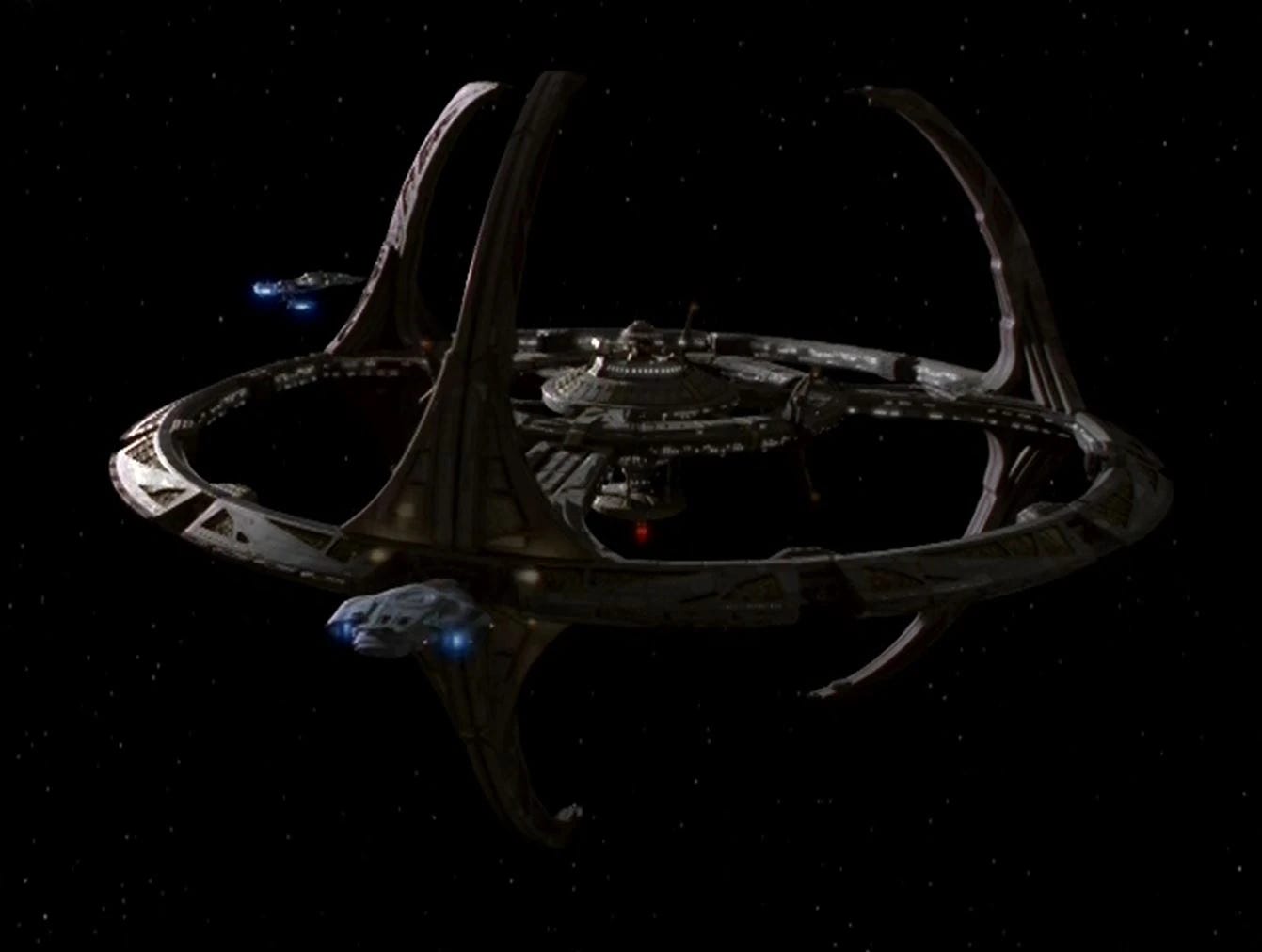
DS9 didn’t begin as a space station concept. Production designer Herman Zimmerman confirmed the show evolved from a colony on a planet, then a floating landmass, then a mining colony inside an asteroid before becoming a space station. “It seemed we had a choice between doing another spaceship, doing a space station, or doing a colony on another planet,” producer Rick Berman explained. “And we actually explored the colony idea for quite a while. I think we even had some sketches made of what it might look like.”
Razorfist notes the blade cuts both ways: “In the original series bible for Babylon 5, the station wasn’t even near a wormhole. By your flawed logic, did they therefore rip off DS9?”
The wormhole similarity collapses further when you examine Star Trek’s own history. The concept appeared prominently in multiple Next Generation episodes and the original 1979 Star Trek motion picture. TNG’s season two episode “The Price,” which aired November 3rd, 1989—simultaneous with Straczynski’s Paramount pitch—already featured a stable wormhole as a centerpiece of commerce and military strategy.
The numbered title similarity earns particular contempt from Razorfist: “Gene Roddenberry must have had a wicked premonition back in 1967 that a 13-year-old J. Michael Straczynski was going to dream up that idea because the space station featured in the Trouble with Tribbles episode was Deep Space K7. So I bet you buy some Deep Space K7 and jam your fakey plagiarism allegation up your ass, J. Mike.”
The shapeshifter argument fares no better. TNG’s season six episode “The Chase” introduced a featureless progenitor race in 1993, while the season two episode “The Dauphin” from 1989 introduced the Allasomorphs—a prototype changeling race. Both predate any alleged copying.
Perhaps the most damning evidence against the plagiarism theory comes from Babylon 5’s own creative team. In a 1995 SFX magazine interview, Babylon 5 CGI director Ron Thornton described the show’s White Star vessel as being like “The Defiant on DS9.” When the reporter asked if he was allowed to say that, Thornton replied simply: “I’ll say what I want.”

“One of the most obvious, actual, and only outright proven examples of a ripoff between the two shows to date,” Razorfist observes. “But unfortunately for your hastily stapled together narrative, it’s not the Star Trek creative team, but Babylon 5’s who admitted to ripping off the USS F*** Around and Find Out.”
Nearly three decades of opportunity for DS9 insiders to confirm the plagiarism story have produced nothing. Writers, directors, actors, and producers who survived Paramount’s multiple bankruptcy scares, the Moonves scandal, and the firing of Berman’s entire creative team—people with every incentive to expose corporate wrongdoing—have said nothing. Ronald D. Moore, when asked about DS9’s long-form storytelling being “like Babylon 5,” replied: “We’re just doing the show the way we want it.” Showrunner Ira Steven Behr stated: “We were too busy to watch other TV shows, let alone copy them.”
Razorfist frames his conclusion as a defense of Babylon 5 rather than an attack on it. “Babylon 5 is so damn good, it doesn’t need internet lies to improve it. It stands just fine all on its own as a towering achievement to television and one unremittingly influential in its own medium.”
His frustration targets fans who perpetuate the myth: “For the past 20 years, every online discussion about this banging ass series has come with a cringy ass compulsory interlude featuring a ludicrous plagiarism accusation about being ripped off by a rival TV show. It ain’t Star Trek or CBS who’s keeping this killer series in Cisco’s shadow. It’s you.”
The plagiarism narrative has persisted because it satisfies a particular kind of fan grievance—the belief that a beloved underdog was sabotaged by corporate giants. Babylon 5’s genuine achievements in long-form storytelling, CGI innovation, and narrative ambition deserve recognition on their own terms. Tying those achievements to an unproven conspiracy theory about DS9 diminishes both shows while keeping a three-decade argument alive that the available evidence simply doesn’t support.
What do you think about the DS9 and Babylon 5 plagiarism debate?
If you’re tired of sanitized reboots and craving a fresh, no-holds-barred academy adventure that actually respects heroism and exploration, grab this book now.

NEXT: Brandon Sanderson Shares New Details About His ‘Mistborn’ Film
I enjoyed both and had or made the time to enjoy both in equal measure. When does someone say, "hey that's too much greatness. I can only handle half that amount?" Pa...lease. I wish we had too many quality sci-fi shows to pick to watch today. No. Today we get Communist Dawson's Creek Star Trek slop.
On Usenet, Robert Hewitt Wolfe admitted _one_ case where DS9 was influenced by B5: They changed the originally-planned 'Gray Order' to 'Obsidian Order' to avoid sounding like B5's Gray Council.