


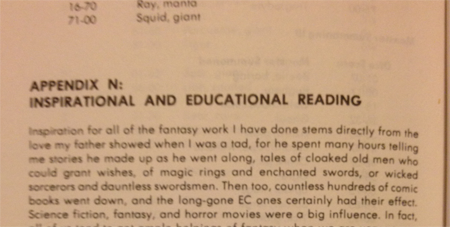
Gary Gygax built Dungeons & Dragons on a reading list. When he published the first Advanced D&D Dungeon Master’s Guide in 1979, he included Appendix N: a short bibliography of the authors and books that shaped the game. Poul Anderson. Jack Vance. Fritz Leiber. Michael Moorcock. Edgar Rice Burroughs. Roger Zelazny. A couple dozen more. These were not decorative citations. They were the source code.
Most people today have never read them.
Jeffro Johnson spent years fixing that. Starting in 2014, he worked through every author and title in Appendix N and published his analysis on the Castalia House Blog. The resulting book, Appendix N: The Literary History of Dungeons & Dragons, came out in 2017 and earned him a Hugo Award nomination. Johnson critically reviews all of the works and authors listed by Gygax, and draws a series of conclusions about the literary gap between past and present that turn out to be surprisingly relevant beyond gaming.

The book is worth your time, even if you haven’t read a single title it covers.
That’s not a hedge. Johnson writes about these books in a way that makes the argument for reading them more convincing than any back-cover synopsis could. His method is close reading with critical teeth. He doesn’t summarize plots. He digs into what makes each author distinct, what they understood about storytelling that current genre fiction tends to forget, and why those techniques produced something that felt genuinely dangerous and alive.
The picture that emerges is not flattering to the present.
Most fantasy readers have a mental model of the genre’s history built almost entirely from post-Tolkien, post-Brooks, post-Eddings commercial fiction. Epic quests. Chosen heroes. Sprawling multi-book series where the prose exists mainly to move characters between action beats. Johnson shows, title by title, that this is a recent and fairly narrow tradition. The pulp-era writers Gygax actually loved worked from different assumptions entirely.
Vance’s magic system was deliberately limited and strange, something retrieved with effort and expended with consequence, nothing like the reliable superpower mechanics that modern fantasy treats as default. Leiber’s Fafhrd and the Gray Mouser are thieves who lose, improvise, and often barely escape with their lives, not destined champions marching toward a prophesied endpoint. Moorcock’s Elric is a study in moral corruption written before the anti-hero became a genre cliché. Anderson’s “Three Hearts and Three Lions” introduced concepts that D&D absorbed so thoroughly that most players encounter them without knowing where they came from.
These weren’t minor influences. They were the imagination behind the game.
Johnson began the project in 2014 and published the first fifteen chapters that year. By the time Castalia House collected everything into one volume, the blog posts had already circulated widely enough to spark real conversation about what the genre had quietly set aside. The book didn’t start that conversation, but it organized it.
Reading Appendix N produces a particular kind of disorientation. You finish it knowing that the golden age of fantasy and science fiction was stranger, harder, and more morally complex than the sanitized cultural memory of it suggests. The writers Gygax admired were not writing comfort fiction. They were writing about failure, ambiguity, and worlds that did not arrange themselves around human convenience.
That contrast matters for anyone who cares about where the genre stands now. The books Johnson covers are not museum pieces. They’re working models of craft problems that current writers are still solving badly.
One reviewer called the book “the most important thing to happen to science fiction, fantasy, and even horror in the past three decades.” That’s a strong claim, though it’s accurate. Johnson earns it not through advocacy but through analysis. He reads carefully, argues specifically, and trusts readers to follow the reasoning.
Pick it up. Then pick up the books it talks about.
Have you read any of the original Appendix N titles? Let us know in the comments which authors from Gygax’s list hold up and which ones surprised you.
NEXT: Seven Science Fiction Series to Read While You’re Done With Star Trek
One of the few negative things about Tolkien was the way that the success of THE LORD OF THE RINGS tended to obliterate any awareness of some of the great fantasy writers that were not influenced by him.
Thank you for this. I had no idea this book existed.
Appendix N wiki:
https://en.wikipedia.org/wiki/Appendix_N
I've read a handful of these authors. Leiber, Lovecraft, and Zelazny are superb. I struggled with Moorcock a bit. I have Vance's Dying Earth series in my pile of shame.
Lin Carter's mythos work is good--haven't read much else. Derleth is far too derivative of Lovecraft, but his efforts to preserve Lovecraft's work were instrumental and he deserves credit for that.
I sadly haven't read any Howard or Burroughs in so long, decades now, that I can only vaguely nod and say they were greats, but couldn't possibly elaborate.
Of the rest, I've heard good things about some, I've at least heard of a few others, the rest are unknown to me.