


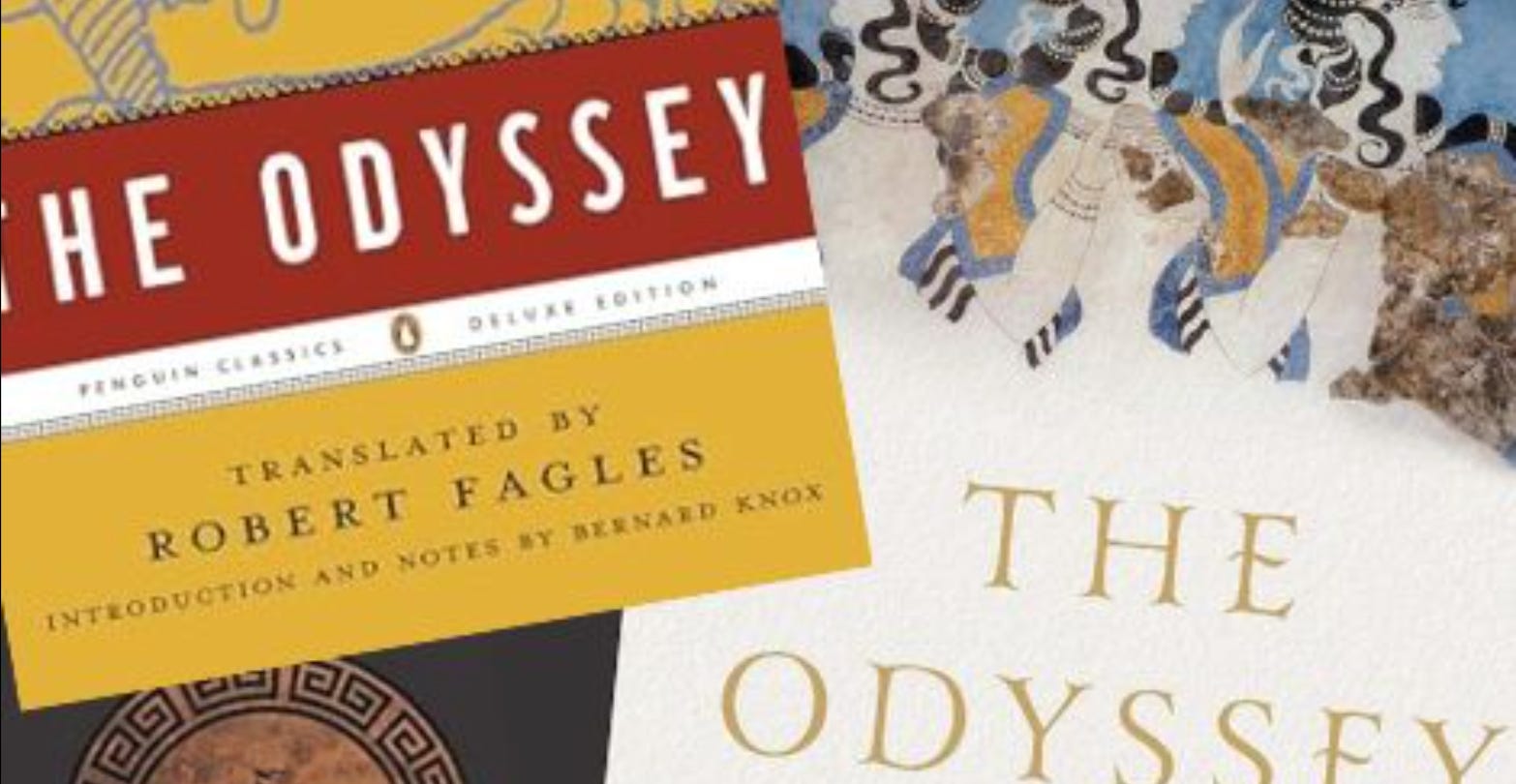
Over 60 English translations of Homer’s Odyssey exist. Most readers have no idea which one actually helps them understand the ancient Greek epic versus which ones impose modern ideology onto a 2,700-year-old text.
The translation you choose matters. Pick wrong and you’re reading a contemporary author’s politics dressed up in Homeric clothing. Pick right and you’re experiencing something close to what Homer’s original audience heard around 725 BC.
Starting Points for New Readers
Before diving into full translations, two resources make Homer accessible without sacrificing the core story.

Collier’s Junior Classics offers an excellent introduction to the Odyssey for younger readers or anyone wanting to familiarize themselves with the material first. These aren’t direct translations but carefully adapted retellings that preserve the narrative while making it digestible. Think of them as a map before the journey. You’ll understand the structure, characters, and major events without wrestling with archaic language or scholarly debates about meter.
Shakespeare’s Troilus and Cressida takes a different approach. While not a direct Odyssey adaptation, Shakespeare’s play draws heavily on Homeric material and characters. It shows how the greatest English-language writer engaged with Homer’s world. The play focuses on the Trojan War period rather than Odysseus’s journey home, but it offers insight into how classical material translates across cultures and centuries. Shakespeare’s version of these characters influenced English literature’s understanding of Homer for generations.
Both options give readers context before tackling a full translation. You’ll know the difference between Scylla and Charybdis, understand why Penelope matters, and recognize major episodes when you encounter them in verse.
The Gold Standard: Richmond Lattimore

Richmond Lattimore’s 1965 translation achieves exceptional fidelity to the original Greek. The English closely mirrors the ancient text’s content and structure. This line-for-line alignment means readers can cross-reference with commentaries and the Greek original without distortion.
Lattimore uses dactylic hexameter, the meter used in the original Greek. This gives the translation a musical quality often lost in other versions. His approach prioritizes literal accuracy over poetic embellishment.
The result can feel stiff to casual readers. But for anyone serious about understanding what Homer actually wrote, Lattimore remains the academic gold standard. His translation is widely read and technically accurate, used in undergraduate classical studies programs precisely because of its faithfulness to the source.
Lattimore’s translation preserves Homer’s repeated epithets and oral tradition roots. It echoes much of the original text’s repetition, an important feature of the poem’s origins in oral tradition. When you read Lattimore, you’re reading Homer’s structure, Homer’s word choices, Homer’s Greece.
The Readable Alternative: Robert Fagles

Robert Fagles’ 1996 translation employs a line of varying length and a diction that feels old yet familiar. The poem has gravitas without being ponderous.
Fagles strikes a balance between scholarly rigor and narrative flow. His translation sold over a million copies and became standard in many American high school curricula.
But Fagles takes liberties Lattimore never would. It freely uses imagery and word choices not closely constrained by the original text. Fagles aimed to emphasize what he called the “sympathetic” depiction of women in the Odyssey. This choice colors his translation throughout.
Fagles found a voice that is stately and natural. It avoids absurd pomposity and too-colloquial folksiness. He succeeds at making Homer readable for modern audiences. Whether he succeeds at making Homer accurate is another question.
The Classic Middleground: Robert Fitzgerald

Robert Fitzgerald’s 1961 translation held the standard position for decades before Fagles arrived. Despite expressions like “Scot-free” in the mouth of Zeus himself, which shouldn’t work, the overall effect is poignant, evocative, heroic, and true to the spirit of Homeric verse.
Fitzgerald uses unrhymed poetry with lines of irregular length. The translation prizes lyricism and beauty over word-for-word accuracy. Readers who want Homer to feel like epic poetry rather than a scholarly text often prefer Fitzgerald’s approach.
Where Fitzgerald stumbles is in modernizing language that pulls readers out of the ancient world. When Zeus says “scot-free,” you’re reading 20th century American idiom, not 8th century BC Greek culture.
The Scholarly Workhorse: Albert Cook

Albert Cook’s 1967 translation uses verse with long lines to accommodate Homer’s hexameter. Lines are stretched or compressed by one or two beats, whatever works best. It matches Homer’s verse line for line and is considered linguistically accurate but more readable than Lattimore’s hexametric verse.
Cook’s translation captures one of Homer’s most important qualities: a direct, unembellished language. For classroom use, Cook offers a middle path between Lattimore’s scholarly rigor and Fagles’ dramatic flair.
The Worst: Emily Wilson

Emily Wilson’s 2017 translation made headlines as the first complete English Odyssey translated by a woman. The achievement matters less than what she did with the opportunity.
Wilson explicitly set out to impose modern feminist ideology onto Homer. She has stated that she is “making visible the cracks in the patriarchal fantasy.” That’s not translation. That’s activism.
Wilson’s work advances a radical undertaking of erasing the old myths and writing new ones. This wouldn’t be ignoble if the process weren’t being obfuscated. But there is something brutal about taking a classic work, rewriting it against its own grain, and then passing it off as true to the original.
Wilson’s opening line translates polytropos as “complicated.” The ancient Greek word literally translates to something like “many-turned” or “many-turning.” The word is ambiguous in context. Even classicists have trouble discerning whether it describes Odysseus as passive or active.
“Complicated” is modern therapy-speak. It flattens the ambiguity of the Greek into contemporary psychological language. Wilson claims that she made this decision to better reproduce the brisk pace and emotionally engaging experience of Homer’s storytelling. The real effect is making Odysseus sound like a troubled modern man rather than an ancient hero.
Critics note the text being too modern and therefore not epic. Wilson adapts more than she translates. Her use of iambic pentameter as opposed to dactylic hexameter is a poor choice. Her characterization of Odysseus is simplistic.
The translation reflects a contemporary feminist perspective that alters the tone of Homer’s original work. Wilson didn’t translate Homer. She rewrote him for 2017 political sensibilities and called it scholarship.
Her defenders claim she’s correcting bias in earlier translations. Other scholars criticized Wilson’s translation as a deviation from the content of the original. When your translation philosophy centers on “making visible the cracks in the patriarchal fantasy,” you’ve abandoned any pretense of faithfulness to the source material.
The Wilson translation recently sparked new controversy when Christopher Nolan revealed he used it as inspiration for his upcoming adaptation. Nolan’s adaptation has already generated backlash over casting choices and its modern reinterpretation. Using Wilson’s ideologically driven translation as source material explains why.
The Verdict
For understanding the Odyssey: Lattimore first, always. His translation may feel academic, but that’s because it actually translates what Homer wrote rather than what a modern translator wishes he had written.
For enjoying the story while staying relatively close to the source: Fagles or Cook. Both make Homer readable without completely abandoning fidelity to the Greek.
For poetry that captures epic grandeur: Fitzgerald, with the caveat that you’re sometimes reading mid-century American idiom.
For first-time readers wanting to know the story before tackling verse: Collier’s Junior Classics provides an accessible foundation.
To avoid entirely: Wilson. If you want 21st-century feminist theory, read 21st-century feminist theory. Don’t read it dressed up as Homer.
What translation of the Odyssey do you prefer? Let us know in the comments.
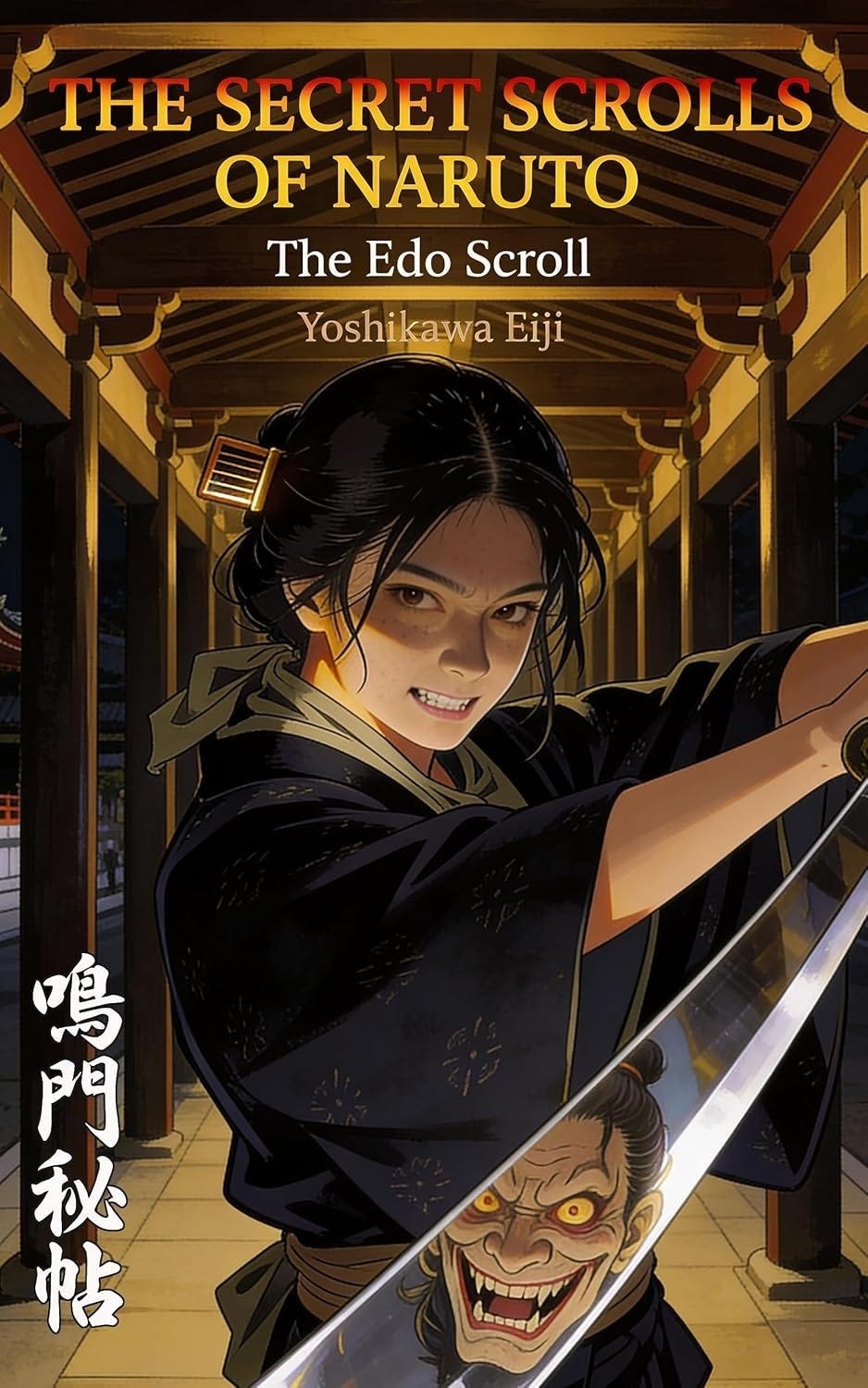
The second book of The Secret Scrolls of Naruto shifts the action from the open roads and waterways of the Kamigata to the warren of Tokugawa-era Tokyo, where the conspiracy runs deeper, the villains are closer, and nobody can be trusted. Two killers strike a deal over saké: one will murder the swordsman-monk Gennojō, the other will claim the woman he has been hunting since Osaka. Underground chambers, a great urban fire, a swordfight in total darkness on a plum-scented path, a deathbed confession that transforms a pickpocket, and a midnight ambush at Sensō-ji temple — this is the book where Yoshikawa Eiji earns his reputation as the Alexandre Dumas of Japan.
NEXT: Castalia Library Just Translated One of Europe’s Greatest Unread Novels
He's very modern and openly so but Lombardo's translation is very fun.
Thank you! I have wanted to know which translation to read.