



Supergirl opened to $37.1 million domestic and $62.6 million worldwide. Warner Bros. spent $170 million making the film and another $120 million marketing it. The studio’s breakeven sits at roughly $300-315 million worldwide. Variety now projects a final theatrical loss between $80 million and $120 million, putting Supergirl in the same financial bracket as Black Adam and The Flash, two of the biggest superhero bombs in recent memory.
Before a single ticket sold, Warner Bros. had already started lowering the bar. TheWrap reported that studio insiders quietly began framing anything above $300 million worldwide as a “win” days before opening weekend numbers landed. Puck had previously reported the studio actually wanted $500 million and would only call $425 million “good enough” with strong reviews and box office legs. The new $300 million target sits below the film’s own breakeven figure. A studio does not move its definition of success downward, in private, ahead of an opening, unless it already knows what the opening is going to look like.
The New York Times decided the explanation for the failure was misogyny.
“Box office analysts on Sunday noted an uncomfortable truth,” the Times wrote. “Female-led superhero movies have been rejected almost uniformly over the past five years or so, perhaps reflecting a resurgent misogyny among the core fan base, which is largely male. Before its release, ‘Supergirl’ became caught up in a now-familiar cycle of online abuse, with some fanboys attacking Milly Alcock’s casting and appearance. Warner Bros. executives said they were surprised by both the ferocity of the backlash and its reach, believing the culture had evolved past that sort of campaign.”
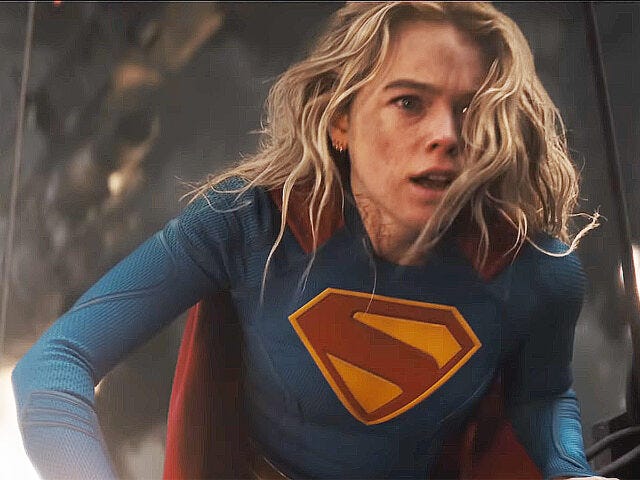
Deadline ran a version of the same argument: “There’s a horrible reality and that’s that there is a toxicity among fanboys and critics with female-led superhero and action films.”
Both pieces skip the part where Alcock herself started the conflict, repeatedly, in her own words, on the record, months before release.
In March, Vanity Fair asked Alcock about the pressure of the role. Her answer: “It definitely made me aware that simply existing as a woman in that space is something that people comment on. We have become very comfortable having this weird ownership of women’s bodies.”
In April, Variety profiled her again. Asked about online critics, she said: “It’s from a lot of people whose profiles have no photo, who are burner accounts. Or someone’s name and then ‘Dad of four, Christian,’ which is hilarious to me. But I mean, whose opinion do you really care about? If you’re pissing the right kind of people off, you’re doing OK.”
In June, asked whether Kara’s queerness in the comics shaped her preparation, she said: “It wasn’t, but in honor of Pride month, as I’m getting all these questions... I don’t know. I think that what makes this film beautiful is that it’s not centered around a man, it’s not centered around love at all. I don’t really know. I don’t know. I don’t know. She probably goes both ways.”
None of that is in the source material. None of it appears in the marketing. All of it came from Alcock, unprompted, in interviews intended to sell tickets to a film whose target audience includes the exact demographic she spent three separate press cycles dismissing.
Grace Randolph, a film critic with no partisan dog in this fight, flagged the pattern in May before the damage was done: “If I were a publicist, I’d be like, ‘Stop talking for the love of God.’” Nobody told her to stop.
Online, the predictable defense came from Forbes contributor Paul Tassi, who posted: “You are not gonna convince me Milly Alcock saying liberal things is the reason Supergirl bombed, when harassed to living hell Brie Larson’s Captain Marvel made $1.1 billion. You guys don’t matter as much as you think.”
Set aside the Captain Marvel comparison for a moment and look at what Tassi is doing. He is telling the audience their reaction does not matter, in the same week the New York Times is blaming that exact audience’s “resurgent misogyny” for the box office failure, in the same week Warner Bros. quietly moved its own win threshold down before the numbers landed. You cannot simultaneously argue that the audience’s response is irrelevant and that the audience’s alleged bigotry is the cause of the failure. Those two positions cancel each other out. If conservative moviegoers, Christian fathers, and general audiences truly did not matter, nobody at the Times or Deadline or Forbes would need an explanation for why the film failed. They would simply note that grosses are down across the genre and move on. Instead, an entire press apparatus spent the weekend constructing an elaborate theory about fan misogyny. That is what people do when an audience’s absence costs real money and somebody needs a story other than the true one.
The Captain Marvel comparison also collapses under its own data. Brie Larson’s film opened to $153 million domestic in 2019, when the MCU still carried five years of consecutive franchise momentum and audience goodwill built by Iron Man, the Avengers, and a decade of careful brand management. Supergirl opened to $37 million, a year after Superman launched the same universe to $125 million with strong reviews and zero promotional controversy. The comparison is not apples to apples. It is a flagship franchise at its commercial peak versus a sophomore entry that immediately followed a hit, undercut by its own star’s press tour.
Variety’s own analysis names a real structural factor too: the superhero genre overall is down roughly $3.5 billion annually from its 2017-2019 peak, and female-led titles specifically have struggled since Wonder Woman ($822 million) and Captain Marvel ($1.13 billion) gave way to Black Widow, The Marvels, and now Supergirl. That decline is real and worth discussing honestly. But genre fatigue does not explain why Supergirl is underperforming Superman, released by the same studio one year earlier, by this margin. Genre fatigue affects every film in the category roughly equally. It does not explain why one film’s lead actress generated three separate viral controversies before release while the other film’s lead generated none.
Cosmic Book News noted something else worth sitting with: the marketing materials themselves featured unflattering shots of Alcock, choices “approved by James Gunn,” following the same visual pattern used in The Marvels, Madame Web, and Snow White. Whether that pattern reflects deliberate sabotage or simple carelessness is unclear. What is clear is that nobody at the studio corrected course after seeing it work against three previous films in the exact same way.
Peter Safran’s public response stuck to the standard script: “While Supergirl didn’t meet our box office expectations, it’s just one component of a broader, long-term strategy at DC Studios that we remain confident in.” That is the same sentence every studio executive reaches for after a miss. It does not explain the quietly lowered win threshold from the week before. It does not explain why Warner Bros. executives told the Times they were “surprised” by backlash that critics and analysts had been predicting publicly since March.
The press blaming misogyny while the studio quietly moves its own goalposts is not two separate stories. It is one story, told twice, by people who already knew what the numbers were going to say and needed an explanation that did not involve looking at the marketing campaign they approved.
First contact with the Oridians was supposed to be humanity’s proudest moment. Instead, their chief engineer is dead, their ship is sabotaged, and an ancient alien technology is stealing souls. Book one of the Valiant Frontiers series delivers exploration, mystery, and the kind of crew you’ll want to follow across the galaxy. Read The Soul Catcher on Amazon and start the adventure.

NEXT: Comcast Just Admitted What Hollywood Won’t Say Out Loud: The Tech Is Worth More Than the Content
Interesting that no one ever blames any part of the female population for not rushing to the theater to support a fellow WOMAN-- no, it's always the men's fault...
How is this misogynic when she looks like a down syndrome boy?