


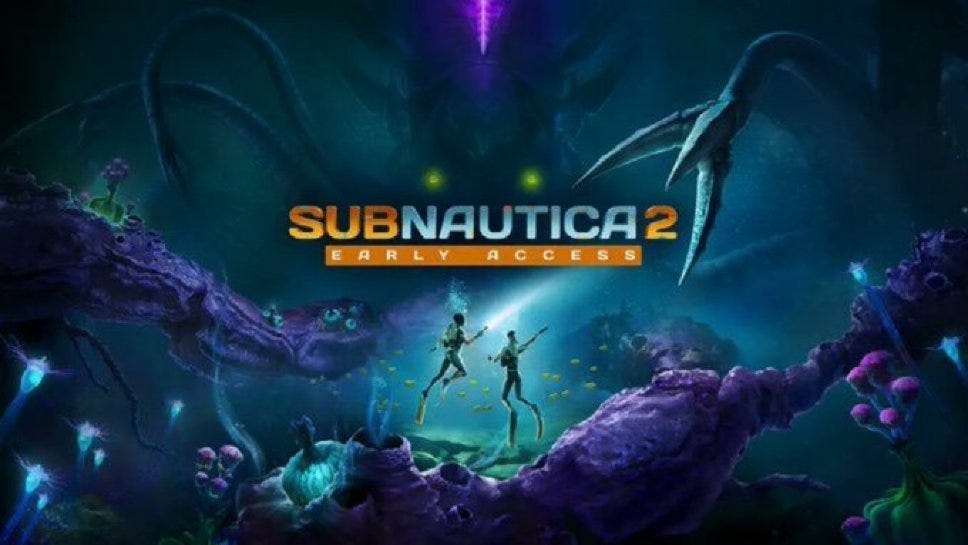
Subnautica 2 sold two million copies in its first twelve hours of Early Access and peaked at 651,000 concurrent players across Steam, Epic, and Xbox, one of the largest Early Access launches in gaming history. Days later, the conversation has shifted entirely to the game’s End User License Agreement, and Unknown Worlds has confirmed it is reviewing player feedback on the terms.
The backlash started with a single Steam review. A user going by Spexceptional posted a detailed breakdown of approximately 40 clauses in the EULA before refunding the game. The review went viral across Reddit, Steam discussions, and social media, with players accusing Krafton of including overly aggressive and anti-consumer terms. Negative reviews flooded Steam. EU players filed reports with consumer protection agencies. Steam discussion forums ran dozens of active threads dissecting specific clauses.
The most inflammatory terms, drawn from Steam reviews and the actual EULA text, break down as follows. Streamers and content creators cannot publish recordings, screenshots, or gameplay footage without a disclaimer that the content is not supported by Krafton. Monetized content is prohibited outright. Krafton reserves the right to revoke access to the game at any time for any reason without prior notice. The publisher claims the right to remote access the game at any time without direct user consent. The agreement covers collection of personal data including full legal name, email, physical address, phone number, and date of birth, with clauses permitting transfer of that data to third parties including marketing agencies and cloud services. There is no guarantee that collected data is protected or anonymized. Players waive the right to participate in class action lawsuits against Krafton. Dispute resolution runs through arbitration in California exclusively. Using a VPN is prohibited. Playing the game on more than one device requires purchasing an additional license. Any action that “tarnishes the reputation of Krafton” constitutes grounds for license termination.
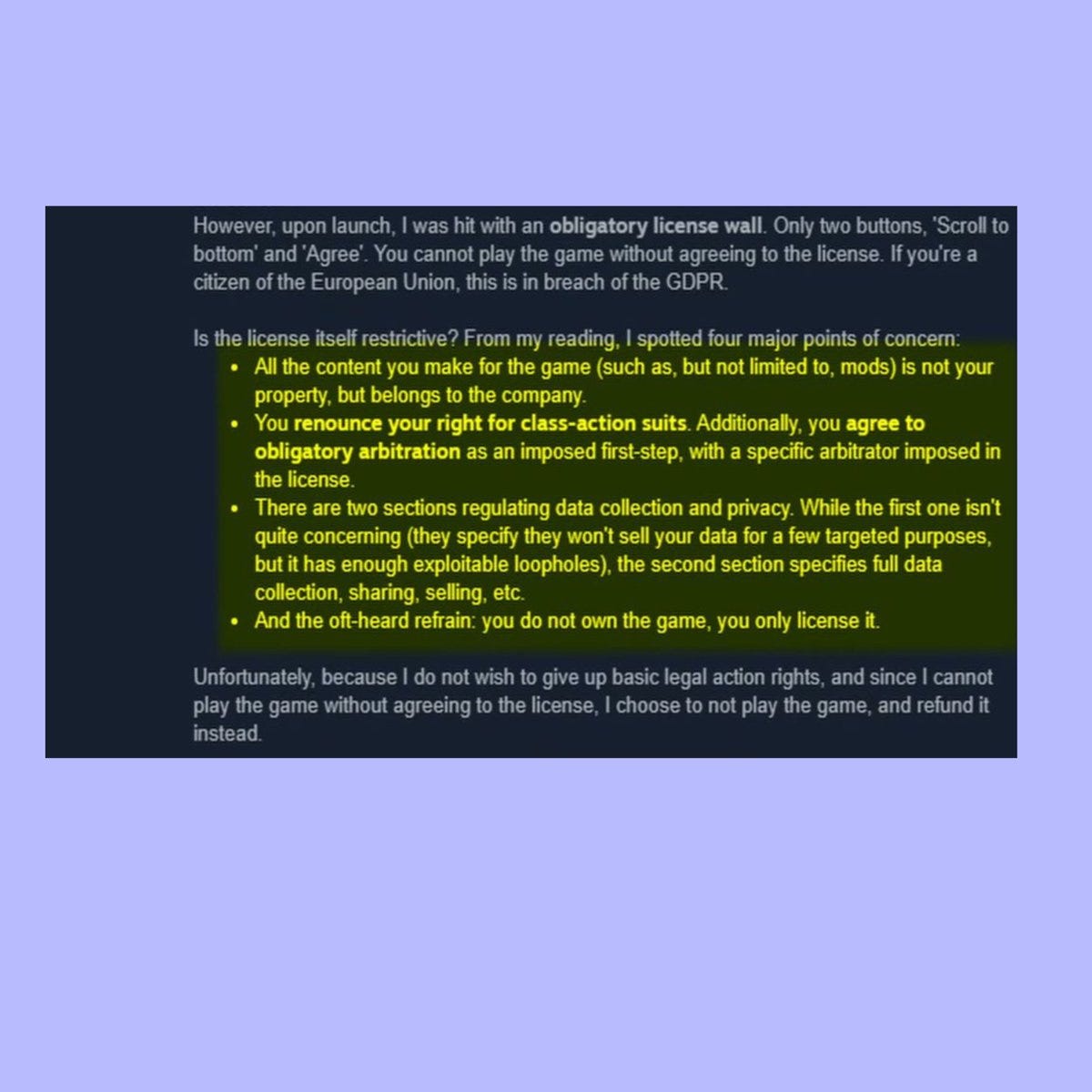
The industry-standard defense exists and is not wrong. Every digital game sold on Steam operates on a license basis, not an ownership transfer. That clause is enforced by Valve’s own storefront terms, not invented by Krafton. Forced arbitration clauses appear in tens of millions of consumer agreements every year, including home appliances and mobile phone contracts. The streaming disclaimer requirement is restrictive but not uncommon among publishers who want their Early Access messaging controlled. Some of the more alarming-sounding data provisions are boilerplate that courts in democratic countries have consistently declined to enforce.
That defense does not hold for the full document. EU players filing consumer complaints have identified specific GDPR violations. The EULA requires blanket consent to data collection, including postal addresses and phone numbers, as a mandatory prerequisite to play, with no granular opt-in mechanism and no alternative for players who refuse. Under GDPR Article 7, consent obtained under these conditions is not legally “freely given” and is therefore invalid. The clause claiming automatic, royalty-free, exclusive ownership of all user-generated content including modifications sits in direct conflict with EU copyright law. The European Court of Justice’s ruling in UsedSoft v. Oracle established that a digital purchase made via one-time payment cannot be reduced to a revocable license under EU consumer protection law. Several of these terms are likely unenforceable in Europe regardless of what the EULA says.
One detailed technical review found four parallel telemetry pipelines active at launch, with silent account creation occurring at Krafton, Epic, and a proprietary player service simultaneously. Players who purchased Subnautica 2 during Early Access received an opened Krafton account, an active Epic session, and a numeric player ID generated without being informed or asked.
The Krafton context makes all of this land worse than it would from a neutral publisher. This is the same company that fired the Unknown Worlds leadership team to avoid paying a $250 million contractual bonus, used ChatGPT to strategize around the payment, lost in court, and was subsequently removed from the game’s own Steam publisher listing. Krafton is not a company that has earned the benefit of the doubt on its intentions toward players. When a clause prohibits any action that “tarnishes the reputation of Krafton,” the response from players who watched the CEO lawsuit unfold in public is not going to be charitable.
Unknown Worlds has noted it is reviewing player feedback on the EULA. That is the right response. The game itself is receiving strong reviews. The core experience holds up. The EULA is a separate problem, and it is a problem the studio did not create. This document arrived with Krafton’s fingerprints on it, in a game that Krafton tried to sabotage and still legally owns despite losing operational control. ScreenRant
The players buying Subnautica 2 are rooting for Unknown Worlds. Most of the negative EULA reviews say it explicitly: the game is good, Krafton is the problem. One Steam review captures the sentiment directly: “Negative review is more of a message towards Krafton than it is towards the game. I hope Unknown Worlds all the best.” Thegeek
Unknown Worlds should revise the EULA, strip the terms that exceed industry standard, and publish a clear statement on data collection practices. The game deserves to be judged on what it is, not on the legal document Krafton attached to it.
Did the Subnautica 2 EULA affect your decision to buy the game? Let us know in the comments.
450 pages of classic superhero storytelling that puts character first. The Flying Sparks Omnibus collects the complete saga of Meta-Girl — the kind of cape comic the mainstream forgot how to make. Sign up to get your copy.

NEXT: Subnautica 2 Sells 2 Million Copies in 12 Hours After the CEO Krafton Tried to Fire Got His Job Back
Well, with Stop Killing Games having the momentum it's got, im not buying this game or any game that labels itself as nothing more than "licensed" to me, not bought until I can play my games passed their "expiration dates".
Three things stopped me from even considering Subnautica 2.
One: woke, Marxist devs trigger-raging over the player base asking for guns in Sub2.
Two: profusion of "bisexual lighting" (blues and purples).
Three Krafton's shady contract canceling to screw the septum ring devs out of their bonuses by firing them all.
I won't support people that hate me.
I won't play a game specifically hitting me with subliminal effects that promote bisexuality.
I won't give money to a company as predatory as Krafton, even if the victims were nose-rings.