


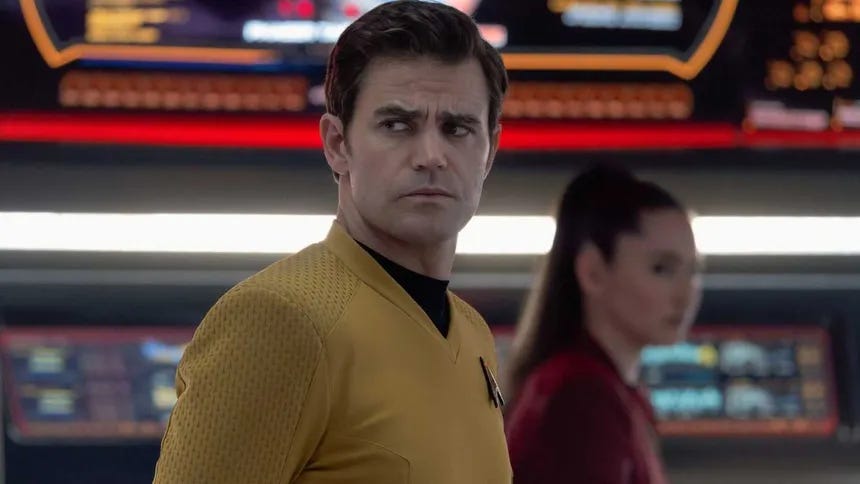
“Orders of Magnitude,” the eighth episode of Star Trek: Strange New Worlds season four, splits its hour between a hijacked Enterprise and a stranded landing party, and spends most of that runtime asking whether James T. Kirk is right to disobey a superior officer. The episode mostly answers that question by refusing to answer it, and that refusal is the most frustrating choice it makes.
The premise sends Captain Pike, Number One Una Chin-Riley, Nurse Christine Chapel, Ensign Uhura, and Vulcan cadet A’Sha down to a moon chasing a distress call, conveniently clearing the bridge the moment Admiral Simon Reeger, played by Joe Morton, arrives to commandeer the ship. Reeger claims he is hunting a cloaked vessel responsible for a massacre that killed his own family among millions of others, and with Pike out of contact, Lieutenant Commander Kirk finds himself standing in as de facto second in command. The setup is eye-rolling on two fronts at once: Kirk conveniently being aboard the Enterprise for this crisis in the first place, and an admiral conveniently showing up the exact moment Pike and Una both leave the ship. Neither contrivance gets so much as a line of justification before the plot moves on.
What follows is a slow-motion mutiny told in escalating stages. Kirk starts by following Reeger’s orders. Then he starts quietly working around them. Then he disobeys outright. Then he gets close enough to a court martial that the threat becomes real, and finally he reroutes the ship’s phaser array well enough to sabotage the mission entirely, ending up captured by Lieutenant La’an Noonien-Singh’s security team in the process. Almost nobody on the bridge backs him up along the way, and that is the episode’s sharpest unforced error. La’an, who by every indication should be able to see that Reeger’s order risks killing a large number of innocent people, still moves to bring Kirk in at Reeger’s command rather than question it herself. Watching a crew this smart and this loyal to Pike’s command style fall in line behind a stranger throwing his weight around, with nobody willing to act until Kirk forces the issue, makes the ship feel less like Starfleet and more like an institution that will not move until it is made to.
Kirk’s solution happens off to the side rather than on the bridge. He convinces Dr. M’Benga to secretly slip cordrazine, the same drug that sent McCoy into a psychotic spiral in “The City on the Edge of Forever,” into Reeger’s coffee. The dose is enough to trigger a breakdown severe enough that M’Benga can invoke medical grounds to remove the admiral from command. It is a clean reference for anyone who knows the original episode, and it works as a resolution. But it is also a needlessly roundabout way to get there for a crew that had already pegged Reeger as a problem from the moment he stepped aboard and still would not act on their own instincts until Kirk forced their hand.
The landing party plot runs on a parallel track and has its own credibility problems. Andorian mercenaries capture Pike’s team, hoping to use them, or their equipment, to move stolen Starfleet material past patrols without interference. A’Sha is wounded badly enough in the process that Uhura fakes cooperation to buy time for treatment, then turns the tables and takes the mercenaries down herself once she has the opening. Andorians are established across Star Trek as physically stronger and more militaristic than humans, which makes one human ensign, on her own, dropping a group of trained Andorian mercenaries one of the episode’s harder swallows. The character work underneath the action fares better than the fight choreography’s plausibility. Uhura and A’Sha replay the mentor dynamic from the season premiere almost beat for beat: A’Sha is ready to walk away from Starfleet again, Uhura blames herself for the near-fatal outcome, and the two work through it together. Then, only a moment after that guilt-heavy beat, Uhura gets a promotion. The show wants that to land as a triumphant capstone, but coming directly off a scene where she is torn down emotionally, it plays as whiplash rather than earned uplift. The script needed another pass to give that transition room to breathe.
By the end, Reeger’s plan collapses, but the episode declines to hand Kirk a clean, unambiguous victory, and this is where the math actually gets ugly. The cloaked ship is clearly the same vessel that shows up decades later in “Balance of Terror,” which means anyone who has seen that episode already knows this ship does not simply vanish. It goes on to kill more people. Reeger wanted to destroy it here, in this episode, and Kirk stopped him to save the colonists in the ship’s immediate blast radius. That trade saved lives in the moment, but it also let the threat get away intact, free to keep killing on the other side of the timeline. Kirk is not just left unproven at the end of this hour. He is responsible, whether the show wants to admit it or not, for the deaths that ship goes on to cause later, because he is the one who made sure it survived to cause them. The episode never puts that cost on screen or holds Kirk to account for it, which is exactly the problem. It wants credit for a morally complicated choice without actually showing the complication playing out.
Reeger, thoroughly discredited by the end, still walks away with enough institutional weight to threaten both Kirk’s career and M’Benga’s on his way out, leaving both threads dangling into the rest of the season, the second unresolved plot this stretch of episodes has left hanging. Rather than commit to Kirk as the clear hero the setup spent the whole hour building toward, or force him to reckon with what letting that ship go actually costs, the episode settles for a morally gray resolution instead of a black-and-white one. That is the modern instinct at work more than a Star Trek one, and it costs the episode the payoff it had actually earned by that point. If the writers wanted Kirk established as a hero here, the material was in place to do it. If they wanted him to sit with the weight of a decision that gets people killed later, that material was in place too. They picked neither and left both threads unresolved instead.
None of this makes “Orders of Magnitude” a bad hour of television. The badmiral plot itself is well-worn Star Trek territory, run through this same basic shape more than once across the franchise’s history, and it is not a fresh idea at this point. The M’Benga and Kirk twist is satisfying to some degree, the character material for Uhura and A’Sha had some potential even where the pacing around it stumbles, and the hour moves at a good clip. By contrast, the setup’s contrivances, the unconvincing solo takedown of a squad of Andorians, and a script that needed tightening around its emotional beats, this plays as a six out of ten with the bones of a seven or eight underneath it. It stands above most Strange New Worlds episodes this season even with those flaws intact, which says as much about the season’s usual output as it does about this episode’s ceiling.
Does Strange New Worlds owe Kirk a clear, on-screen accounting for the cost of letting that ship escape, or does the show intend to make him answer for it once “Balance of Terror” comes due?
First contact with the Oridians was supposed to be humanity’s proudest moment. Instead, their chief engineer is dead, their ship is sabotaged, and an ancient alien technology is stealing souls. Book one of the Valiant Frontiers series delivers exploration, mystery, and the kind of crew you’ll want to follow across the galaxy. Read The Soul Catcher on Amazon and start the adventure.
NEXT: Heather Antos Is Officially Off Star Trek Comics, Her Successors Raise Their Own Questions
Lame writing. This makes five for five I don't have to watch.
StarFleet officers have always been able to refuse to obey orders that violate their conscience.
But then, what does hollywood know about that? They refused to step up and defend actresses that were being raped. Hollywood only understands virtue signalling...they no longer understand story telling.
https://youtu.be/bP4bNGwANlw?si=SQyfP6clJn1bjXkV