


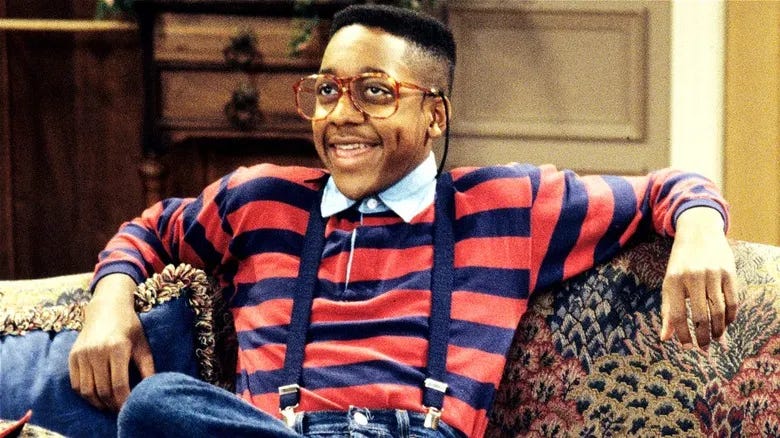
I fell among YouTube fragments and found Family Matters again. I grew up watching that show and, I admit, I liked Steve Urkel. Looking back, however, I had to ask myself. Why wasn’t he allowed to become his alternate ego, Stefan Urquelle, permanently?
The series began as the story of the Winslows, a working-class Black family in Chicago. Steve Urkel entered in Season 1 as the next-door neighbor. Although he was conceived as a guest appearance, he conquered the show because the audience resonated with him. Steve’s look and manner are the whole gag that follows him throughout the series. The voice is squeaky, his glasses are thick, and his pants are high-water. He breaks the furniture and asks, “Did I do that?” And the audience roars with laughter.
He is also an inventor. Later seasons hang whole plots on his gadgets: the transformation chamber, shrinking, cloning, teleportation. The other constant is Laura Winslow. From the very beginning, he cannot help but express how much he loves her. She finds him grating and does not want him. Time and again he begs for her affection, even after she has been dating other men, and even after the room has long since placed Steve as the butt of the joke.
Enter Stefan Urquelle. He arrives in Season 5, episode 8, “Dr. Urkel and Mr. Cool.” Steve drinks a serum said to suppress “nerd genes” and raise “cool genes.” Then Steve achieves a brand-new bearing: better clothes, a normal voice, and far more ease in a room. Stefan has that rizz, and Laura is immediately taken with him. Other girls are too. People who never granted Steve his dignity now treat Stefan as a man worth addressing.
Yet even as Stefan receives the attention Steve never received, he is also written as vain. He speaks of his former incarnation as an annoying, clumsy nerd and the village idiot. Laura objects, and the show installs her objection as the moral of the story. Sure, Steve may be irritating, but he cares, dammit. Stefan may look like the man she wanted, but he acts as if everyone else exists to orbit him. So Laura commands him to change back. Reluctantly, Stefan takes the antidote and becomes Steve again. Laura is glad. That is the entire moral resolution.
But then they bring Stefan back in “Stefan Returns.” Steve builds a transformation chamber and lessens the arrogance. This Stefan is kinder and Laura falls for him again. Unfortunately, the formula expires while she is telling him she loves him. Here the show wants two contrary things at once: the cool man may be decent, but for some reason he still needs to disappear so that the “real” man can continue.
The Season 6 Disney World two-parter makes the preference naked. Steve shows the transformation chamber at a contest and steps out as Stefan. Secretly, Laura sabotages the machine so he cannot change back, leaving Steve trapped as Stefan for the rest of the trip.
They spend their time at Disney World as a couple, and after Stefan proposes in the park, Laura accepts.
Then Myra, Steve’s actual girlfriend, arrives from Chicago. Unlike Laura, she has been in a committed relationship with him as Steve. Her arrival exposes the situation for what it is: Laura has taken advantage of Steve’s inability to return to his normal form while building a romance around the version of him she prefers. Laura confesses. Stefan is furious, not only because she wrecked the machine, but because the engagement itself now feels like a trap built around one form of him. She asks him to repair the chamber and become Steve again. And so he does.
This is where the show’s little piece of magic begins interfering with whatever moral the story thinks it is telling. The transformation chamber is never allowed to settle on who Stefan actually is, existentially. Is he Steve’s authentic potential, a genuine aspect of his personality finally given a body and a voice? Is he an artificial persona, a handsome costume produced by technology? Or is he something darker, a dangerous alter ego whom Steve must periodically lock back inside himself before temptation leads him away from his proper life?
The episode wants all three answers when convenient. Stefan is real enough to fall in love, propose marriage, become furious at Laura’s manipulation, and demand recognition as someone with his own desires. Yet when the plot requires Steve Urkel to return, Stefan can be folded back into the machine as though the handsome man were merely a spell that needed to be broken. The science-fiction premise becomes a moral escape hatch. Nobody has to decide whether Laura loves a real person, whether Steve has genuinely changed, or whether Stefan represents a legitimate future for him. The chamber simply reverses the problem.
The most generous interpretation is that Laura is not allowed to keep the handsome man because she had to cheat in order to be with him. That would at least be a coherent lesson: she manipulated the circumstances, got caught, and lost the relationship built on the deception. But this begs the question: is it imperative that Steve be restored to the role the series requires?
Must he remain a man who wants Laura more than he wants to remain the person she actually said yes to?
The series never adequately decides who Stefan is. And Family Matters is hardly alone in this. A great many sitcoms of the era wanted the benefits of character growth without accepting the consequences of it. Characters could learn lessons, enter new relationships, change jobs, mature, fall apart, reinvent themselves, and briefly become someone new. By the next episode, the furniture of the series usually had to be put back where it belonged. The audience was invited to watch change happen while being quietly assured that nothing essential would actually change.
Season 7’s “Send in the Clone” is the show’s most revealing attempt to solve the problem it had spent years refusing to answer. Steve clones himself. And so, of course, Laura wants to place the clone in the transformation chamber and make Stefan a separate, permanent person. What is funny is that Laura’s logic, on its own terms, is perfectly sound. Divide the men between the women. Laura gets Stefan. Myra gets Steve. Everyone receives the version of Steve they actually want, and the immediate romantic conflict appears to disappear.
Yes, Steve Urkel was asked to participate in his own replacement while continuing to affirm that his rejected self is still authentic.
At this point, the story has gone well beyond whatever lesson it was originally trying to teach. The science-fiction machinery has turned morals about romance into a metaphysical problem about identity, personhood, and change. Laura’s solution also opens a series of questions that the writers seemingly had no interest in addressing. If Stefan can now exist independently as a permanent person, then what exactly was he before? Was he always a genuine part of Steve, or was he an artificial personality created by the machine? And if Laura can legitimately choose Stefan over Steve, what does that say about the years in which the show insisted that Steve’s persistence was a form of romantic virtue?
What makes this even more bizarre is that Steve consents to having his clone used this way. He even says he wants Laura to be happy, and the show presents this as generosity, perhaps even as maturity. But it is difficult to ignore what the arrangement actually means. There is something almost cuckold-like in the structure of it. Steve can keep his dignity, his identity, and his authenticity, so long as someone else gets to have the man Laura actually wants. More than that, the other man is himself, or at least everything Laura has told Steve she wishes he were. Meanwhile, the original Steve stands aside and watches the woman he loves receive the version of him she actually desires, while he settles for someone else. That is what makes the gesture even stranger: Steve is not surrendering Laura to some rival who defeated him. He is manufacturing his own rival and then endorsing the arrangement. The humiliation is metaphysical. This is “simp” rewritten as virtue.
A person is not a thing that remains identical. A person is one who answers and is changed by the answer. Family Matters increasingly writes Steve according to the opposite principle: a soul whose authenticity is certified by its refusal to change. The clone becomes the technical image of that refusal. One person might grow into someone new, but two distinct bodies solve the problem without requiring anyone to grow. The old man can remain frozen in place while the new possibility is separated from him and treated as another person altogether.
Even after Stefan exists on his own, the ranking does not entirely disappear. He dates Laura, builds a life of his own, and works as a model. By Season 9’s “Pop Goes the Question,” the show finally brings the two men to the same point. Both propose to Laura. Steve’s proposal is characteristically self-effacing. He tells her that she could have a grander life with Stefan and a more modest one with him. He even prepares to leave for Russia to join his parents, convinced that the loving thing to do is remove himself so Laura can choose what he believes is the better option.
Laura stops him. In the end, she chooses Steve.
The reason she gives takes the story all the way back to the beginning. Steve has been a gentleman since they were children. He has demonstrated that he will be there when times are difficult. Stefan, she argues, could eventually revert to the arrogant, uncaring man he once was in “Dr. Urkel and Mr. Cool,” take her for granted, and ultimately destroy the marriage.
There is something revealing in that reasoning. Why did the writers spend years complicating the distinction between Steve and Stefan, only to reach backward and treat his original transformation as evidence against his future? In other words, Stefan was allowed to change, but he was never completely allowed to escape the meaning of how he first changed. His later kindness and maturity did not erase the memory of the arrogant man who first emerged from the chamber. Steve, by contrast, wins precisely because his character is understood as continuous. The qualities Laura values in him have been demonstrated repeatedly over time. That constancy becomes the proof of his worth.
Steve wins because he never stopped being Steve. More specifically, he wins because the show has spent years rewarding his refusal to give up on Laura. He just kept asking and was kept waiting. He repeatedly put Laura’s happiness ahead of his own, even when she had given him very little reason to believe that his persistence would ever be rewarded. The show presents this as devotion. By the end, it starts to look remarkably like simp behavior being rewarded as moral virtue. Steve’s willingness to endure rejection is treated as evidence that he deserves the woman who rejected him. The moral becomes: you will eventually be rewarded if you never stop pleading for attention. That is perhaps the strangest irony of the entire story: While Steve’s persistence is treated as evidence of his nobility, the series never seriously considers whether that same persistence could become its own kind of pathology.
Two episodes later, the series itself is over. Steve and Laura are engaged. Steve returns from the space-mission finale, and they kiss. Stefan does not receive another transformation, another attempt, or another argument. Once Laura has chosen Steve, his part in the story is finished.
That may be the most revealing thing of all. Nothing in the plot required Steve to stop being Stefan. Nothing required Laura to stop loving Stefan. Nothing required the two possibilities to remain mutually exclusive forever. The series had already established that Stefan could exist independently. It had established that Laura could genuinely love him. It had even established that Steve and Stefan could coexist. The final choice therefore does not really resolve the contradiction. It just closes the door on it. Steve is rewarded for remaining the same rejected man who spent years pursuing Laura, and the alternative version of himself simply disappears from the story.
Myra is perhaps the clearest evidence that the show’s romantic logic does not quite hold together. She wants Steve as Steve. She does not need him to become Stefan before she can love him. She accepts Steve’s awkward nerdiness without requiring him to become someone else first. In that sense, she represents the alternative the show never fully explores: a woman who says yes to the man before the upgrade. Yet the machinery of the story kept pointing toward Laura.
Why was Laura ultimately given the authority to determine which version of Steve deserves to become permanent? That is where the show’s treatment of Steve’s simping becomes difficult to ignore. Stefan represents the possibility that Steve might receive Laura without having to spend years begging for her attention. So why contain that?
Why was the nerd the authentic core while Stefan was merely the mask? The more interesting possibility is that Steve was an unfinished version of the same man. What would have happened if Steve had been allowed to grow without needing a transformation chamber to turn him into someone else? What if he could have become more confident, more capable, and more self-assured while still remaining Steve Urkel? Would Laura’s eventual choice still feel like the triumph of genuine character, or would it reveal how much the series depended on Steve remaining the same rejected, endlessly persistent admirer?
Perhaps that is where we should leave the question.
Was Steve really rewarded for becoming a better man, or was he rewarded for never stopping his pursuit of Laura? And if the series had allowed Steve to grow into a more confident and capable version of himself without ever becoming Stefan, would we still recognize the ending as a happy one? Or did Family Matters ultimately need Steve to remain the nerd that he always was?
NEXT: Deadpool, Spider-Man, and the Trap of “Feeling Like Itself”

This must be the deepest anyone has ever thought about Family Matters, including the creators and writers.
Stefan was known to hang out with Bill Cosby when he was slipping drugs into women's drinks.