


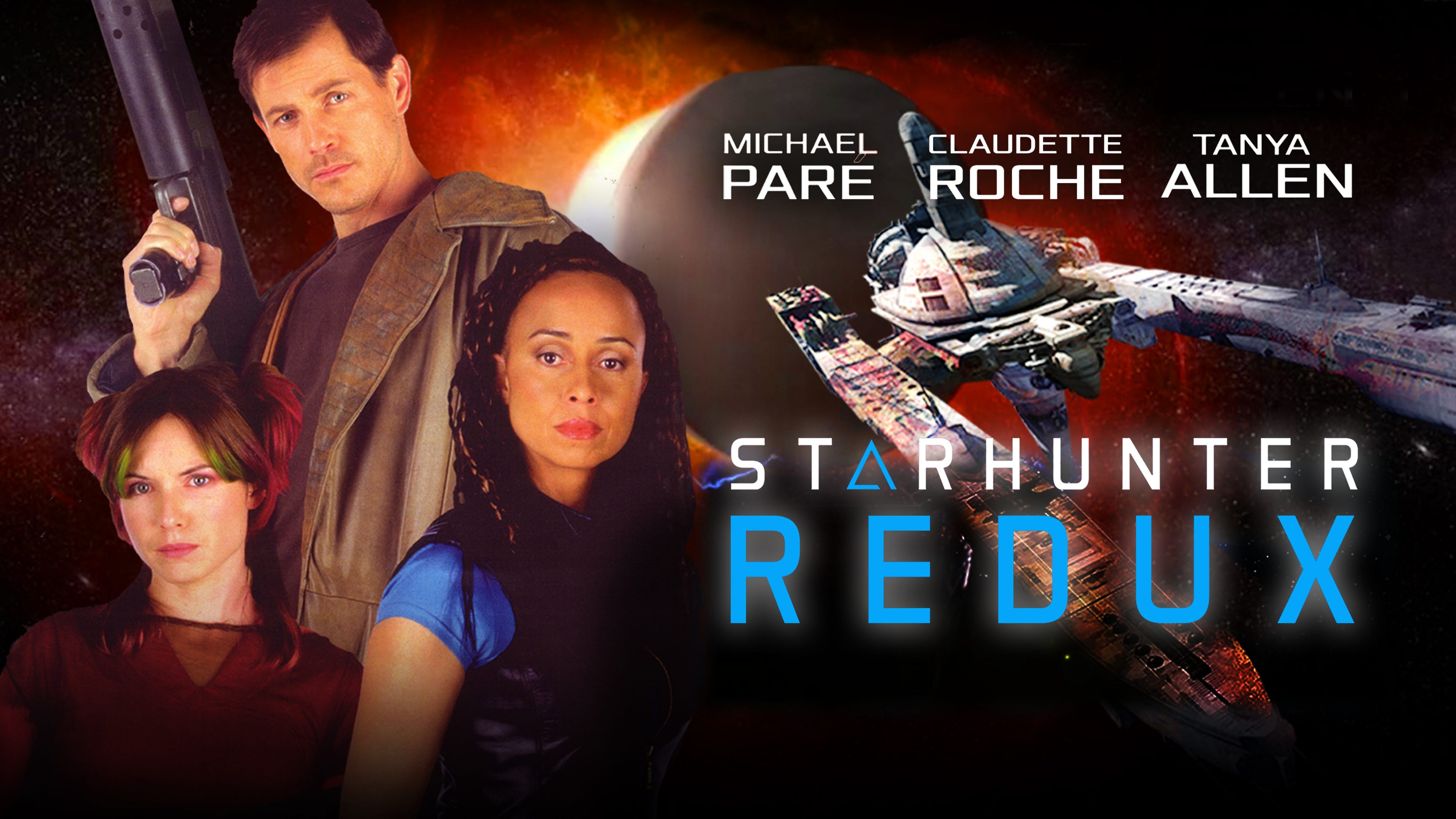
In the crowded graveyard of canceled science fiction television, most shows get a proper burial. A final episode that wraps things up, a network announcement, a clear ending that fans can mourn and move on from. Starhunter didn’t get that courtesy. It simply stopped and left its small but devoted audience staring at a screen that went black and never came back.
Twenty years later, it’s still unfinished.
What Starhunter Was
Starhunter premiered in 2000 as a Canadian co-production, set in the year 2275. The premise was lean and effective: Dante Montana, a former soldier turned bounty hunter, operates a prison transport vessel called the Tulip through a solar system that has been colonized but not civilized. The outer planets are lawless. The inner planets are corrupt. And somewhere out there, Dante’s son, who was kidnapped years earlier by a mysterious group called the Divinity Cluster, might still be alive.
The show operated in the tradition of low-budget Canadian science fiction that produced Lexx and Earth: Final Conflict, productions that compensated for limited resources with ambitious concepts and a willingness to go strange places narratively. The Tulip was a prison transport crewed by a handful of people who had no particular reason to trust each other and every reason to stay together anyway. The bounty hunting premise gave the show a procedural structure while the Divinity Cluster mythology built something larger underneath it.

The Divinity Cluster was the show’s most interesting element. A genetic legacy embedded in certain humans, it connected its carriers to something ancient and powerful—alien intelligences who had been manipulating human evolution for centuries. Dante’s son Percy carried the Cluster. So did others. The mythology deepened with each season, promising revelations that never came.
The production design worked within its limitations intelligently. The Tulip felt lived-in. The outer planets looked appropriately rough. The CGI was modest by any standard but used economically enough that it rarely embarrassed the production.
The Network Struggle
Starhunter aired on a patchwork of Canadian and international broadcasters, the kind of multi-territory co-production arrangement that keeps low-budget science fiction alive but makes it perpetually vulnerable. No single broadcaster owns it. No single network feels responsible for it. When the money gets complicated, everyone looks at someone else.
The show ran for 22 episodes in its first season, building a small but loyal audience while never breaking through to mainstream awareness. It existed in the gap between cult hit and cancellation, becoming popular enough to justify a second season, not popular enough to generate the kind of passionate fan response that saves shows.
The second season, rebranded as Starhunter 2300, jumped the timeline forward and partially reconfigured the crew. The reset frustrated some viewers who’d invested in the original dynamics. New characters replaced familiar ones. The mythology continued developing, now incorporating time travel elements alongside the Divinity Cluster storyline. The show was reaching for something more ambitious than its budget could fully support.
The Cliffhanger That Never Resolved

The season two finale ended in the middle of a crisis. The crew of the Tulip attempts a desperate maneuver to escape hyperspace. The countdown runs. The screen cuts to black.
It’s one of science fiction television’s more frustrating endings precisely because it’s not an ending at all. The show wasn’t cancelled mid-episode in the normal sense. Production simply stopped when the financing evaporated and the planned third season never materialized. The finale aired as a finale by default, not by design.
Behind the scenes, the situation was complicated. Financial issues plagued the production’s distributor. The company structure that had kept Starhunter alive through two seasons collapsed. Key producers faced serious setbacks. The path to a third season, which had seemed viable through pre-sales and broadcaster interest, closed.
Then it stayed closed for years.
The Revival Attempts
The story of Starhunter‘s attempted revivals is its own kind of tragedy, with a series of almost-moments that never quite became anything.
Talk of a third season circulated in fan communities for years after the cancellation. The show had enough of an audience, and enough mythology worth resolving, that the appetite existed. The production company, Starfield CreatorCo, remained attached to the property and worked on keeping it alive in various forms.

The most concrete result of these efforts is Starhunter Redux, a remastered version of the original 44 episodes with updated visual effects, improved sound, and some reshoots. Redux represents a genuine attempt to make the existing show more watchable for modern audiences and to reintroduce it to a streaming generation that never caught it during its original run. The remastered episodes have been re-released and made available on streaming platforms.
It’s a labor of love. It’s also not a third season.
The pandemic disrupted whatever momentum had been building toward an actual continuation. Deaths among key figures associated with the production further complicated any path forward. As of 2026, Starhunter: Season III remains in the category of things that have been discussed, hoped for, and not made.
The fan community on Reddit maintains a small but dedicated presence with people who found the show years after its cancellation, who worked through both seasons on streaming and arrived at that black screen with the same frustration as the original audience. They discuss the mythology, speculate about where season three would have gone, and occasionally share updates on the Redux project.
The updates rarely include news of an actual continuation.
Why It Matters Anyway
Starhunter is unlikely to get its third season. The honest assessment of where things stand points toward permanent incompletion.
In the past, the show was doing something genuinely interesting with limited resources. The Divinity Cluster mythology had real ambition. The premise of bounty hunters operating in a colonized but ungoverned solar system gave the show flexibility that more rigidly defined premises don’t have. And the cast worked hard to make characters feel real in a production environment that didn’t always give them much to work with.
Low-budget science fiction is where a lot of the genre’s most interesting ideas live. The shows that can’t afford to rely on spectacle have to rely on concept and character. Starhunter understood this. Its limitations forced creativity in ways that bigger productions sometimes don’t bother with.
The Starhunter Redux project ensures the show is at least watchable in a form that does it more justice than the original broadcast versions. For viewers willing to seek it out, two seasons of flawed but genuinely interesting science fiction are available. Just don’t expect the countdown to ever finish.
Starhunter is a part of science fiction television history, proof that ambition doesn’t require a network budget, and that cancellation can happen to shows that don’t deserve it. The Tulip is still out there somewhere in hyperspace, crew intact, waiting for a rescue that probably isn’t coming.
Some doors stay open. This one just happens to lead nowhere.
What do you think? Are there other forgotten low-budget science fiction series that deserve the kind of fan attention Starhunter has maintained, or is incompletion part of what keeps a cult audience loyal?
If the golden age of Trek and Babylon 5 left a hole in your sci-fi diet, The Stars Entwined fills it — interstellar espionage between two civilizations on the brink of war. Read The Stars Entwined on Amazon!

NEXT: Serenity Review: Joss Whedon’s Firefly Film Still Holds Up 20 Years Later
Who knows what AI Santa will bring.