


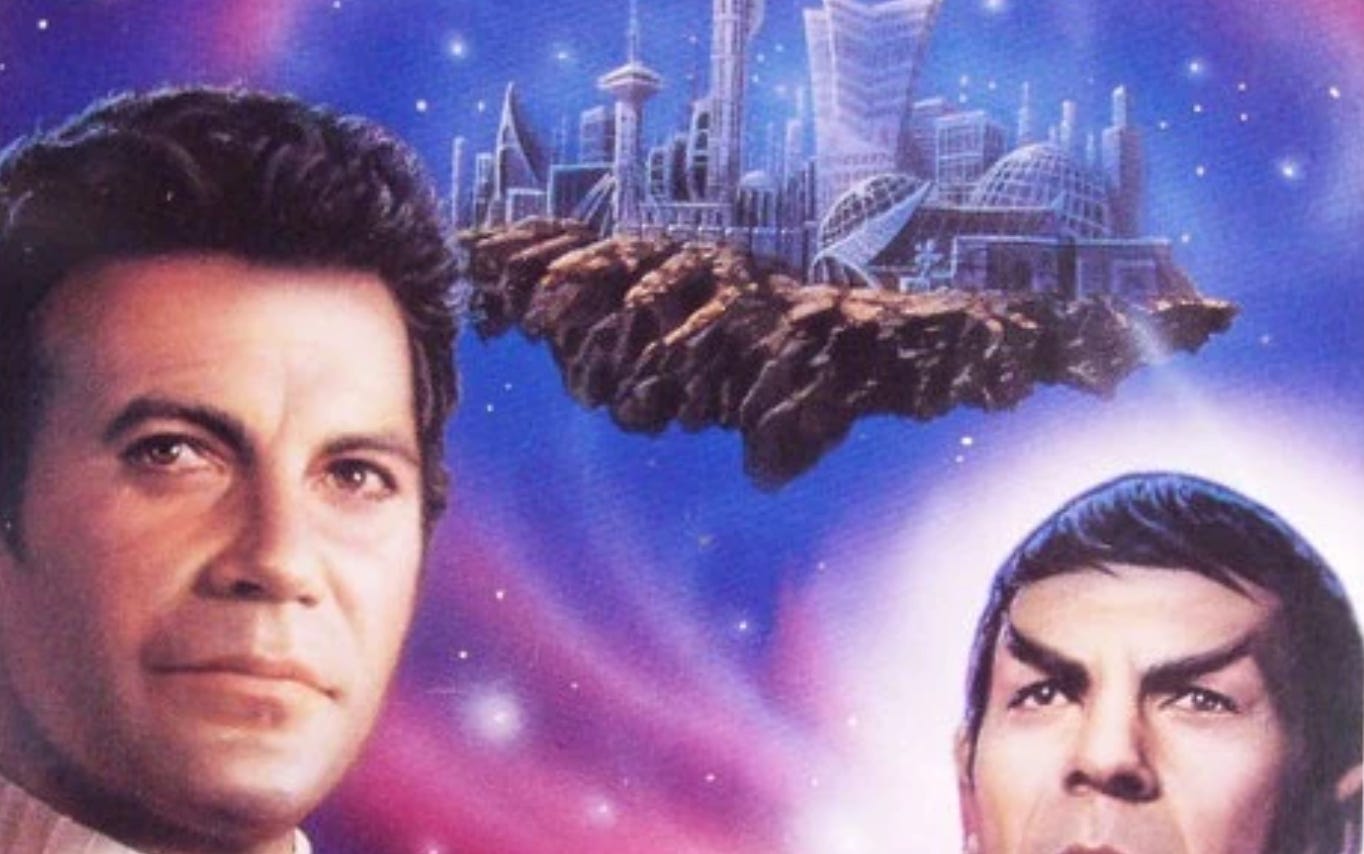
Peter David’s “The Rift” hit shelves in November 1991 as book number 57 in Pocket’s numbered Star Trek line, and it stands out in his bibliography for a reason that has nothing to do with plot. David’s Star Trek career runs almost entirely through The Next Generation era and his own New Frontier crew. His first Trek novel, “Strike Zone,” was a TNG entry back in 1989. Original Series novels from him are rare enough that “The Rift” and 1995’s “The Captain’s Daughter” cover most of his output in that timeline. A book built around Kirk, Spock, and McCoy from David is worth flagging just for being a rarity in his own catalog, and this one earns the attention on its own merits too.
The setup starts somewhere most TOS novels don’t bother going: the Pike era, picking up directly after “The Cage.” Number One appears on the page, and in one of the novel’s better touches, Spock learns the word “fascinating” from her, deciding it fits his temperament well enough to keep using it. It’s a small connective thread between the pilot episode and the character viewers know decades later, and it lands the way this kind of continuity should.

A rift opens in space, connecting the Federation to an alien civilization called the Calligar out past known territory, in what reads now as an early stab at wormhole storytelling years before Deep Space Nine made the concept a franchise staple. The rift only stays open for a matter of days before sealing again for decades. During the Pike-era opening, a young officer named Tyler falls for a Calligar woman on the other side. By the time the rift reopens, the story has jumped forward past the events of “The Voyage Home,” and Tyler returns as a commodore to find the same woman ready to request asylum from her own people. That jump from pre-TOS to the movie era in a single book is not something David’s other Trek work tries, and it gives “The Rift” a structural ambition that punches above its weight for a mid-list paperback.
The Calligar themselves carry the novel’s sharpest idea. Their civilization runs ahead of the Federation technologically, and they maintain that edge partly by euthanizing their own people at the height of their abilities, before any decline can set in. The Federation’s reaction to learning this is exactly what it should be, and the discomfort the practice generates carries through the back half of the book. Layered on top of that is the asylum-seeker’s own history: a relationship with her brother that produced a child, framed in the text as coercion rather than romance, with the brother positioned as the story’s actual villain once the full picture comes out. Kirk bends the Prime Directive to get involved, which is exactly what Kirk does, and the standoff between Andorian and Tellarite forces adds some welcome Federation politics to the stakes before the crisis resolves into the happy ending the setup promised.
Spock’s characterization throughout is a highlight, and the Arthurian material woven into the climax adds an unexpected layer to it. McCoy compares Kirk to Sir Galahad riding into the grail quest, and rather than brushing the comparison off, Kirk leans into it on the way to a rescue shuttle. Later, when Spock mind melds with the Calligar hive mind, Kirk talks his way past it through wit rather than force, and the Arthurian imagery resurfaces inside that sequence as a way of showing how Kirk’s will manifests under pressure. The epilogue closes things out with the kind of after-the-fact summary you’d expect at the end of a film, David’s humor intact the whole way through.
None of this was supposed to happen, by David’s own account. He submitted three different outlines to Paramount without his name attached, written in three distinct styles. “I drafted up three different story outlines and Pocket submitted them without my name on them. I did them in three completely different styles. Roddenberry’s office wound up reviewing three story outlines, all by me. Interestingly, I wrote one outline which I thought was fantastic, one that I thought was okay and one outline that was simply a conglomeration of old clichés from previous Star Trek episodes. That was the one they liked. Once I got into it, I actually thought I managed to make it a pretty decent book. The outline was the most unpromising thing I ever crafted because it was designed to make the other two look good. It wasn’t designed to be the one they picked.”
The outline he considered his weakest turned into a novel that plays with structure, era, and character in ways his stronger-pitched ideas apparently never got the chance to. “The Rift” garners an 8.5 out of 10. If the outline David thought was worst produced this, what does that say about how tie-in fiction actually gets greenlit?
When genetic engineering nearly doomed the species, humanity made a desperate bargain: let the frontier do what nature intended. In a harsh universe, these cadets have to make impossible decisions. Read Space Fleet Academy today.
Own this book and rather enjoyed it.