


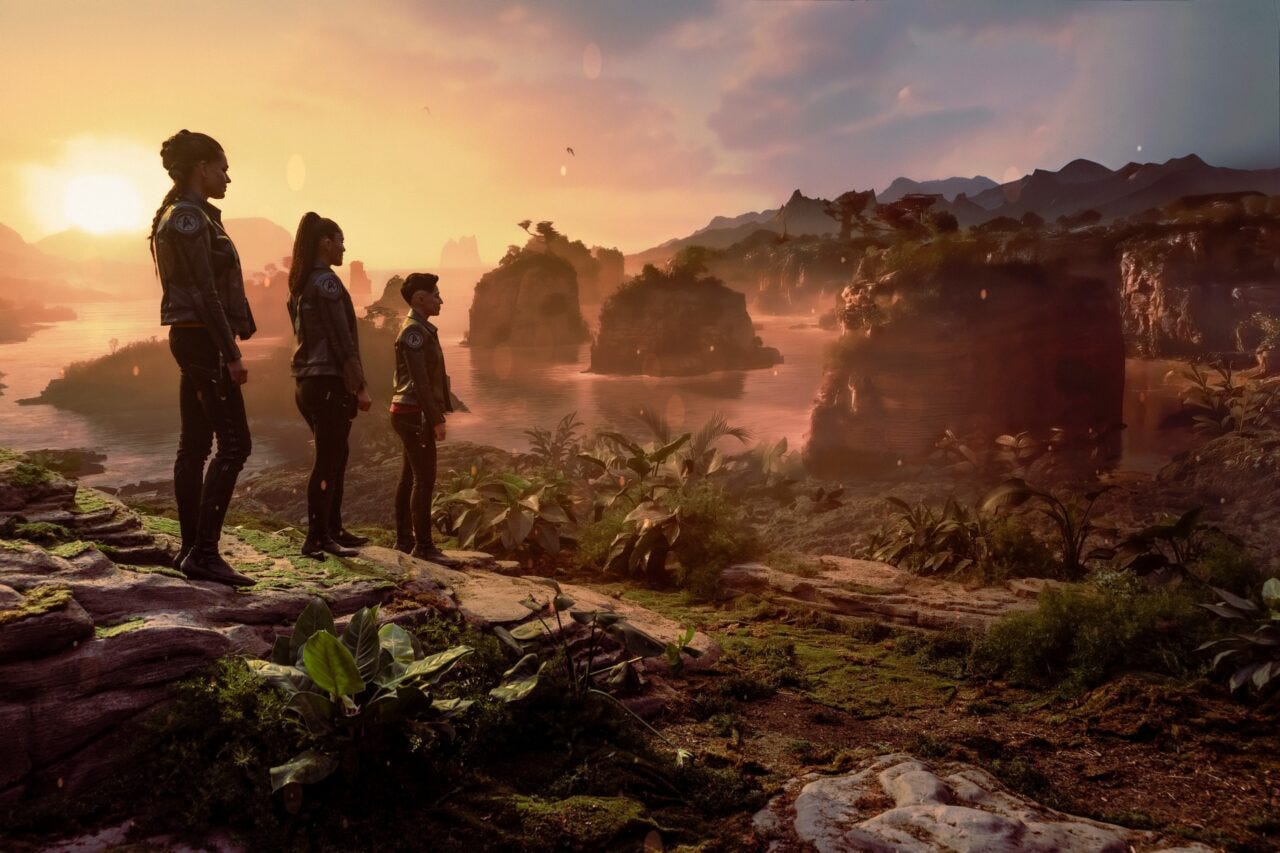
Star Trek: Strange New Worlds returned with its Season 4 premiere, “Valles Marineris,” sending the Enterprise crew 65 million years into the past and dropping them squarely into the extinction event that killed the dinosaurs. The episode opens on Captain Pike finishing up a horseback pursuit on an alien world, a sequence that ran under thirty seconds despite anchoring much of the marketing push ahead of the premiere. Viewers expecting a full pulp adventure episode built around that setup got a quick tease instead.
The real plot kicks in once the crew reports back and Fleet Captain Robert April offers Pike a promotion to Commodore. Pike asks for time to consider it, and the Enterprise heads off to investigate an interstellar storm. The storm throws the ship back in time and lands it on prehistoric Earth, at the tail end of the Cretaceous period. The dilithium supply takes damage in the process, a problem the show has leaned on before, and Number One, La’an Noonien-Singh, and Erica Ortegas take a shuttle down to the surface to find a replacement while dodging a Tyrannosaurus rex.
Back in orbit, a hostile ship traps the Enterprise. Its crew can phase through walls and deploys a tractor beam, and it belongs to a Martian commander named Cassell, fighting a war against an insectoid species called the Dol’drm. Cassell steals antimatter from the Enterprise and uses it to destroy the Dol’drm homeworld, the actual fifth planet in the system. The strike wipes out the population and blows the planet apart, forming what becomes the solar system’s asteroid belt. A chunk of that debris gets flung toward Earth, setting up the very impact that ends the age of dinosaurs and opens the door for mammals, and eventually humanity, to rise. Mars itself survives the blast but ends up barren afterward as a consequence.
That’s a predestination paradox on a planetary scale, and the episode doubles it. The crew doesn’t stumble into altering history. History happened because they were there, and the Enterprise only entered the interstellar storm to begin with because it was answering a distress buoy the ship itself had dropped 65 million years earlier during this same mission. That’s a loop inside a loop. Star Trek has run this kind of play before, most memorably in Deep Space Nine’s “Little Green Men,” where the Ferengi accidentally trigger the Roswell incident. This premiere pushes the stakes further by tying the loop to the origin of human life on Earth, a swing that leans closer to Doctor Who’s timey-wimey sensibility than the show’s usual Trek logic.
Chief engineer Pelia adds another data point to the Doctor Who comparison. She drops another reference to having once been inside a phone box, a callback the character has made before across the series. Paired with a premiere built around a predestination loop that rewrites the crew into the origin of their own species, the line stops reading as a throwaway joke and starts reading as a deliberate signal. Whoever wrote this episode leaned into the Doctor Who structure on purpose, and the phone box nod confirms it. That’s a needle threaded well.
The Martian angle creates a bigger problem than the show seems to notice. Dr. M’Benga runs DNA analysis on Cassell and the Martians and finds genetic similarities to numerous other species across the galaxy, pointing to Martian refugees scattering after their homeworld’s ecosystem collapsed and seeding humanoid life elsewhere. Star Trek already has an explanation for why so many alien species look humanoid: the Progenitors, introduced in The Next Generation’s “The Chase,” and the Preservers referenced back in the original series. Both were established as ancient, advanced civilizations that seeded humanoid DNA across the galaxy long before this point in the timeline. Dropping a second, competing origin story next to lore that’s been settled for decades is the kind of thing a nine-season franchise usually works hard to avoid, and nothing in the episode acknowledges the overlap.
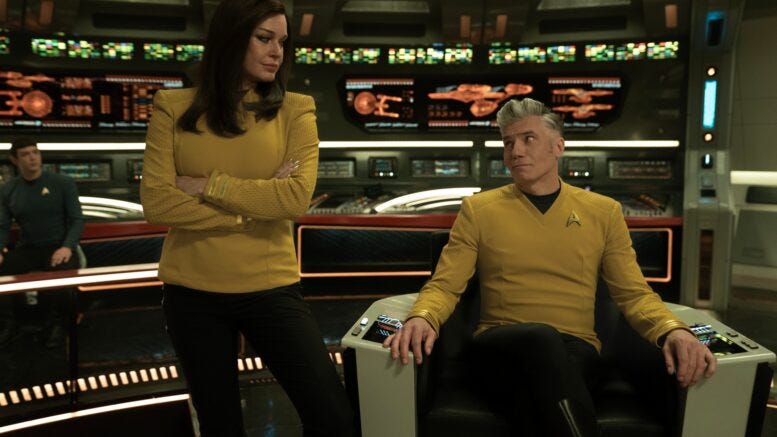
The science on the asteroid itself holds together better than a casual viewing suggests. Real astronomy once entertained the idea that the asteroid belt was the remains of an exploded fifth planet, sometimes called the Phaeton hypothesis. That theory was abandoned decades ago for a simple reason: the belt’s total mass comes to only about four percent of the Moon’s mass, nowhere near enough material for a destroyed planet. The premiere’s choice to destroy the Dol’drm homeworld with antimatter accounts for that gap directly. Antimatter annihilation converts matter into energy on contact, so a blast of that scale would erase most of a planet’s mass rather than leave it behind as rubble. What’s left over as belt debris lines up with the thin remnant real astronomers have measured, instead of the far larger mass a simple explosion would need to leave behind.
The timing checks out as well. A natural asteroid drifting out of the belt toward Earth typically needs millions of years of gradual gravitational nudging before it lands on a collision course, which would make it impossible for the strike on the Dol’drm homeworld and the extinction event 65 million years ago to land in the same episode. A fragment blasted directly onto an Earth-crossing orbit skips that drift. Thrown hard enough from the mid-belt region, a chunk of debris on a tight elliptical transfer orbit could reach Earth within a handful of years, closing the gap between cause and effect the story needs.
That said, the antimatter weapon itself opens a hole the episode never addresses. A single pod of the stuff, small enough to steal off a starship in progress, is enough to erase an entire planet. If that kind of yield is achievable with technology the Federation already carries as fuel, the question of why the Klingons, the Romulans, or any other galactic power hasn’t weaponized it into a standard planet killer goes unanswered. Trek has always kept its doomsday weapons rare and exotic for a reason. Making planetary annihilation this accessible undercuts that restraint without the episode seeming to notice it did so.
The away team’s own restraint gets an explanation, at least. When questioned about only stunning the Tyrannosaurus rather than killing it outright, the crew reasons that removing any creature from this period, even a predator that would die soon after in the extinction event anyway, risks a butterfly effect on the timeline they can’t predict. It’s a reasonable answer to a fair nitpick, and it’s consistent with a crew that already knows it’s standing inside history rather than beside it.
The visual work backs up the science. The dinosaur encounter and the planetary destruction sequence carry real scale on screen, and the effects work throughout the episode delivers the kind of production value this series has built a reputation on.
A quieter subplot pays off in a way the loud time travel plot doesn’t. A human cadet aboard the Enterprise clashes with a Vulcan cadet who dismisses her for being human, and by the end of the episode she opts out of Starfleet altogether. It’s a small thread, but it does real work explaining a detail Star Trek has never bothered to address: why Spock stands out as one of the only Vulcans serving in Starfleet by the time of the original series. If Vulcans generally regard the institution as beneath their own standards, and this episode suggests they might be right to think so, that absence stops being an unexplained gap and becomes a deliberate choice on the part of an entire species.
Pike and his crew also take far longer to piece together what’s happening than the audience does. The moment the timeline reveals itself as 65 million years in the past with a fifth planet in the system, the endgame is obvious, and Pike’s hesitation to fire on what turns out to be the impending asteroid reads as a suspense device rather than something Starfleet’s best and brightest would actually miss.
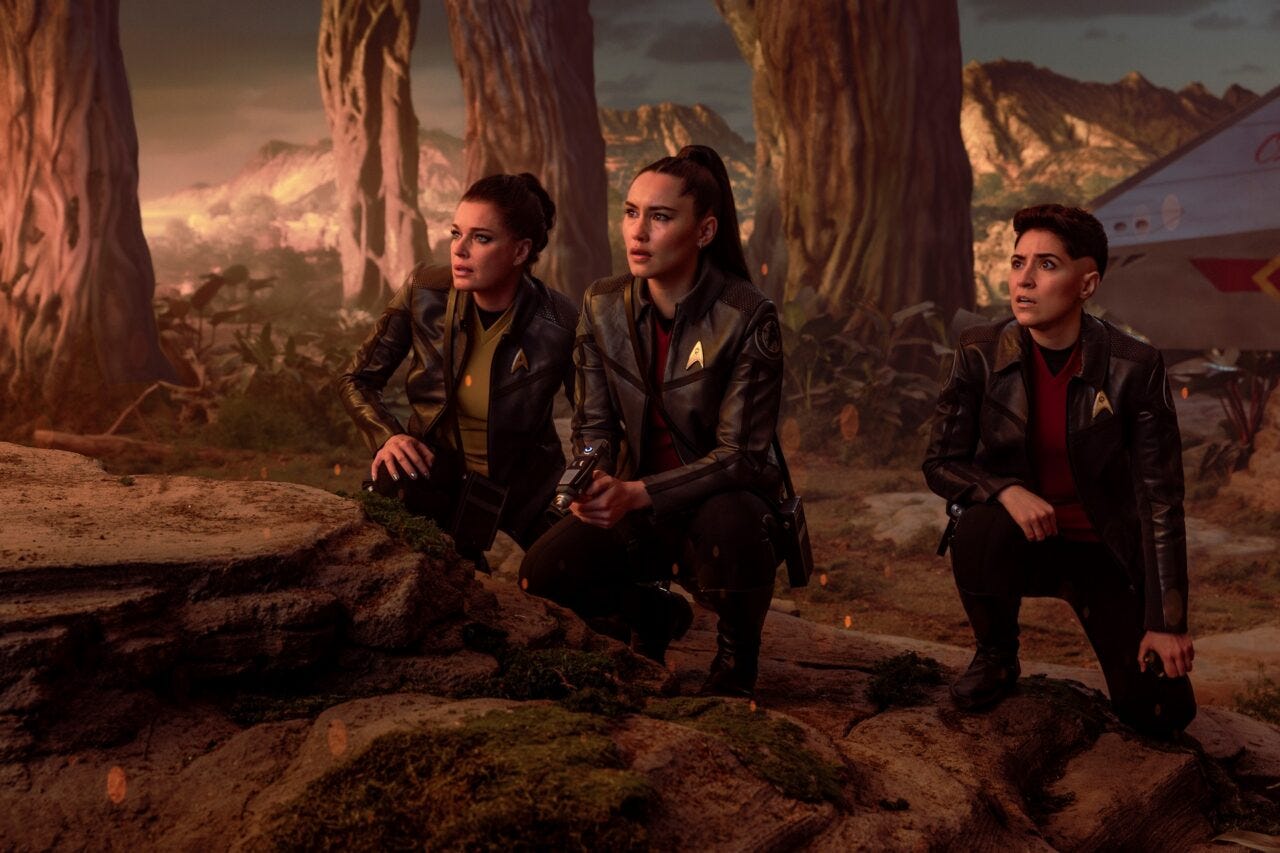
La’an’s arc reopens a canon problem the show created the moment it cast her. Her augmented genes begin activating by the episode’s end, prompting a scene where Christine Chapel tells her that having those genes doesn’t mean that’s who she is, a line that undercuts the entire premise of the augment stigma the franchise built around the Eugenics Wars. More pressing is the reminder that Spock and Kirk would already know exactly who Khan Noonien-Singh is well before “Space Seed,” given their history with La’an. The show has never resolved why neither man says a word when Khan turns up years later.
The episode also has a discipline problem that’s less about this story specifically and more about a pattern the show keeps repeating. La’an opens fire on the planet without waiting for an order, and Number One signs off on it after the fact without objection. Pike gives Ortegas a direct instruction on the bridge, and she answers “already on it,” having jumped the order before he finished giving it, despite having been reprimanded for the same habit before. Number One calls Pike “Chris” on the bridge in the middle of a formal moment. None of it derails the episode on its own, but stacked together it reads less like a Starfleet command crew and more like a social club that happens to wear uniforms. That’s a recurring issue with this show rather than something unique to the premiere.
Number One receives a promotion to Commander by the end of the episode. Pike turns down the Commodore promotion for himself.
The premiere garners a 7.5 out of 10. Strange New Worlds committed to a real science fiction premise with actual stakes attached to it, but the unacknowledged collision with the Progenitors and Preservers lore, on top of the discipline problems and the unanswered question of why antimatter isn’t already a standard weapon across the galaxy, are the kind of continuity holes that keep this episode from landing as clean as its visuals and its central paradox deserve.
Does tying the Chicxulub impact directly to the Enterprise crew, on top of a second and competing origin story for humanoid life across the galaxy, commit the franchise to more lore debt than future writers can realistically pay down?
First contact with the Oridians was supposed to be humanity’s proudest moment. Instead, their chief engineer is dead, their ship is sabotaged, and an ancient alien technology is stealing souls. Book one of the Valiant Frontiers series delivers exploration, mystery, and the kind of crew you’ll want to follow across the galaxy. Read The Soul Catcher on Amazon and start the adventure.
NEXT: This Klingon Fan-Film Series Does Star Trek Better Than Star Trek On Zero Budget, All With AI
Dol’drm = Doldrum = a state of inactivity, listlessness, or depression.
That's what this episode, which I haven't even seen, invokes in my mind.
Boredom.
OK, geek time engaged. The USS Intrepid was a TOS Federation ship crewed entirely by Vulcans, it was mentioned in "Court martial" and destroyed in "Immunity Syndrome". That does not derail your premise that Vulcan don't like working with humans in Star Fleet, that may have been solved by giving them a ship of their own crewed strictly by Vulcans.