


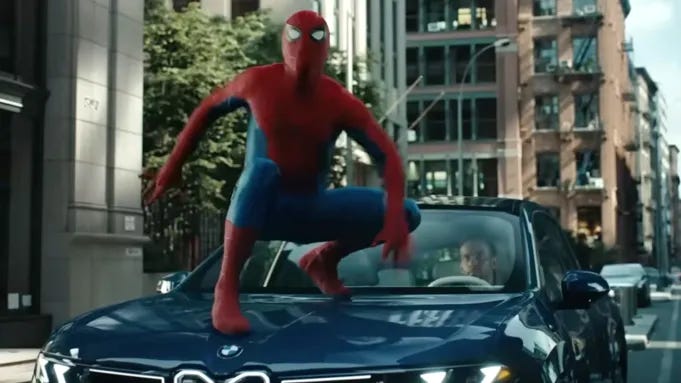
Spider-Man: Brand New Day opened July 31 and immediately started rewriting box office record books. The film pulled in $355 million from 4,487 North American theaters, the second-biggest domestic debut in history behind Avengers: Endgame’s $357 million, and China alone delivered over $71 million in its first day there. Critics and audiences lined up behind it too, with a 90 percent critic score and a 98 percent audience score on Rotten Tomatoes. The numbers back up what plays out on screen over two and a half hours: this is the strongest Peter Parker Tom Holland has put on film, even with some rough patches along the way.
The Setup
Director Destin Daniel Cretton, working from a script by returning writers Chris McKenna and Erik Sommers, picks up after the memory-wipe ending of No Way Home. Neither Ned nor MJ remember Peter anymore, and MJ has moved on to a new boyfriend. Aunt May is gone, killed off before this film even starts, and Marisa Tomei’s casting in that role continues to draw the same complaint it always has: she was too young for the part from the day she was announced. Ned sticks around mostly as comic relief, a character whose presence still feels more like a box checked for the sake of the ensemble than someone Peter actually needs.
Peter spends most of the runtime alone with what he lost, patrolling the city in secret while every other character in his orbit tells him to stop moping and do something about it. That framework carries the film well. The pacing holds up for most of the two and a half hours, and the balance between action and personal drama never tips too far in either direction. The dialogue stumbles in a few spots getting there. A scene where Black Widow lectures Peter about not wanting to be alone, followed later by Frank Castle giving him relationship advice, reads a little off for two characters built on ruthless pragmatism rather than therapy talk. It still does its job. Both scenes exist to raise the emotional stakes for what Peter is about to lose again, and the plot earns the beats even where the specific lines don’t quite fit the characters delivering them.
The Villain and the Government Overreach Angle
The film’s mysterious threat, a telepath who can seemingly control anyone’s mind except Spider-Man’s, turns out to be Jean Grey, played by Sadie Sink, marking the character’s introduction into the MCU. She’s searching for something called V-Max while hopping between bodies across New York, working to break into facilities run by the Department of Damage Control. She isn’t the villain the setup makes her out to be. Her sister Sara had the same telepathic powers, was captured by Damage Control, and was killed during the agency’s experiments on her. Once Peter figures out he’s been fighting for the wrong side, the film pivots into a straightforward indictment of a government agency running unchecked experiments and violating basic rights in the process.
That turn works because it doesn’t need to be explained twice. A government program overstepping its bounds and treating people as test subjects isn’t a hard sell to any audience that lived through the last several years, and the film trusts viewers to make that connection without spelling it out in dialogue. The visualization of Jean’s ability, watching bystanders stagger as she jumps from body to body within a set radius, gives the concept a genuinely fun payoff on screen rather than treating it as a throwaway power.
MJ and the Emotional Stakes
The relationship material with Zendaya’s MJ carries real weight despite the character’s memory wipe resetting things from scratch. When Jean forces a kiss on Peter through mind control partway through the film, Peter apologizes for it afterward, and MJ brushes it off instead of playing the victim, a choice that could easily have gone a very different direction in a modern studio film. It pays off later when Peter finally tells her how he feels and she tells him flatly that she doesn’t love him back. That single moment lands harder than most of the action in the film, and it’s the strongest scene Zendaya gets in the role.
Comic Book Easter Eggs
Readers who grew up with the comics get rewarded throughout. The film restages the Amazing Fantasy #15 cover and the Todd McFarlane Spider-Man #1 cover, and it reworks the Punisher’s first appearance, sniper scope and all, into a new context within the current plot. None of it plays as a wink to the camera. These are built into the story with intention rather than dropped in as a nod for people scanning for references, and it’s the kind of attention to the source material that separates a film made by people who know the comics from one made by people who only know the wiki summary.
Performances and Visuals
Tom Holland sells this version of Peter Parker better than he has in any of his three prior outings, carrying long stretches of the film through body language alone under the mask. Jon Bernthal gives his most complete take on Frank Castle across any of his appearances in the role. Sadie Sink wasn’t an obvious choice for Jean Grey going into the film, but the way the script handles her arc won over any doubts about the casting once her motivation comes into focus.
The visuals look expensive throughout, which isn’t a surprise given the budget behind the production. Some of the swinging shots and a CGI-heavy brawl against a crowd of enemies lean too far into video game territory, weightless in a way that undercuts the otherwise grounded tone of the rest of the film. It’s a minor complaint. Nothing in those sequences pulls the viewer out of the story entirely.
Where It’s Headed
This is a street-level Spider-Man story with no multiverse detours, and the ending sets up a more cosmic direction for the character going forward. The “Brand New Day” amnesia reset borrowed from the comics, one of the weaker ideas in Spider-Man’s publishing history, gets handled with more care here than the source material ever managed, and the film also draws on elements of J. Michael Straczynski’s “Spider-Man: The Other” storyline for Peter’s evolving powers.
Hollywood’s habit of wiping out established relationships just to rebuild them from scratch, rather than telling stories about people who are already together, shows up here again, and the ending sets up round two of that same rebuild for the next film. It’s a minor gripe against a film that otherwise earns its momentum, and the studio has already teased where Peter’s relationships go from here.
The Verdict
Eight out of ten. Newcomers can follow Brand New Day without having seen the three Homecoming-era films thanks to the memory-wipe reset, though longtime viewers get the fuller emotional payoff from the relationships being rebuilt. Between the box office numbers and the reception so far, Sony and Marvel found a way to make the fifth Holland outing feel like a fresh start rather than a retread.
Does Marvel finally have its formula back on track after the post-Endgame slump, or is Brand New Day riding the simple scarcity of a five-year gap since the last Spider-Man film?
First contact with the Oridians was supposed to be humanity’s proudest moment. Instead, their chief engineer is dead, their ship is sabotaged, and an ancient alien technology is stealing souls. Book one of the Valiant Frontiers series delivers exploration, mystery, and the kind of crew you’ll want to follow across the galaxy. Read The Soul Catcher on Amazon and start the adventure.

NEXT: J. Michael Straczynski Takes Babylon 5 To The Podcast Arena After Years Of False Starts
"Marisa Tomei’s casting in that role continues to draw the same complaint it always has: she was too young for the part from the day she was announced."
This may be true, but she's still the hottest Aunt ever!
Sigh. Good article Jon but how about clearer separation between a general review and more detailed spoilers?