



Apple TV+ closed out “Silo” Season 3 on September 4 with an episode titled “Troy,” and after nine episodes of the show hoarding its answers, the finale finally opens the vault a little bit, even if it took far too long to get there. We’re still left with more questions than what they provide.
Season 3 spent most of its runtime splitting screen time between Silo 18 in the present and a “Before Times” flashback thread following Congressman Daniel Keene (Ashley Zukerman), his sister Charlotte (Jessica Brown Findlay), and journalist Helen Drew (Jessica Henwick) in the lead-up to the dirty bomb attack blamed on Iran. That flashback thread ran as pure backstory for nine straight episodes, circling events the present-day timeline had already confirmed happened. The finale finally catches the audience up on why that backstory mattered, but the show spent an entire season getting there when the same ground could have been covered in a fraction of the time.
The reason it took that long traces back to a decision showrunner Graham Yost made before a single Season 3 script existed. Season 3 draws primarily from Hugh Howey’s novel “Shift,” and in that book Juliette Nichols barely appears. She is absent for nearly the entire novel and only shows up in its final pages. Yost has been open about the problem that created for a series built around Rebecca Ferguson: “We’ve got Rebecca Ferguson and her face is on the poster, so we weren’t gonna have a whole season without her.” Rather than adapt “Shift” as written, with its focus on Congressman Donald Keene waking up centuries later as Troy, Yost told Howey directly the show would not sideline its lead for a full season, and Howey let the writers room run with it. Yost also renamed the character from Donald to Daniel, a change he has said was made to avoid the character sharing a first name with a sitting president, though the surname, the sister, and the Georgia congressional seat all stayed intact.
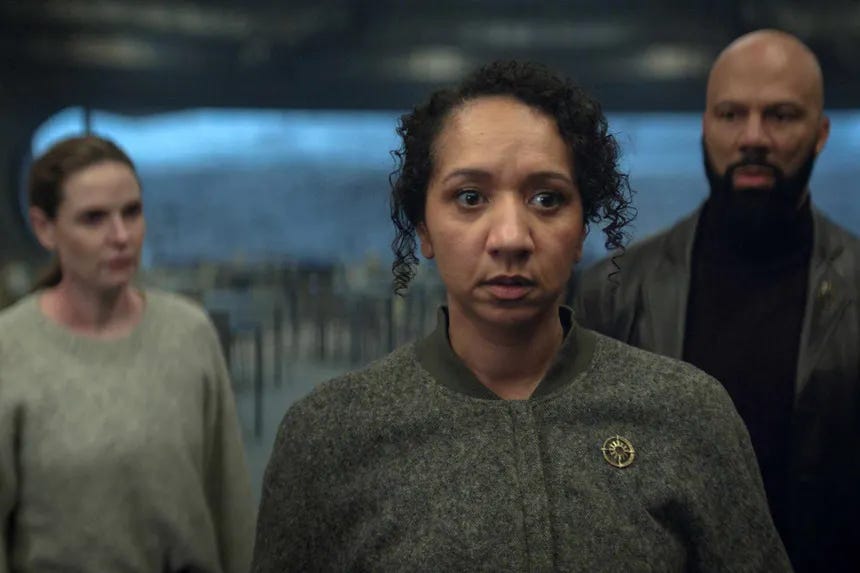
That is the root of everything dragging about this season. Daniel Keene’s storyline never had a version where it ran in parallel with a full Juliette arc, because the book never gave Juliette one to run. The show invented the parallel structure from whole cloth to keep its star in every episode, and what should have been condensed backstory got stretched into a co-equal storyline eating half the season’s runtime. Daniel spends most of Season 3 as a passive vehicle for exposition, a congressman pulled into a conspiracy he barely understands, offering little reason to invest in him even once the show finally reveals what he becomes.
“Troy” opens with Daniel waking from cryogenic sleep inside Silo 1, years after the events the season spent its runtime building toward. He answers to Troy now, cycled in and out of stasis for years or decades at a stretch, pulled out only when Silo 1 needs him. Why a former congressman gets cycled through cryogenic sleep instead of simply being replaced by the next generation of administrators is a question the episode raises and never answers. The finale reveals that Victor Crnkovich has been the voice behind The Algorithm all along, running the silos from behind a curtain like the man in “The Wizard of Oz,” and that Silo 17 was slaughtered outright when its residents tried to leave and make contact with other silos. Silo 1 does not tolerate silos going outside their boundaries, and it kills to enforce that rule.
What the finale does not do, even after nine episodes of built-up expectation, is explain why the rule exists in the first place. Fans get the how. The who finally has a face attached to it, and that face turns out to belong to a storyline invented to solve a scheduling problem rather than one the source material demanded. The why, the actual reason 10,000 people per silo live under a regime willing to gas an entire population rather than let them talk to their neighbors, remains locked away for Season 4. Three seasons in, that is not a mystery box anymore. That is a show banking on the audience’s patience running longer than its writers’ room takes to produce a payoff.
Inside Silo 18, Juliette Nichols (Rebecca Ferguson) and mayor Camille Sims (Alexandria Riley) run a con on the rebel faction threatening to kill hostages, tricking them into believing the water supply is about to erase their memories when it is actually being flooded with oxygen. Juliette finds a tunnel leading toward the standoff, and the episode ends with a negotiated peace: Silo 18 gets to keep living so long as nobody tries to contact another silo again. Meanwhile Troy starts to recover flashes of a woman his cryogenic cycles wiped from his memory, and the episode closes with a video message from Victor that finally tells him who Helen Drew was.
That is the entire season finale. A name gets attached to a face he already half remembered. A truce gets negotiated that keeps the status quo intact. The show that promised Season 3 would finally deliver answers spends its last hour re-arming the same mystery box and shipping it off to Season 4 with a new bow on it, after building an entire invented storyline to get there.
Streaming television has run this exact play before, and “Lost” is still the cautionary tale every mystery box show gets measured against. Six seasons of accumulated questions, and when the answers finally arrived, they collapsed under the weight of everything they were supposed to justify. “Silo” is now three seasons deep into the identical bet, and Season 3 spent half its runtime on a storyline that only exists because keeping a poster-ready star on screen mattered more than trusting the source material.
Episodes 9 and 10 were the first stretch all season where something actually happened on screen, and that is worth crediting on its own. But nine episodes of invented table-setting to earn one competent finale is not a good trade, and a season that could have been told in half the runtime does not get graded on the strength of its last hour alone. This one lands at a 6 out of 10, carried almost entirely by a finale that finally moved.
Season 4 has been confirmed to wrap up the trilogy through Howey’s third book, “Dust.” If it does not finally deliver the why behind the Safeguard and the silos themselves, the entire invented Before Times detour will have existed for nothing more than keeping Rebecca Ferguson on screen every week. How many more seasons of manufactured mystery is an audience supposed to sit through before deciding the answers were never coming?
First contact with the Oridians was supposed to be humanity’s proudest moment. Instead, their chief engineer is dead, their ship is sabotaged, and an ancient alien technology is stealing souls. Book one of the Valiant Frontiers series delivers exploration, mystery, and the kind of crew you’ll want to follow across the galaxy. Read The Soul Catcher on Amazon and start the adventure.

NEXT: Lanterns’ Writer and DC’s Podcast Host Are Now Openly Arguing the Franchise Is Sexist and Racist