


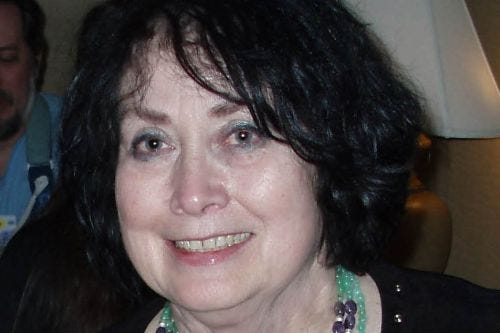
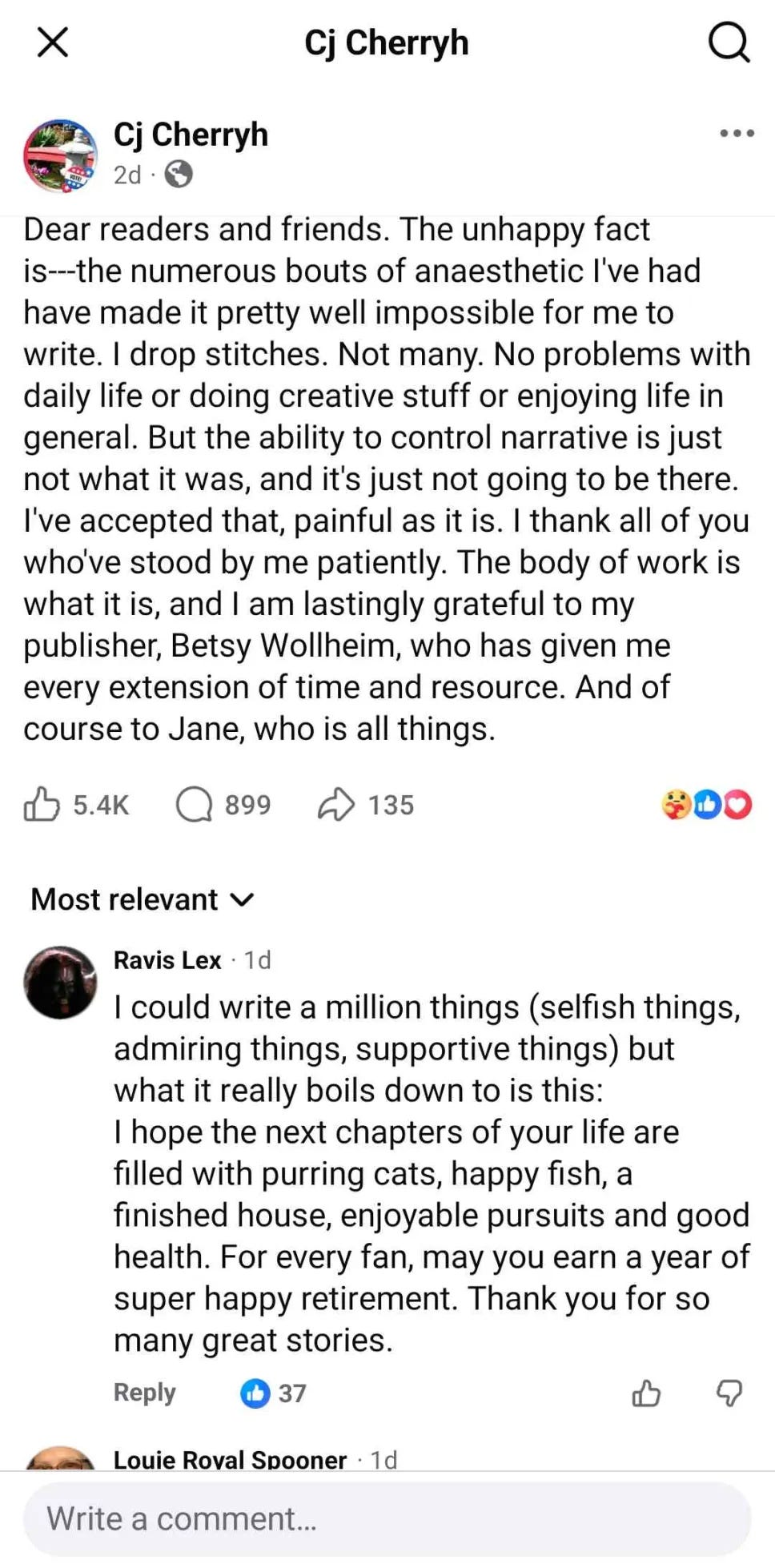
C.J. Cherryh posted a farewell to her readers on Facebook this week. She is 83 years old. The post read in full:
“Dear readers and friends. The unhappy fact is---the numerous bouts of anaesthetic I’ve had have made it pretty well impossible for me to write. I drop stitches. Not many. No problems with daily life or doing creative stuff or enjoying life in general. But the ability to control narrative is just not what it was, and it’s just not going to be there. I’ve accepted that, painful as it is. I thank all of you who’ve stood by me patiently. The body of work is what it is, and I am lastingly grateful to my publisher, Betsy Wollheim, who has given me every extension of time and resource. And of course to Jane, who is all things.”
“The ability to control narrative is just not what it was.” From a writer who spent fifty years building some of the most architecturally complex fictional universes in science fiction, that single sentence carries the full weight of what she is describing and accepting.
Carolyn Janice Cherry was born September 1, 1942 in St. Louis, Missouri and raised in Lawton, Oklahoma. She began writing at age ten, motivated by the cancellation of her favorite television show, Flash Gordon. She earned a Bachelor of Arts in Latin from the University of Oklahoma in 1964, a Master of Arts in classics from Johns Hopkins in 1965, and taught Latin, Ancient Greek, and ancient history at a high school in Oklahoma City for eleven years before DAW Books editor Donald A. Wollheim purchased her first two manuscripts in 1975.
She added the silent “h” to Cherry at Wollheim’s suggestion, who felt “Cherry” sounded too much like a romance novelist. She used only her initials to avoid the bias against female science fiction writers that was standard practice in the industry at the time. The pen name C.J. Cherryh disguised both the femininity of her first name and the plainness of her surname. What it could not disguise was the quality of the work.
Her first two novels, Gate of Ivrel and Brothers of Earth, published in 1976, established the creative instincts that would define her career: alien cultures built from the inside out, human characters dropped into political and psychological situations beyond their full comprehension, and prose dense enough to require active reading. She won the John W. Campbell Award for Best New Writer in 1977, the same year her debut novels appeared. In 1979 her short story “Cassandra” won the Hugo Award for Best Short Story. She quit teaching that year to write full time.
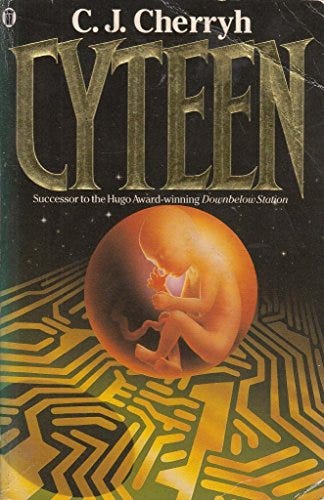
What followed was one of the most prolific sustained careers in the history of the genre. Over fifty years she published more than 80 novels, constructing interconnected future histories of such scope and internal consistency that academics produced book-length studies of them. Her Alliance-Union universe alone spans dozens of novels set across thousands of years of human expansion, covering the Company Wars, the Merchanters, the Hani, the Kif, and the long downstream consequences of humanity reaching the stars. Downbelow Station won the Hugo Award for Best Novel in 1982. Cyteen won it again in 1989. Three Hugos total, plus the Campbell, the Locus, the Prometheus, the Nebula, the Skylark, and the SFWA Grand Master award in 2016 — the field’s highest career honor, placing her alongside Isaac Asimov, Arthur C. Clarke, Ray Bradbury, and Ursula K. Le Guin.
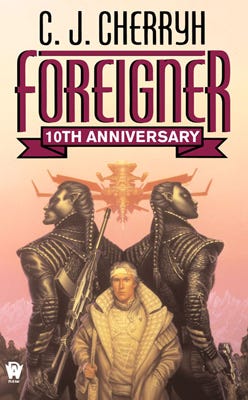
Her Foreigner series, which began in 1994 and ran to at least 23 volumes, traced the relationship between a human diplomat and the alien atevi across decades of cultural negotiation, miscalculation, and hard-won understanding. It became one of the longest-running science fiction series with a consistent readership in modern publishing, with readers returning for each new installment not because of action set pieces but because Cherryh built characters and alien societies worth caring about for their own sake.
She described her approach to alien minds as the central challenge of her work: not to make aliens human in disguise, but to make them genuinely other while still comprehensible enough to generate empathy. The asteroid 77185 Cherryh, discovered in 2001 and named in her honor, came with a citation from its discoverers: “She has challenged us to be worthy of the stars by imagining how mankind might grow to live among them.”
She is in a lesbian relationship with Jane S. Fancher, who collaborated with her on several later novels and is the “Jane” named in the farewell post. Her publisher Betsy Wollheim, daughter of Donald Wollheim who bought Cherryh’s first manuscripts in 1975, has run DAW Books since her father’s death and maintained the relationship across five decades. The gratitude in Cherryh’s post toward Wollheim for “every extension of time and resource” reflects a publishing partnership that lasted longer than most careers in the industry.
The body of work is what it is. That is how she chose to put it, and it is the right frame. Eighty-plus novels. Three Hugos. A Grand Mastership. An asteroid. Fifty years of readers who found in her Alliance-Union universe and her Foreigner series a kind of science fiction that took the difficulty of understanding other minds seriously and never condescended to the reader.
We wish C.J. Cherryh every good thing in whatever comes next.
What is your favorite C.J. Cherryh novel or series? Leave it in the comments.
Space marines on a holy crusade across the galaxy. If that sentence got your attention, Justified: Saga of the Nano Templar is your next read. Three books of relentless action Read Justified: Saga of the Nano Templar on Amazon!

It would be really hard to choose a single book, maybe Rimrunner, since I really enjoy the Alliance-Union universe. I wish her the best and understand the need to leave on her own terms and without compromising her standards. David Drake did the same thing.
I am recalling a piece written by Harlan Ellison from 1986, after he had attended something like his fourth funeral that year, and in this piece he railed against the stupidity of death in regards to how much knowledge is lost whenever someone like Theodore Sturgeon or Judy-Lynn Del Rey passed away (two of the four in question).
Me personally, it's just as bad when a similar titan sees their creative sunset but might still have a few years of existence still to go.