


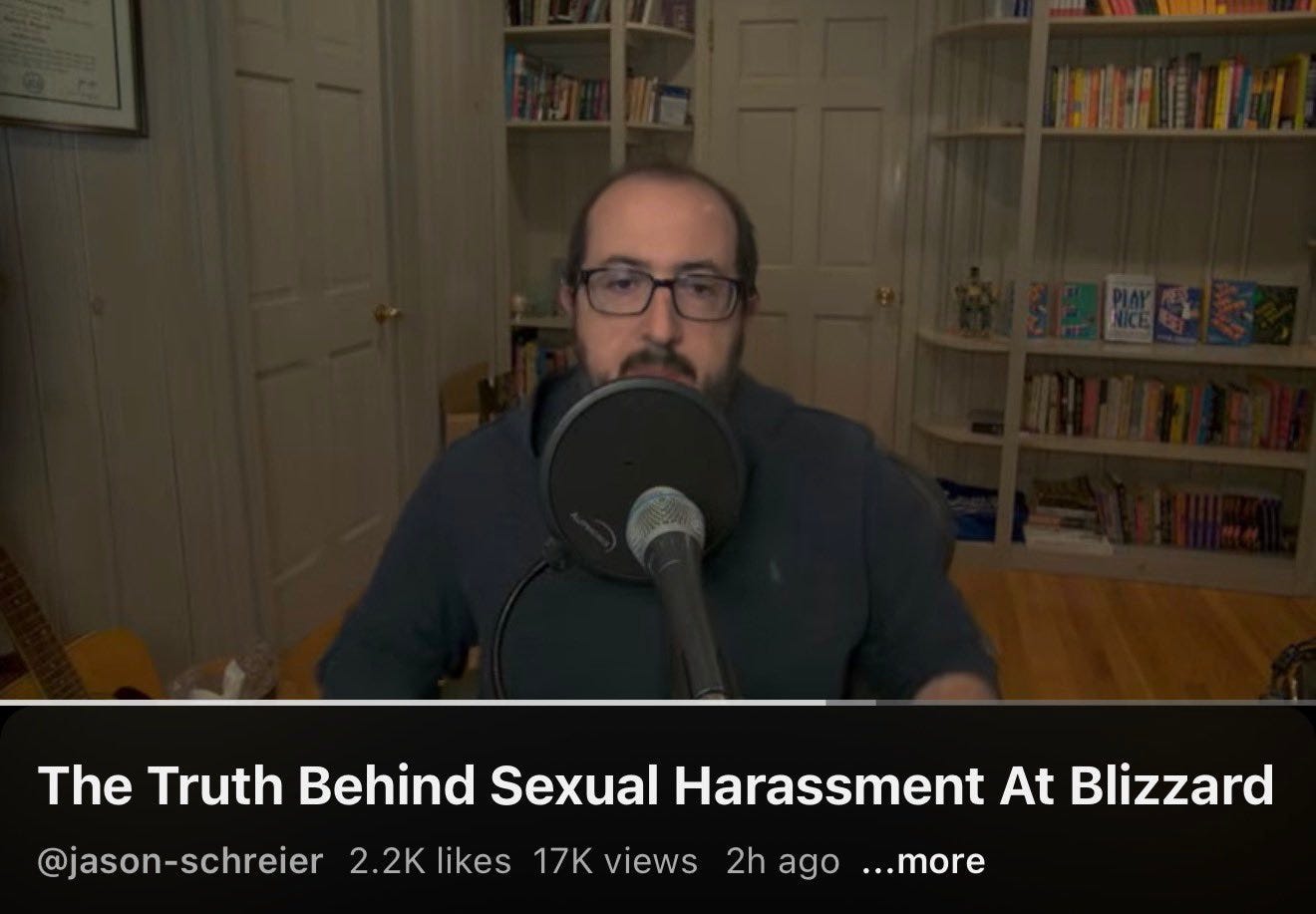
Jason Schreier put out a new video defending his Activision Blizzard reporting, and we have to ask a simple question after watching it: where’s the proof?
For anyone unfamiliar with the players here, Schreier is a Bloomberg reporter who spent roughly eight years at Kotaku building a reputation on video game industry investigations, particularly around crunch culture and labor conditions. He’s the author of Play Nice, a history of Blizzard Entertainment published in 2024, and it’s his Bloomberg reporting and that book he’s now defending. His critic, Grummz, is Mark Kern, a game industry veteran who worked at Blizzard itself in the late 1990s and early 2000s as a producer on StarCraft and Diablo II and as team lead on the original World of Warcraft, before leaving to co-found Red 5 Studios. Kern has spent years as an outspoken industry commentator, and he’s not new to pushing back on games journalism he views as agenda-driven.
The backdrop is the 2021 lawsuit California’s Department of Fair Employment and Housing filed against Activision Blizzard, alleging widespread sexual harassment and discrimination. It was an explosive story at the time. It triggered walkouts, protests, and ultimately factored into Microsoft’s acquisition of the company. It’s also the case that ended in a settlement carrying language that undercuts a lot of what got reported in the years since, which is exactly what this new dispute is about.
Schreier spends the opening minutes of the video dismissing his critics as “outrage merchants” and “squealing cretins” who don’t ask questions or talk to sources. That’s a strange opening move for someone about to deliver an argument built almost entirely on unnamed sources and vague characterizations, or “outrage merchanting,” as one might put it. He tells his audience to trust him because he “spent all day on the phone with people,” while the people he criticizes get mocked for supposedly not doing that work. Fine, but a phone call isn’t evidence. It’s an anecdote. And the video is packed with anecdotes standing in for proof.
The Settlement Language He Can’t Talk Around
The most important moment in the video is the one Schreier himself reads out loud and then rushes past. The Activision Blizzard settlement states, in his own quoted words:
“No court or any independent investigation has substantiated any allegations that there has been systemic or widespread sexual harassment in Activision Blizzard... or that Activision Blizzard’s board of directors, including its chief executive officer, Robert Kotick, acted improperly with regard to the handling of any instances of workplace misconduct.”
Schreier reads it, and dismisses it, calling it “the core of this week’s outrage merchant argument,” and then pivots immediately into a fresh round of anonymous anecdotes as if that pivot answers the problem. It doesn’t. It sidesteps it.
Grummz Asked the Right Question
Grummz’s response cuts right to it:
“If Jason is so confident in his ‘truth’ he should name names and cite exactly what they did. I’m sure it would all hold up and not be slander and libel right? He can’t get sued if they are true facts. Oh wait, he only named 2 names that were in the CA lawsuit against Blizzard? Claims that were subsequently dropped by the State as reported by the NYT? Instead we get a lot of ‘people said’ and ‘it was well known’ and a lot of vague posting. Hmmmm!”
That’s the issue. Schreier’s video is loaded with phrases doing a lot of unverifiable lifting like “many women told me,” “it was well known,” “a common theme,” “six different women.” A handful of people go on record by name. The sweeping cultural claims rest on “many,” “several,” and “some,” which cannot be checked, cannot be cross-examined, and conveniently cannot be sued over either.
A Story Built to Generate Reaction, Not Resolve Anything
Notice the structure of the video itself. Schreier opens by framing his critics as bad-faith attention farmers feeding an “ecosystem that rewards people getting paid for spreading misinformation.” Then he spends the rest of the runtime doing exactly what he accuses them of, building a long, emotionally charged narrative heavy on scandal-adjacent details (a hotel party nickname, a tech department’s drinking habits, executive dating rumors) that generate outrage and shares, while the actual substantiated legal record says the opposite of what the narrative implies.
If the goal were clarity, the settlement language would be the headline, not a footnote he reads once and moves past. If the goal were accountability, the named allegations would stand on their own without needing forty minutes of unnamed “many women said” padding around them. Instead what you get is a video engineered to keep a three-year-old story alive, generate clicks off a controversial topic, and cast anyone questioning the framing as a liar before they’ve said a word.
Grummz noticed the same thing everyone should notice: when someone insists their story is airtight but won’t put names to most of it, that’s not caution. That’s the tell.
What do you think, is this a real accountability story, or just another drama cycle designed to keep views up?
NEXT: Another Star Trek Game Is Being Erased Entirely, And It’s The Fourth One In Ten Months
I found out Schrier is a gay communist (literally), and now I understand why he devoted his career to making games have ugly female characters and putting straight white males through humiliation rituals.
I can't believe Bloomberg hired this asshat. As if they needed the extra loss of credibility.
He never did anything especially notable except keep up on things like EA_Spouse. Extra special because only every other site was covering it.