


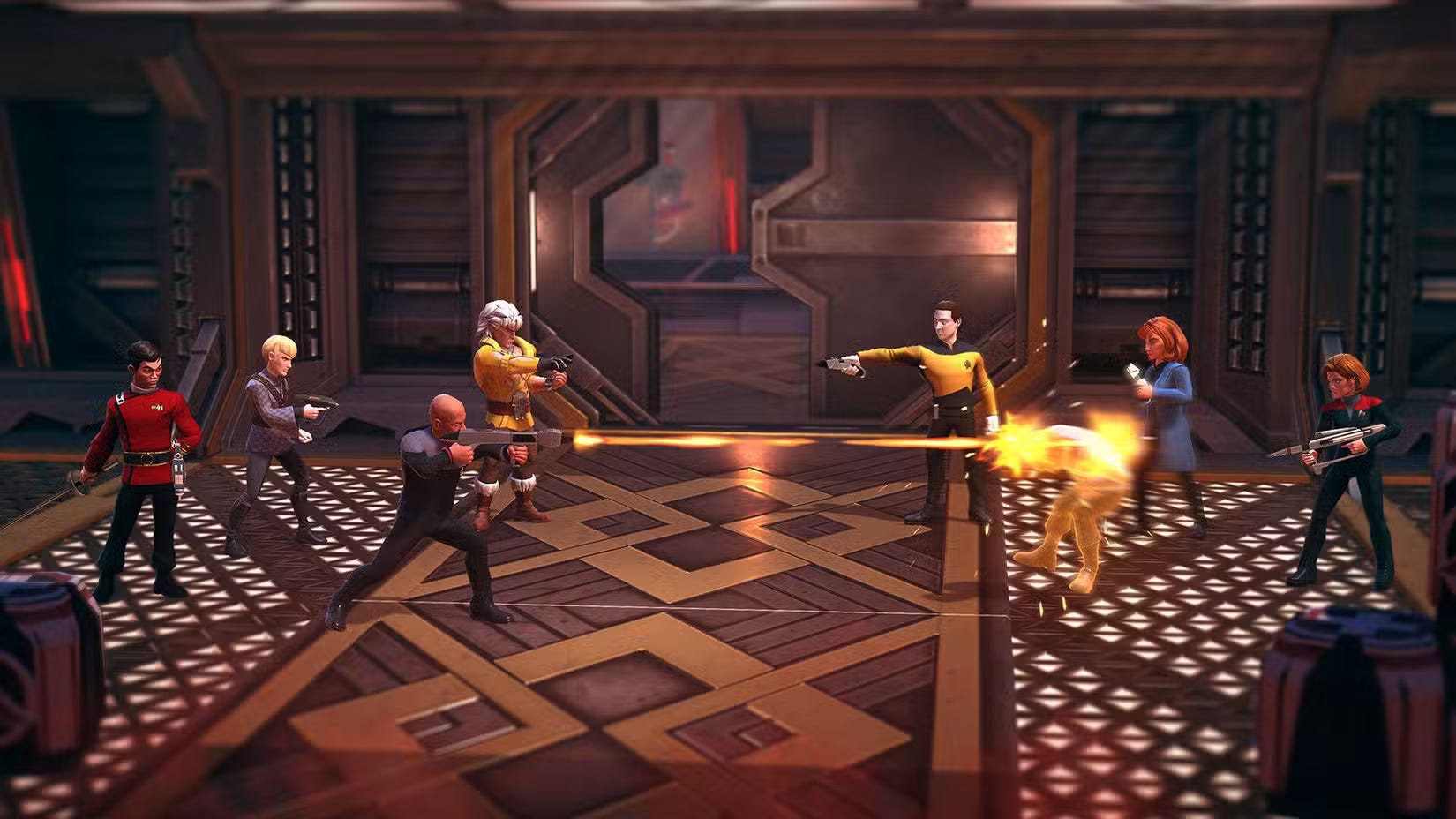
Star Trek: Legends is being killed, and not in the usual way a mobile game quietly dies. Developer Tilting Point confirmed the RPG will be pulled from every remaining storefront, Steam, the Epic Games Store, and the Microsoft Store, on August 20, 2026, with servers shutting down permanently on September 3. After that date, the game becomes completely unplayable on every platform, including its own single-player content. Console versions on PlayStation, Xbox, and Switch had already been quietly delisted without warning weeks earlier.
That last detail is what makes this shutdown different from a typical live-service sunset. Star Trek: Legends is built around substantial offline content: turn-based team combat, resource collection, and a hero-unlock system players can engage with entirely disconnected from any server. As GameRant’s own reporting put it, “Star Trek: Legends has extensive offline content that could still keep players engaged, but the publisher plans to take down the entire game, removing both its offline and online features.” There’s no technical reason a purely single-player mode needs to stop functioning when a publisher decides to move on. Tilting Point hasn’t given fans a specific reason for the shutdown at all, only thanking the community in a farewell message, but the timing and pattern point squarely at one explanation: licensing costs. Keeping the Star Trek name attached to a five-year-old mobile-turned-PC RPG with modest player numbers isn’t worth whatever Paramount charges to keep that license active, so the whole product gets erased rather than simply left alone to run offline for the people who already paid for it.
This isn’t an isolated case, either. Star Trek: Legends is the fourth Star Trek game delisted in roughly the past ten months. Star Trek Prodigy: Supernova was pulled last September. Star Trek: Resurgence, a narrative adventure game that received genuinely positive reviews across most platforms, was delisted from Steam and Switch earlier this year despite that critical reception, an outcome that left plenty of players who’d been meaning to pick it up simply unable to. Paramount’s pattern of swapping and lapsing licenses across its game partners keeps producing the same result: functioning, purchased products disappearing entirely, regardless of quality or whether an offline mode exists that could have kept them playable indefinitely at zero ongoing cost to anyone.
This is exactly the practice a real consumer movement has spent the last two years trying to stop, and it’s worth understanding why that fight came up empty. Stop Killing Games, founded by Ross Scott after Ubisoft’s 2014 racing game The Crew was rendered permanently unplayable in 2024, built a formal European Citizens’ Initiative demanding publishers leave discontinued games “in a reasonably functional (playable) state” rather than remotely disabling them entirely. The campaign gathered 1,294,188 verified signatures, well past the one million threshold required to force a European Commission response, and was formally submitted in January 2026. On June 16, 2026, the Commission answered: no binding legislation. Citing intellectual property and copyright concerns, the Commission said it couldn’t legally require publishers to keep games playable after ending commercial support, offering instead a voluntary industry code of conduct to be developed by the end of 2026 and a consumer-awareness campaign about existing rights. Ross Scott’s response was blunt: “We can move on without the Commission and their non-decision,” confirming the movement is now pushing to fold its demands into the EU’s upcoming Digital Fairness Act instead, alongside a parallel effort in California, where AB 1921, the Protect Our Games Act, passed the state assembly in May requiring at least 60 days’ notice before a game shutdown.
A voluntary code of conduct, written by an industry that includes the same publishers currently deciding whether to strip offline modes from games they no longer want to support, isn’t a meaningful check on anything. Star Trek: Legends is a clean, specific example of exactly the gap Stop Killing Games was trying to close: a game with real offline content, no technical dependency on ongoing servers for most of what it offers, being made entirely unplayable anyway because a licensing relationship expired. Nobody who bought Star Trek: Legends is getting a refund, and nobody gets to keep playing the parts of it that never needed a server in the first place. When four installments of the same franchise get erased this way inside less than a year, the pattern stops looking like routine business housekeeping and starts looking like an open question worth asking directly: if a publisher can delete something you paid for at will, whether or not it ever needed their servers to function, what did you actually buy?
First contact with the Oridians was supposed to be humanity’s proudest moment. Instead, their chief engineer is dead, their ship is sabotaged, and an ancient alien technology is stealing souls. Book one of the Valiant Frontiers series delivers exploration, mystery, and the kind of crew you’ll want to follow across the galaxy. Read The Soul Catcher on Amazon and start the adventure.
NEXT: Xbox’s Layoffs Triggered an Industry-Wide Panic, and the Reactions Keep Piling Up
Just don’t buy Star Trek games. Physical copies only.
Originally, licensed games were the worst of the worst because the publishers didn't care about making a good game, only about the sales that would come from slapping a known IP on the box.
Anyone remember LJN games?
Now, licensed games are the worst of the worst because publishers will kill them off and take them away from you as soon as the balance sheet demands it.
And it will always demand it.
It's not worth buying one now. Even if a licensed game is great, eventually, the original console or system will become obsolete or stop working. You won't be able to redownload it as it's long since been delisted and the original storefront is shut down too.
Good luck getting a remaster or rerelease because whatever movie/show/IP it's attached to isn't "IT" right now, so what publisher would even bother? But even if they do, it'll be a case of PAY US MORE, and eventually, the remaster will disappear too.
Remember Simpsons Hit & Run or the 3-4 good LOTR games? If you don't have a physical disc and a functional system to play them on: TOO BAD, SO SAD.