


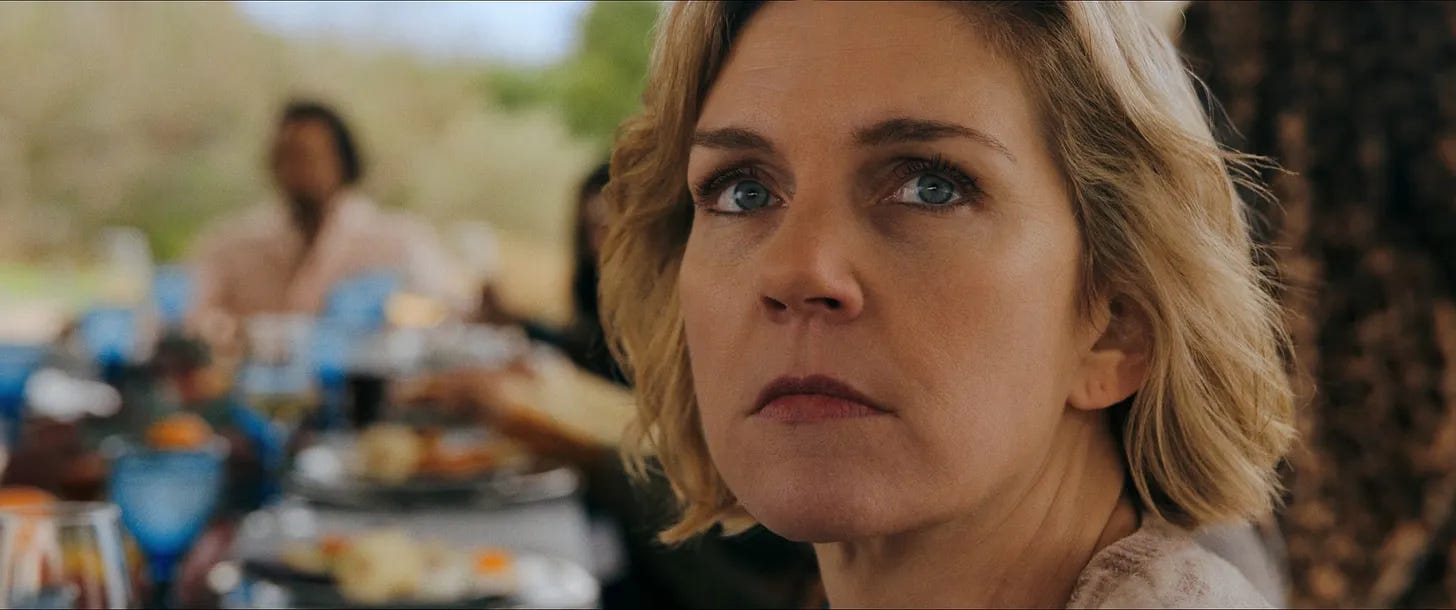
Variety published a new interview today with Rhea Seehorn and Bryan Cranston, the two principal actors in Vince Gilligan’s corner of prestige television. Most of it is warm career retrospective. The relevant section concerns Seehorn’s character on Pluribus, the Apple TV+ sci-fi series now in its second season, and the fan complaint that has dogged the show since its first season launched last year: Carol Sturka is not a likable person.
For readers who haven’t caught Pluribus, the premise is Gilligan’s inversion of the alien invasion genre. Nearly every human being on earth has undergone “the Joining,” a mass possession event that converts people into relentlessly cheerful, optimistic automatons. Seehorn plays Carol, a romance novelist among the thirteen people on the planet who remain unconverted. Carol is not heroic. She is, in Gilligan’s own description as relayed by Seehorn, designed around the question: “What if the most miserable person on Earth had to save the world from happiness?”
Variety pushed on the fan likability complaints, and in doing so handed Seehorn an easy opportunity to play victim. She did not take it.
It started with this interchange: “Vince’s little logline that he came up with was, “What if the most miserable person on Earth had to save the world from happiness?” And we had a couple people say, “I don’t think she’s the most miserable.” Certainly, the brilliant Carlos Manuel Vesga’s portrayal of Manousos is pretty angry. I would also put out there that — and Vince has said this on panels — nobody asked that about Walter White. Nobody asked that about Jimmy McGill: “What’s up with them being so unlikable?” They were behaving in an honest way to the situation they were in.”
Cranstonthen asked: “You think it’s a gender issue?”
She replied, “I don’t know. When people are like, ‘She’s so unlikable,’ I’m like, her wife’s dead; they killed her. Career’s done, might not ever be back. You may very well die alone and never speak to anybody again on a couch eating a frozen meal, watching ‘Golden Girls.’ There are no friends anymore, there’s no family and the world is saying, ‘We’re just waiting around until we can take your brain away.’ And she’s not polite about it.”
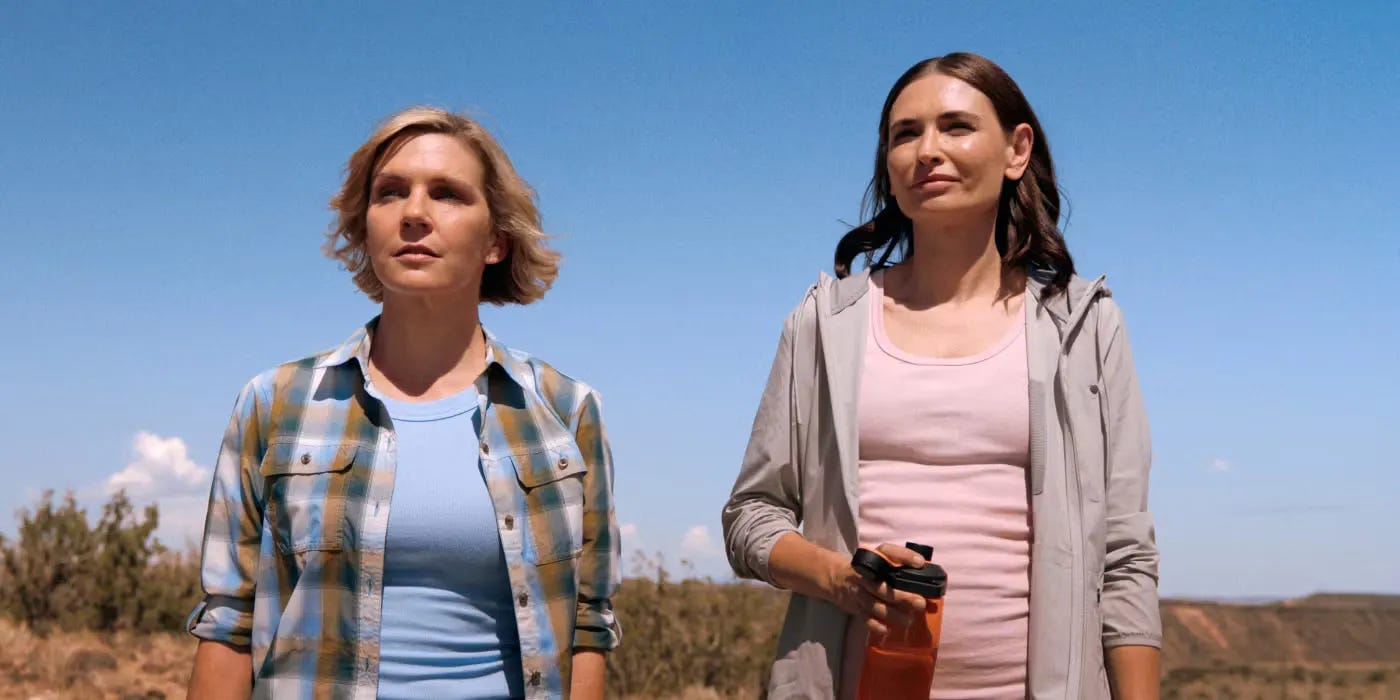
She immediately redirected to Gilligan’s instruction to play the character with complete realism given an absurd situation, and left the gender grievance on the table untouched. Variety clearly wanted her to pick it up. She declined.
Her restraint is worth noting because it is not what the current entertainment press cycle rewards. Seehorn had a ready-made narrative, “fans call her unlikable because she’s a woman,” and she chose not to run with it. Her co-star raised the prompt and she answered with a shrug and a pivot back to craft.
What she did not avoid entirely was the identity politics baked into the show’s construction. The character is written as a lesbian, which Seehorn acknowledged without much elaboration. This was an Apple TV choice: Vince Gilligan originally conceived the Pluribus lead as a man. The network pushed for a female lead to create what has become a recognizable pattern in prestige streaming, the mandatory strong female lead regardless of original creative intent. The gender swap brought the lesbian characterization as part of the same package. Seehorn plays it without making it the center of every interview, which is something.
In the rest of the interview, Cranston describes the experience of shooting Breaking Bad without knowing where the story was going. He recounts performing a scene in which Walter White furiously denies poisoning a child, then receiving the next script days later and discovering Walter did in fact poison the child. He describes his performance choice: play the denial as completely genuine, because Walter had to be believable. It is a useful data point on how Gilligan’s withhold-the-script method produces a specific kind of naturalistic tension that more structured productions tend to write out.
The interview also includes Cranston’s tribute to Catherine O’Hara, who died in January at 71. He played her husband in three separate productions and appeared opposite her in The Studio, the Apple TV+ series in which O’Hara won a posthumous SAG Award. “I miss her so much,” Cranston said. “She was such a joy to be with. Catherine O’Hara was a person who, you not only marveled at her comedic chops, but when it’s ‘cut,’ you say, ‘I want to sit next to Catherine.’”
On Pluribus itself, Seehorn confirmed Season 2 is in the writers room and she has received no scripts or outlines. She does not know what Carol does with the atom bomb in the driveway at the end of Season 1. Whether the show can sustain an audience remains the open question. The first season earned critical attention but did not generate the fan engagement that Breaking Bad or Better Call Saul built. The likability complaints are a symptom of something the show has not solved, which is giving viewers a reason to want Carol to win beyond the logic of the premise. Seehorn defends the character well. The defense and the viewing experience are not the same thing.
If the golden age of Trek and Babylon 5 left a hole in your sci-fi diet, The Stars Entwined fills it — interstellar espionage between two civilizations on the brink of war. Read The Stars Entwined on Amazon!

NEXT: N.K. Jemisin’s Grand Master Speech Is A Race Grievance With a Trophy Attached
That I give her credit for. Not falling for Variety’s bait.
Seehorn sounds like she'd make a fine lead under the right director.