


The humidity in Tokyo at the end of May is the kind that sits on your skin and does not move. I had the windows open and the fan going and a glass of mugicha sweating onto the table beside me, and I could not sleep, so I picked up the Japanese edition of 白夜行 that had been on my shelf for three years, daring me to open it.
I finished it in four nights. I read the English afterward, during the day, at the same table, with the fan still going and the rain that had finally arrived tapping against the glass.
The book is cold. I read it in the heat and the book was cold.
白夜行 opens with a murder. A pawnbroker named Kirihara Yosuke is found stabbed to death in an abandoned building in Osaka in October 1973. Detective Sasagaki investigates. The victim’s son, Ryōji, is eleven. The daughter of the primary suspect — a woman who dies soon after — is a girl named Yukiho. She is also eleven.
The novel follows these two children for the next nineteen years. It does not follow them from inside.
This is the thing I kept turning over while I read. Higashino gives us Ryōji and Yukiho only as other people see them — through detectives, classmates, coworkers, lovers, business associates, victims. Across nineteen years and five hundred pages, we never once hear either of them think. We never stand behind their eyes. We read their faces the way a stranger on a train would read them: from outside, inferring, always uncertain.
The effect is disorienting, and then it becomes frightening. In most novels, even cold ones, the reader has a home, a consciousness to rest inside, a voice that organizes the world. 白夜行 offers none. You are passed from hand to hand through people who each see a fragment: Sasagaki sees the unsolved case that will not let him sleep. A classmate sees Yukiho’s strange, perfectly maintained beauty. A colleague sees Ryōji’s quiet talent with computers. A woman sees the man who destroyed her. No one sees the whole shape. Only the reader, slowly, over years and chapters, begins to assemble the outline of what these two people are doing and what they have done to survive since that October in Osaka.
It is reading as detective work. And the thing you are detecting is terrible.

The secret at the center of the novel, the thing Ryōji and Yukiho have been carrying since they were children, is something I will not reveal here, though Higashino lets the reader suspect it early. 白夜行 is a novel about damaged children who become dangerous adults, and it does not flinch from either half of that sentence. The damage is real. The danger is real. And the silhouette technique is not a gimmick. It is the only honest way to tell this particular story. To put the reader inside Ryōji’s head or Yukiho’s head would be to force an intimacy with damage that the novel has no right to demand. Higashino keeps us outside, and the distance is a form of respect, even when what his characters have become is something worse than what was done to them.
This is the book’s real achievement, and it has nothing to do with genre classification. It is a structural decision, the refusal to enter two specific minds, that becomes a moral one. I did not expect to find moral architecture in a mystery novel.
Higashino’s sentences do not want to be noticed. This is not modesty; it is strategy. The prose in 白夜行 is clean, short, and procedural. It is the kind of writing that moves the reader through scenes the way a camera tracks through rooms. There is no weather in the Kawabata sense. No atmosphere in the Tanizaki sense. No warmth in the Murakami sense. The narrator is a glass wall between the reader and the action. You press your face against it. It is cool.
I read the Japanese carefully for evidence that this flatness was a choice and not a habit, and I found it. The register shifts between viewpoint characters. When the novel is in Sasagaki’s perspective, the prose has the clipped rhythm of a detective’s report — the verbs compress, the observations stay functional, the emotional temperature holds just below the surface. When it shifts to a younger character such as a college student or a woman falling in love with the wrong man, the sentences lengthen slightly, the observations soften, the rhythm loosens. Higashino is modulating. The flatness is a key he plays in, not a limitation he is stuck with. There are moments, quiet ones, where you can feel a more expressive writer choosing not to express.
I respect this. I do not love it. I am a reader who reads for sentences, and Higashino wrote five hundred pages of sentences designed to be invisible. The book asks me to admire the architecture and not look at the bricks. I admired the architecture. I kept wanting more from the bricks.
Osaka in 1973 is the book’s foundation, and it is the other thing the translation does not quite carry. The Osaka of 白夜行 is specific: the pawn shop, the narrow streets, the working-class neighborhood where the murder happened and where Yukiho’s mother lived. Higashino does not romanticize the city. He renders it the way Matsumoto Seichō rendered his landscapes, as social fact, as the ground on which class and crime and compromise are built. The Japanese carries trace elements of Osaka dialect, not foregrounded the way Kashiwai foregrounds Kyoto-ben in The Kamogawa Food Detectives, but present as background texture, as the sound of a place that is not Tokyo and does not want to be.
Smith’s English places the story in Osaka without making the reader feel they are in Osaka. The city becomes a setting rather than a sound. This is a smaller loss than the dialect erasure in Kamogawa — Higashino was never leaning on dialect the way Kashiwai was — but it flattens something. The 1973 Osaka of the Japanese has a specific density, a postwar working-class weight, that the English renders as generic urban backdrop.
The larger translation issue is the register shifts I noticed in the Japanese. Smith’s English smooths them into a single competent mid-tone genre voice. The detective and the college student and the businesswoman all use the same vocabulary, the same sentence rhythms, the same emotional temperature. Higashino’s ventriloquism disappears in English. The translation is not wrong. Nothing in it misrepresents the plot. But it has taken a novel that is quietly, carefully doing something with its prose and turned it into a novel that appears to have no prose ambitions at all. The flatness in the Japanese is chosen. The flatness in the English is default. Most readers will not hear the difference. I heard it.
The title kept me company. 白夜 — byakuya — the white night, the polar phenomenon where the sun does not set and true darkness never arrives. The Japanese compresses this into two characters. The English needs five words. Both point at the same image: a light that looks like daylight but is not. Ryōji and Yukiho walk under this light. From the outside, they look like functioning people, successful, attractive, and capable. The reader, who has been assembling the silhouette across nineteen years of external evidence, knows that the light they stand in is not the sun. It has never been the sun. They have been walking in the white night since they were eleven, and the brightness around them is the thing that makes them impossible to see clearly.
Higashino is not a writer I reach for when I want sentences. His prose will not change the way I think about Japanese. But 白夜行 changed the way I think about what a mystery novel can do when it is willing to build something this cold, this disciplined, this structurally committed, and I respect that more than I expected to. The book goes on the shelf next to Matsumoto Seichō, not next to Murakami. It belongs there. It is cold and brilliant and it will not warm you while you read it.
Book: 4/5
Translation: 6/10
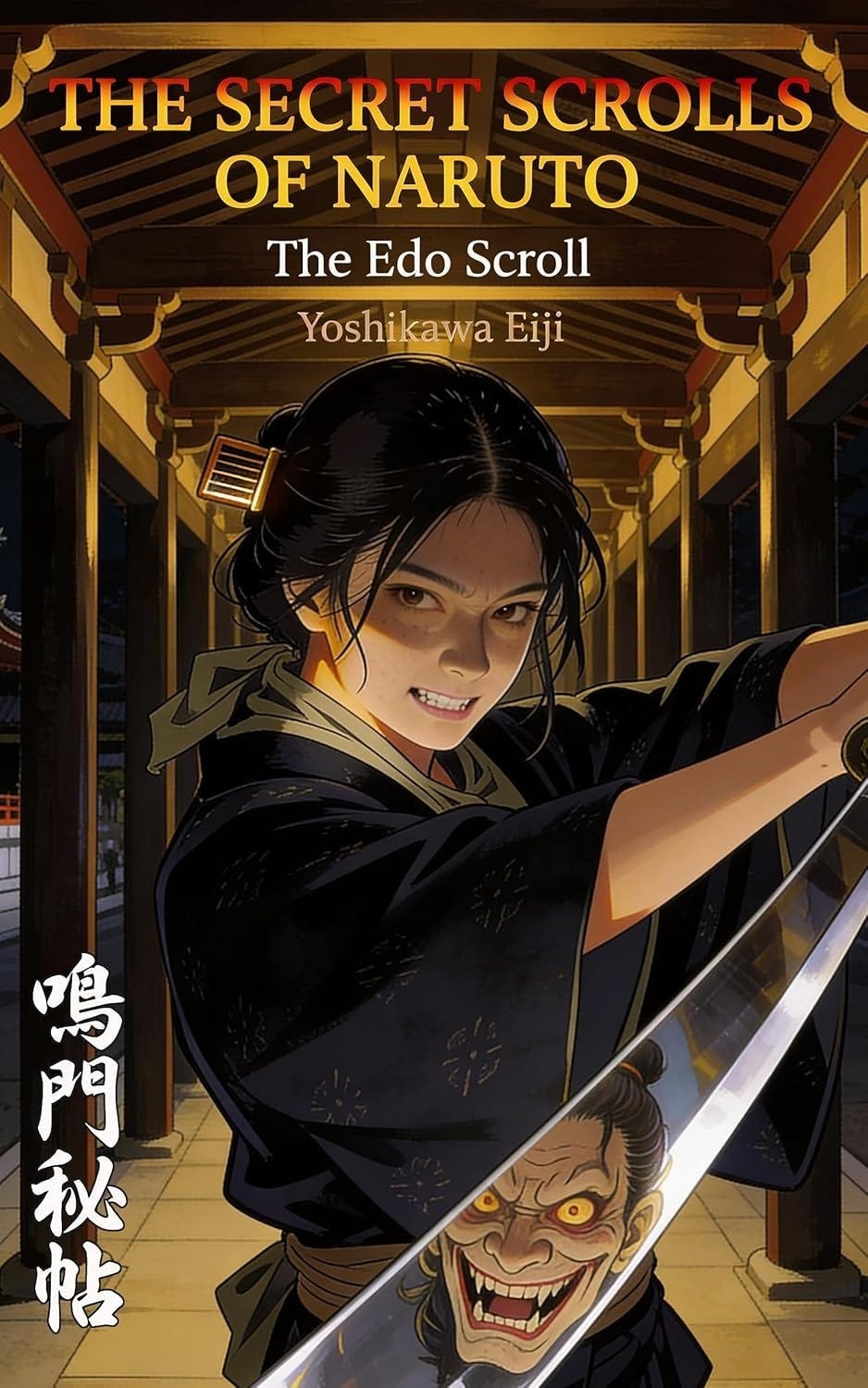
The second book of The Secret Scrolls of Naruto shifts the action from the open roads and waterways of the Kamigata to the warren of Tokugawa-era Tokyo, where the conspiracy runs deeper, the villains are closer, and nobody can be trusted. Two killers strike a deal over saké: one will murder the swordsman-monk Gennojō, the other will claim the woman he has been hunting since Osaka. Underground chambers, a great urban fire, a swordfight in total darkness on a plum-scented path, a deathbed confession that transforms a pickpocket, and a midnight ambush at Sensō-ji temple — this is the book where Yoshikawa Eiji earns his reputation as the Alexandre Dumas of Japan.
NEXT: Vox Day Enters the Magical School Genre with Dorian Vane and the Vampire’s Blood
I'd give it 5/5, honestly. I think it's the best and darkest of Higashino's work to date.