


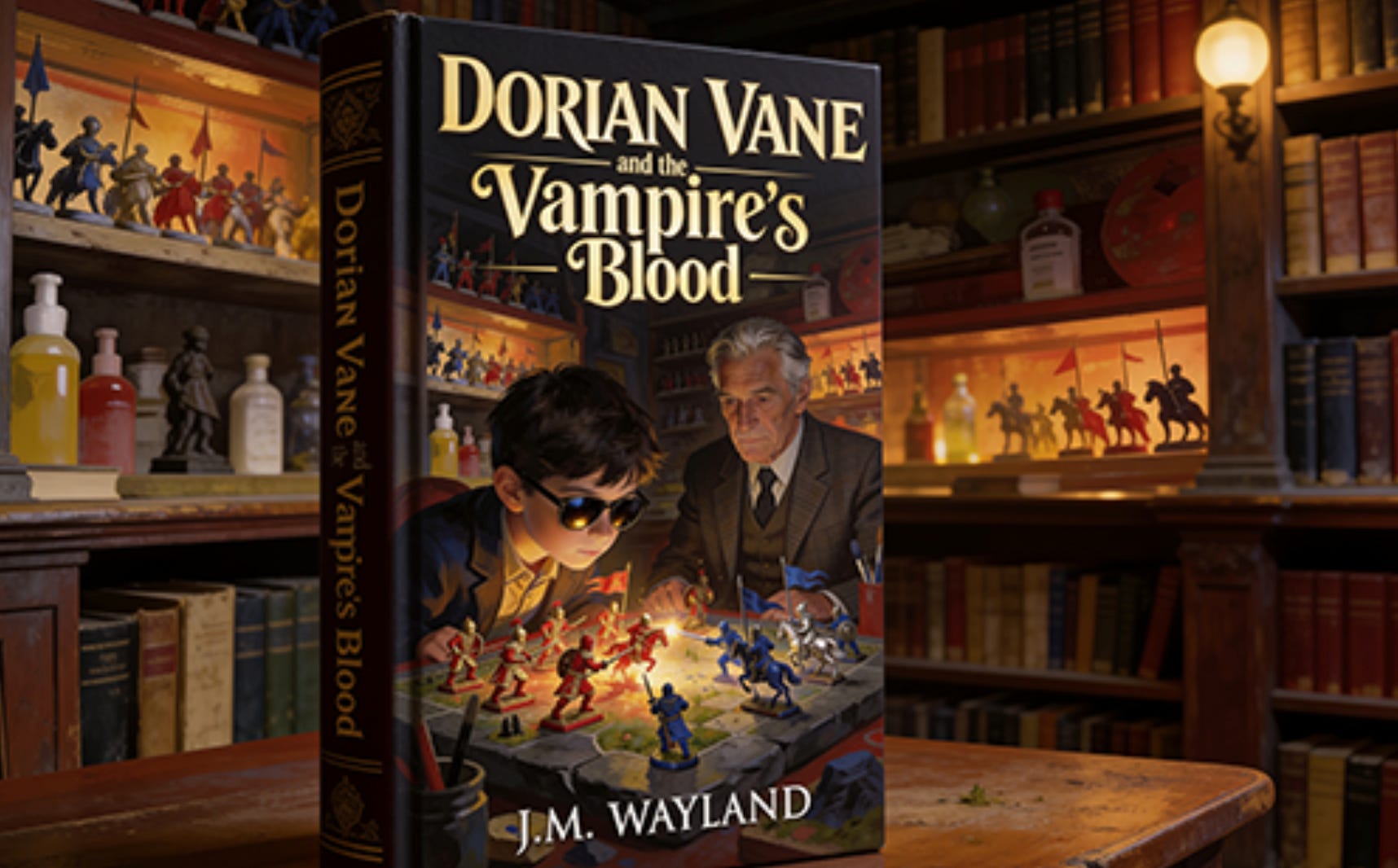
Vox Day, the publisher and author behind Castalia House, has released a new YA fantasy novel that takes direct aim at one of the most dominant formats in children’s fiction: the British magical boarding school. Dorian Vane and the Vampire’s Blood is out now for Kindle, Kindle Unlimited, and audiobook.
“After the success of Space Fleet Academy, I wanted to see what I could do with a world like Harry Potter,” Day told Fandom Pulse.
The book’s origin is explained on Day’s blog. After finishing The Refutation of Kant, he found himself dwelling on what he described as “the various nonsensicalities of the Wizarding World concocted by Ms JK Rowling.” The problems he identified were structural and philosophical: “the absolute absurdities of the Quidditch rules,” “the pointless points system, the insane dual economies, the bizarre competitions, and the upside-down nature of a craven, spoiled elite that left one wondering how it had gotten there in the first place.”
The diagnostic led him to a creative question: what would a magical academy novel look like if it fixed those problems from the ground up? His formulation: “What if the protagonist of an academy novel was not despised, but loved? What if he wasn’t a passive lens for the reader to pass through the world, but a character with strength, independence, and a will of his own? What if there were consequences to historical actions, and if the present was the result of past decisions?”

The result is Dorian Vane, an eleven-year-old boy raised by his grandparents on the Somerset moors, with silver-grey eyes and vertically slit pupils he has spent his whole life hiding behind mirrored glasses. A letter from Wyrmwick College arrives and pulls him into a world of ley-line trains, gnome bankers, Ashwick steel practice blades, and a school carved into a mountainside above a lake. The opening chapter, set in the moorland farmhouse where Dorian grows up, establishes the family with crisp economy: a retired general of considerable reserve, a watercolour-painting grandmother who misses nothing, and a boy who watches beetles climb grass blades from a thinking stump at the bottom of the garden and finds he is thinking along rather seriously for eleven.
The chapter reads more like Alan Garner or Susan Cooper than like Rowling, which turns out to be Day’s stated intent. On his blog he notes that while the core concept derives from the British magical school tradition, “the end result reads more as if Susan Cooper was the primary literary influence, with perhaps a dash of Lloyd Alexander.” Early readers appear to confirm this: one described it as having “Susan Cooper’s feel for deep time, hidden powers in the land, and a boy awakening to a larger, dangerous heritage without flashy destiny tropes.”
What makes the comparison to Cooper worth taking seriously is visible in that opening chapter. Dorian’s grandparents are not obstacles or comic relief. They are people with histories, the general’s upside-down book, the commission and the sabre on the wall, the mother’s trunk brought down from the attic two years ago when Edward decided it was time. The emotional weight of the fireside scene, the family’s last evening before Dorian leaves for school, lands because the world it depicts has already been made specific and solid. A boy leaving that house is losing something real.
Not reading a book written by AI. Stop trying to convince us that this is a worthwhile thing to do. It isn't.