


The Japanese A Wild Sheep’s Chase, published in 1982, is the third novel by a young man who had already written two short, strange books and was not sure yet what kind of writer he was going to be. You can feel him deciding inside the sentences. The famous Murakami voice, the cool, slightly bemused first-person, the lists of records and brand names, the women who appear and dissolve, the well that opens under the floor of an ordinary life, is present here in a recognizable form for the first time. Pinball, 1973 had pieces of it. A Wild Sheep’s Chase has the whole assembled instrument. He picks it up. He plays a tune on it.
The tune is a detective story that is not really a detective story, about a thirty-year-old advertising copywriter who is sent on an absurd errand by a mysterious right-wing power broker to find a sheep with a star on its back. The sheep, it turns out, is something more than a sheep. The hero’s friend, called only the Rat in the earlier books, has gone north and stopped writing letters. Hokkaidō appears at the halfway point and the novel changes climate. There is the girlfriend with the beautiful ears. There is a Sheep Man. There is an empty mountain villa where a record plays through the floorboards.
What I love about this book is that it commits to its own absurdity without ever raising its voice. The narrator’s tone is so even, so unsurprised by the increasingly unhinged things happening around him, that the reader simply enters the dream alongside him. This is Murakami’s favorite trick, and A Wild Sheep’s Chase is where he masters it. The sentence rhythm does the work. He writes a calm sentence about cooking spaghetti, then a calm sentence about a sheep with a star on its back trying to take over the consciousness of Japan, and the two sentences have the same temperature. The horror enters by the same door as the spaghetti. You don’t notice you’ve crossed a border until you’re well across.
The girlfriend, who is given no name, is the part of the book I find most difficult to defend, and I am going to defend her anyway, because the alternative is to pretend I don’t love this book, and I do. She exists only for the narrator. She has the ears, she has the gift, she has the extraordinary perceptions, and then on Hokkaidō she vanishes from the novel without ceremony, and we are not invited to grieve her. This is a real flaw. It is a flaw I have come to terms with. Murakami in 1982 did not yet know how to write women who exist independently of the men they appear to, and The Wind-Up Bird Chronicle eleven years later is partly the book of a writer who learned. Kumiko in Wind-Up Bird is not the girlfriend in Sheep. The girlfriend in Sheep is closer to a function than a person.
What rescues her, slightly, is the moment with the ears. The scene where the narrator first sees them uncovered, in the restaurant, the way the world reorganizes around them, the way she becomes briefly the most powerful person in the novel, is one of the small exquisite moments of Murakami’s finest writing. It is the kind of moment he kept getting better at over time. The girlfriend disappears, but that scene does not.
The Hokkaidō half is the more interesting material. The Dolphin Hotel, the chauffeur who prays to his car, the empty pasture, the snow coming. Murakami had been to that landscape and knew what its silence sounded like. The chapters in the mountain villa, alone with the snow and the fireplace and the records, are doing something his earlier novels could not do, they are sustaining mood across long pages without action. He had figured out by 1982 that you could write a Japanese novel in which nothing visible happens for forty pages and the reader stays in the room. This is harder than it looks.
Now I have to talk about the translation, and I am going to be careful, because the Birnbaum English of this novel is the version most readers in the world have read, and many of them love it, and for many readers it is Murakami. I understand why. It is propulsive. It is fun. It moves. Birnbaum was the translator who introduced Murakami to the English-speaking world in the late 1980s, and he was working under conditions that included an editor at Kodansha International cutting whole passages of the Japanese to fit a length the publisher wanted. Some of what feels brisk in the English is actually just missing.
But even setting aside the cuts, the translation makes a choice on every page that I think a reader who has only read the English would not necessarily detect. Birnbaum’s narrator sounds like an American hardboiled detective. He is wisecracking, faintly cynical, quick with a comeback, possessed of a kind of Chandler-derived cool. The Japanese boku is not this person. The Japanese boku is more diffident, more passive, more puzzled by his own life. He drifts. He does not deliver one-liners. He notices things and leaves them be.

The most compact way to demonstrate this is to point at the conversation in chapter eight where the narrator and his business partner discuss the dissolution of their advertising agency. In Japanese, the narrator’s responses are shorter than his partner’s, hesitant, slightly deflective. There is a faint sadness underneath that the prose does not name. In English, the narrator returns volleys. He has the better lines. The asymmetry is gone. A passive man has been converted into an active one. This makes the book more enjoyable to read in English; it also slightly mistranslates who the narrator is. The whole point of this character is that he is being moved through events by forces he does not control. A wisecracking version of him is a different character.
The other thing the English does is smooth out the strangeness. Murakami in Japanese often writes sentences that are mildly awkward, slightly off, deliberately flat — there is a famous quality of his prose that Japanese readers describe as 翻訳調 (translation-style), as if he were writing Japanese already half-translated from English. Birnbaum’s English does not preserve this. It writes confident, idiomatic American sentences. The reader does not feel the slight strangeness that is part of what makes Murakami sound like Murakami in his own language. This is a difficult thing to translate — you would have to write English that sounded faintly like translated English without being bad — and I am not sure anyone could have done it well in 1989. But the loss is real, and a reader who later picks up Jay Rubin’s The Wind-Up Bird Chronicle will sometimes be surprised by how different the prose feels. It is not just that Rubin and Birnbaum are different translators. It is that Rubin is closer to the actual Japanese and Birnbaum is making a Murakami the English market could understand quickly.
I rate the translation 6 because it is a professional, energetic, readable rendering that has lost the thing that mattered most: the temperature of the narrator. The book it produces is fun. But it is not quite the book Murakami wrote.
A Wild Sheep’s Chase is not the Murakami book I love most — that is The Wind-Up Bird Chronicle — but it is the book where you can watch him become himself. Hear the Wind Sing is a sketch. Pinball, 1973 is a more ambitious sketch. A Wild Sheep’s Chase is the first finished room in the house he was going to build. The sheep, the well, the woman who vanishes, the friend gone north, the snow coming, the strange calm voice that walks into the dream and does not panic — all of it is here, assembled, working.
I would rather read it in Japanese. But the English is how most of the world met him, and most of the world was right to fall in love. They were just falling in love with a slightly different narrator than I did.
Book: 4/5
Translation: 6/10
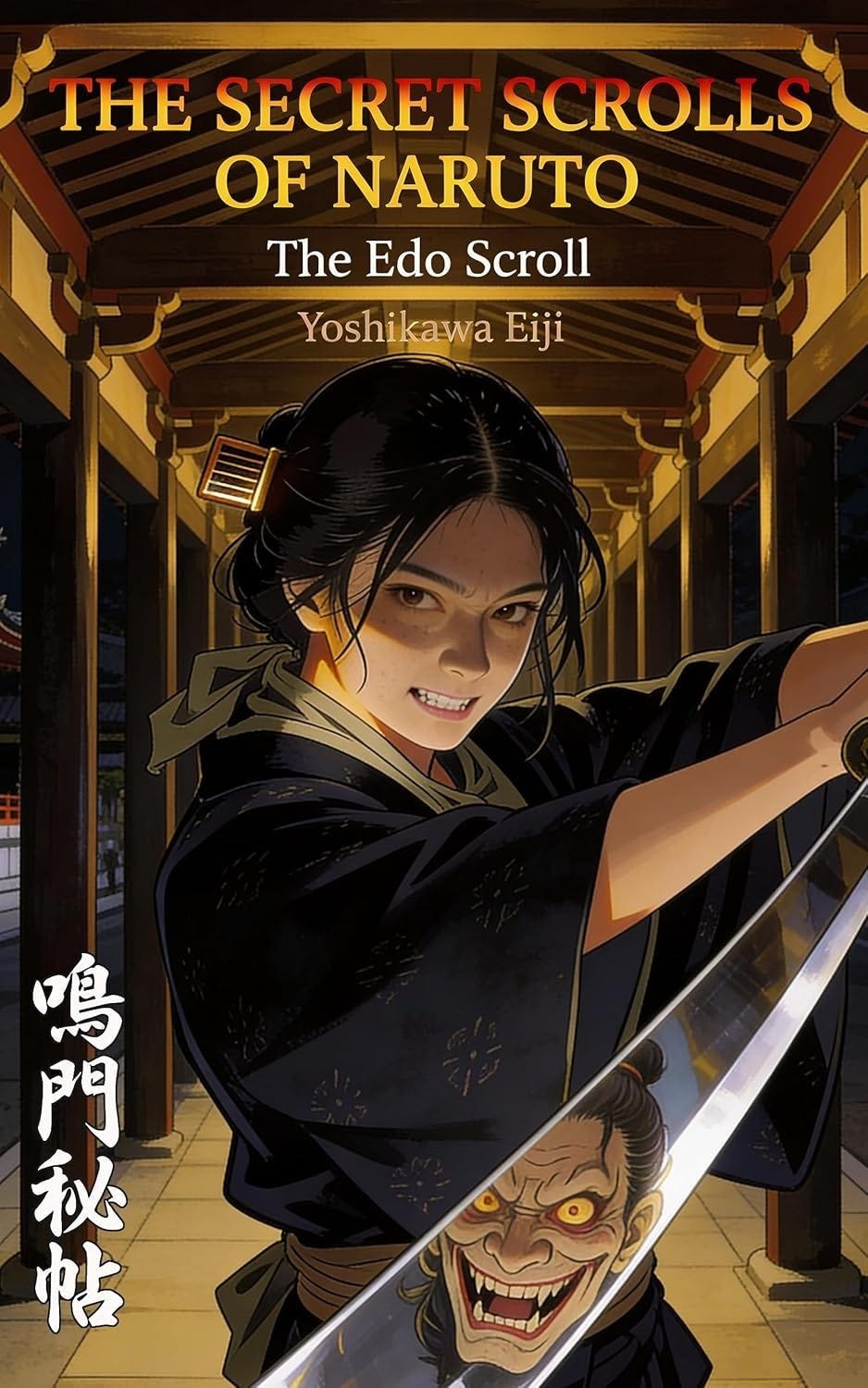
The second book of The Secret Scrolls of Naruto shifts the action from the open roads and waterways of the Kamigata to the warren of Tokugawa-era Tokyo, where the conspiracy runs deeper, the villains are closer, and nobody can be trusted. Two killers strike a deal over saké: one will murder the swordsman-monk Gennojō, the other will claim the woman he has been hunting since Osaka. Underground chambers, a great urban fire, a swordfight in total darkness on a plum-scented path, a deathbed confession that transforms a pickpocket, and a midnight ambush at Sensō-ji temple — this is the book where Yoshikawa Eiji earns his reputation as the Alexandre Dumas of Japan.
NEXT: Review: The Memory Police By Yōko Ogawa, translated by Stephen Snyder
It would be hard not to disagree more, as A Wild Sheep's Chase is tied with 1Q84 for my favorite Murakami novel, but then, as she said, the novel that I love is not quite the novel that she rates 6 of 10.