


The premise of The Memory Police is that things are vanishing from an unnamed island, and most of the islanders forget the things even existed. Ribbons go first. Then perfume, hats, birds, fruit, photographs, novels. When something is “disappeared,” the residents are required to dispose of every physical trace of it, and shortly thereafter the concept itself fades from their minds. They look at a bird and see only a small moving thing they have no word for and no feeling about. A small minority, however, retain their memories. The Memory Police, an authoritarian force whose ranks no one ever quite sees recruited, hunt these people down. The narrator is a novelist on the island. Her editor, R, is one of the people who remembers, so she hides him in a secret room beneath her floor.
The novel was published in Japan in 1994, twenty-five years before it appeared in English. It has been called Orwellian, Kafkaesque, Borgesian, and a half-dozen other useful but slightly misleading shorthands. None of them is quite right. Ogawa is not writing dystopia in any sense Orwell would have recognized; her authoritarian regime is curiously off-camera, more a weather system than a state, and the question of whether anyone runs the disappearances is left unanswered because the question is not the point. The question is what happens to a self when the materials it was built from are slowly removed. The answer, which the book takes its full length to reach and which it reaches by demonstrating rather than arguing, is that the self disappears with them, and that the disappearance can be borne with a strange tenderness, even peace, by the person disappearing.
This is a real book. I want to say that first because the shorthands tend to make it sound like a thought experiment, and a thought experiment is exactly what it isn’t. The Memory Police is a novel of accumulated detail, of sustained quiet attention to weather and food and small domestic rituals — the narrator types her manuscript on an old typewriter; she heats soup; she sits with the old man on the boat where he lives; she lowers food through a hatch to R in his hidden room. The accumulation is the technique. Ogawa is showing you what it feels like to be alive on an island where the materials of being alive are quietly leaving, and the only way to show this is to put the materials on the page one by one and let you feel their weight, and then let you feel the absence when they go. The book that the narrator herself is writing — a novel-within-the-novel about a typist who loses her voice and is held captive by her typing teacher — runs in parallel to the main story and slowly converges with it, until the two narratives are doing the same work from opposite ends. The structural achievement here is real and it is hers; no English-language writer of fantasy or speculative fiction in the last three decades has done anything quite like it.

The book is not perfect. Ogawa works by accumulation, and there are stretches in the middle third, particularly around the disappearance of the calendar, where the accumulation slackens and the novel feels like it is waiting for its next move. The framing of the inner novel is sometimes thin; the typing teacher is closer to a function than a character, and the parallel structure occasionally announces itself when it should disappear into the texture. The ending, which I will not describe, has been called whimpering by reviewers who wanted the resolution Ogawa never had any intention of providing; I think the ending is correct but I understand why some readers find it withholding. Ogawa is a novelist who trusts her reader to accept the terms of the world she has built. Some readers cannot accept the terms. This is not always the reader’s fault, but in this case I think it is.
What makes the book work, where it works, is the prose. Ogawa writes Japanese sentences that look almost transparent on the page, short, measured sentences, with very little syntactic ornament that carry an enormous load of implication. The Japanese reader is meant to feel something specific about each disappearance: not the grief of losing a beloved object, but the more difficult and disorienting feeling of losing a category of feeling. A world without ribbons is not a sadder world; it is a world in which the kinds of sadness associated with ribbons have become unavailable. Ogawa builds this effect through accumulation, through pacing, and through a particular use of Japanese final-verb endings and sentence-final particles that create a faint sense of a narrator slightly distanced from her own experience. None of this is obvious, but it is everywhere on the page.
Stephen Snyder is a serious translator who has been Ogawa’s exclusive English voice for over twenty years, and he has thought longer and harder about what he is doing than most translators working today. He has lectured publicly on the question of whether to foreignize or domesticate; he has written about the “anointed translator” relationship and what it costs and gains; he is, by training, an academic Japanologist of the lineage Kenji takes seriously. His prose in The Memory Police is supple, accurate, and unobtrusive. The pacing is right. The accumulation works. Reviewers who said you wouldn’t feel like you were reading a translation were saying something true. But I have to register a craft objection to the fact that. Snyder has elected to give the English narrator a slightly more present, slightly more emotionally available voice than the Japanese narrator actually has.
The Japanese narrator is more distanced from her own experience than the English narrator is, and the difference is small but cumulative; over 274 pages, it changes the book. The English narrator feels like a person quietly recording her experience. The Japanese narrator feels like a person who is already half-vanished from inside the experience she is recording. The first is moving. The second is what Ogawa wrote. Snyder is fully aware of the difference, as his interviews show, and he made his choice for defensible reasons, mostly having to do with what English readers can metabolize without losing the book’s emotional pull.
I would have made a different choice. I think I would have been wrong in a different way. Translation is negotiation, and Snyder negotiated honestly. The English book that exists is not the Japanese book, but it is closer than most translations get, and it is the book that put Ogawa on shortlists and into book clubs and into the hands of readers who would otherwise never have heard of her.
Reading The Memory Police now, six years after its English translation and thirty-two after its Japanese publication, I prefer to think about the book it actually is rather than the book it is believed to be. The Anglophone reception has wanted to make this a novel an ex post facto statement about totalitarian states, surveillance, the erosion of truth in the age of fake news. It is about all of those things in a peripheral way and none of them centrally. What the book is centrally about is what it feels like to live inside a self that is being removed in pieces, and to do so without protest, without rebellion, without the heroic resistance the American reader is conditioned to expect. The narrator does not fight. She hides her editor, which is the one act of resistance she performs, and even this she performs almost by inertia, almost as an extension of her own slow disappearance into the smaller and smaller life she has left. The novel takes this passivity seriously as a form of human dignity. American readers tend to find this baffling or sad. Japanese readers tend to find it true.
This is the challenge The Memory Police presents to the English-language reader. Some readers meet it; some don’t. Snyder’s translation does what a translation can do, which is to bring the reader to the edge and let them step across. The book is worth the crossing. The four out of five is for a novel I will keep on the shelf and reread at least once, which is more than I can say for most of what gets translated from Japanese in any given year. The eight out of ten is for a translation by a working professional at the height of his powers, with one specific decision I would have made differently. Most readers will never notice it. Most readers shouldn’t have to.
Book: 4/5
Translation: 8/10
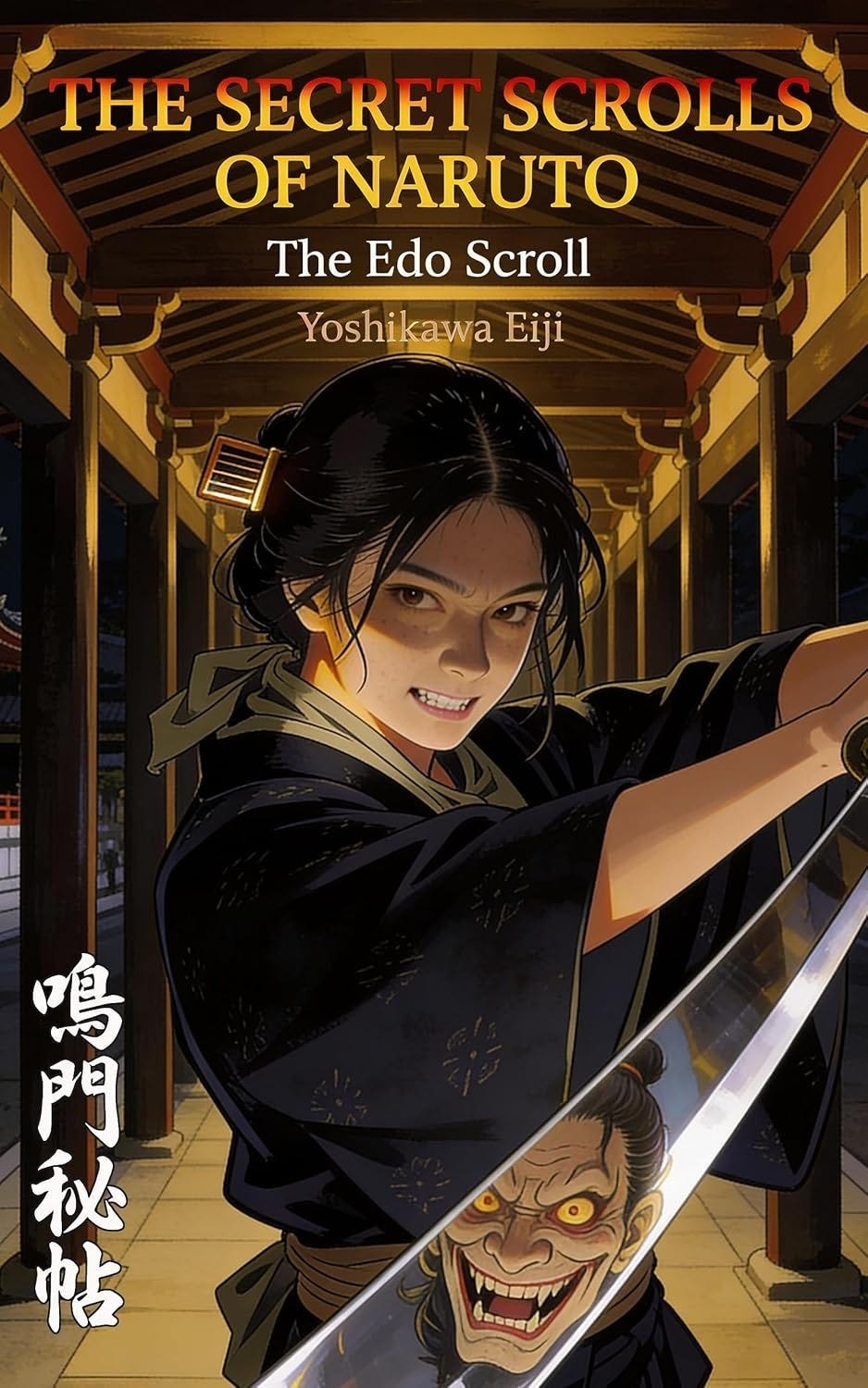
The second book of The Secret Scrolls of Naruto shifts the action from the open roads and waterways of the Kamigata to the warren of Tokugawa-era Tokyo, where the conspiracy runs deeper, the villains are closer, and nobody can be trusted. Two killers strike a deal over saké: one will murder the swordsman-monk Gennojō, the other will claim the woman he has been hunting since Osaka. Underground chambers, a great urban fire, a swordfight in total darkness on a plum-scented path, a deathbed confession that transforms a pickpocket, and a midnight ambush at Sensō-ji temple — this is the book where Yoshikawa Eiji earns his reputation as the Alexandre Dumas of Japan.
Thank you for bringing another interesting translation to my attention.