


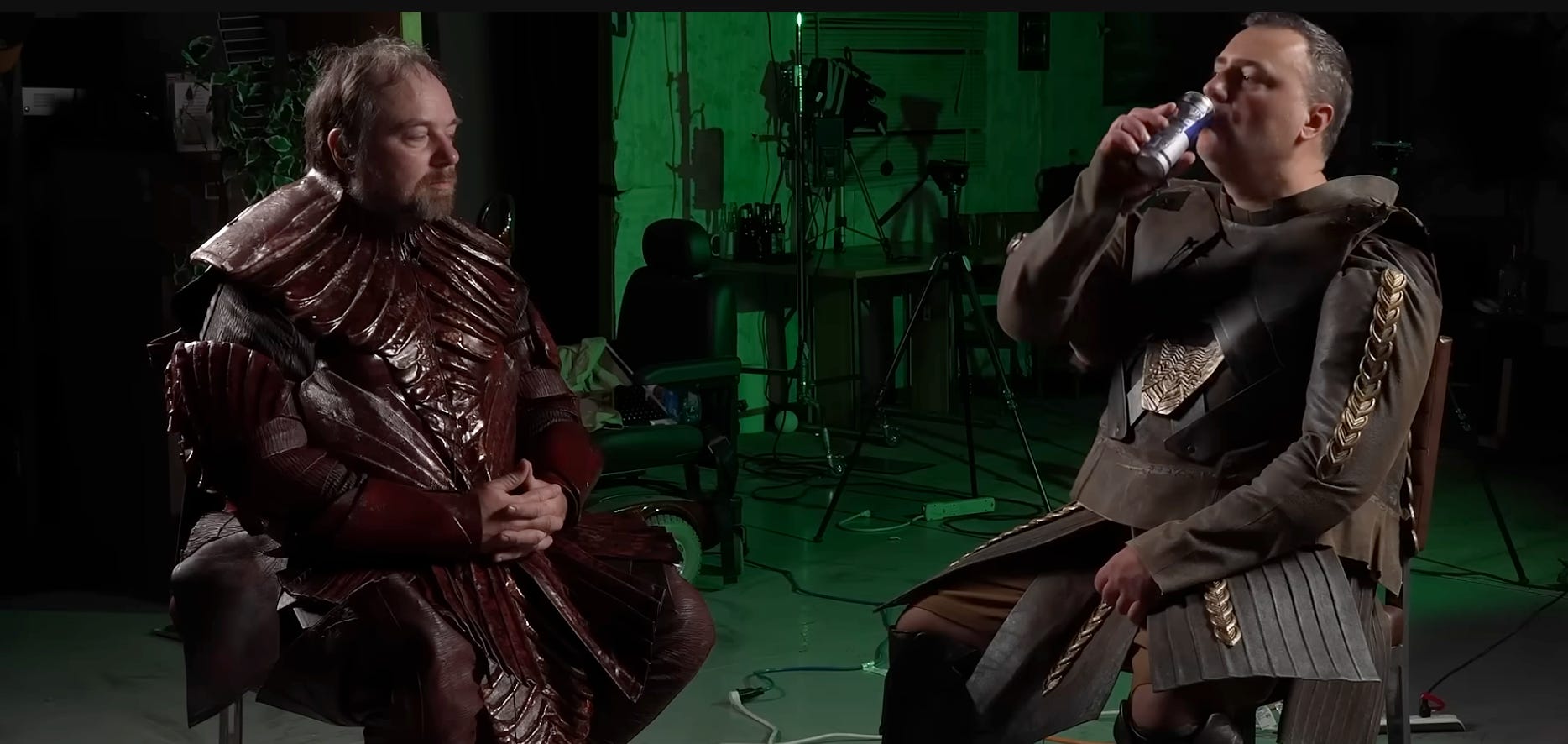
Rich Evans and Mike Stoklasa put on real Discovery-era Klingon costumes, sat down, and delivered one of the more clear-eyed teardowns of the Kurtzman era Star Trek has gotten in years. The premise: the last decade of Star Trek has been a mess, and it’s time to talk about what actually comes next.
They don’t waste time getting to the verdict. Rich sums up the entire era bluntly:
“I don’t think there’s any arguing that new Trek has been just a monumental disaster of biblical proportions.”
Mike doesn’t push back. Instead he escalates the joke, comparing the money spent to the cost of building actual pyramids, which, exaggeration aside, gets at something real. Star Trek under Kurtzman burned enormous budgets across Discovery, Picard, the aborted Section 31 movie, and multiple Kelvin-timeline film attempts, and what’s left standing is a franchise fans are actively unhappy with. Strange New Worlds’ current season is reportedly landing poorly with longtime viewers for being “way too goofy and out of control,” and Starfleet Academy got mocked on the spot as one of the stranger executive decisions in the show’s history.
The Case for Smaller, Smarter Star Trek
The most valuable part of the conversation is Rich laying out what he’d actually want if handed creative control and a real budget:
“I would do my best to try and recreate that... I ditch the humor. And I ditch the emotional nonsense. I want rational people talking about problems and solving them competently.”
That’s the whole argument in one sentence, and it’s exactly what a lot of longtime fans have been saying for years. Star Trek works when it trusts its audience to sit still for people solving a problem with their brains instead of a fistfight or a magic space-anomaly reset button. Mike pushes it further, tying the show’s failures directly to overproduction:
“None of that we’re spending three years to make six episodes and they’re overproduced... we intentionally underproduce it.”
His reasoning is that the old show cranked out 26 episodes a year specifically because it didn’t have the budget to go big, which forced writers to lean on smart plotting instead of spectacle:
“They didn’t have the budgets and the visual effects to go crazy. So they had to really say, how can we use the bridge and sick bay... let’s see how do we keep everyone talking for 42 minutes. A plot.”
Old Trek had constraints and used constraints to force good writing. New Trek has money and uses it to paper over weak writing. It’s something simple but vastly overlooked in modern Trek.
Even The Orville and Lower Decks Get the Same Critique
What’s notable is that the two shows most often cited as “the good version of modern Trek” don’t escape the same criticism. On The Orville, Rich makes a specific structural complaint:
“The first two or three episodes of The Orville, they’re still playing lip service to the fact that it’s a parody. And by the time you get like four or six episodes in they’re just making next gen episodes with a small amount of humor.”
Mike says almost the identical thing about Lower Decks:
“You’re watching it and you’re like wow, this A&B plot in this show or this idea, if you removed all the jokes and you took it seriously would make a great TNG episode.”
The takeaway is obvious. Both of these shows are only good in the moments where they stop being comedies and start being actual Star Trek. The humor isn’t the strength fans are responding to, but it’s the writers sneaking real science fiction storytelling in underneath the jokes. Strip the jokes out entirely and, according to both hosts, you’d have something stronger, not weaker.
The New Movie — Cautious, Not Hopeful
The news hook for the conversation is the newly announced Star Trek film from Jonathan Goldstein and John Francis Daley — the directing/writing team behind Dungeons & Dragons: Honor Among Thieves, Game Night, and Spider-Man: Homecoming. Rich flags the obvious concern immediately, noting their background leans toward comedy, which is exactly the instinct Star Trek doesn’t need more of right now. Both hosts stay skeptical rather than hopeful, and for good reason — Mike counts off just how many “next Star Trek” projects have quietly died in development over the years without ever reaching a screen.
The Real Diagnosis
The sharpest moment in the whole conversation is Rich’s closing read on why this era went wrong in the first place:
“I think they gave them way too much money. It had way too many attempts to reach wider audiences and I think they reached the audience they wanted to, but that audience is actually smaller than the older, wiser Star Trek fans.”
That’s the whole story of the Kurtzman era in one sentence. Star Trek chased a broader, younger audience with bigger budgets, flashier action, and softer, more meme-friendly writing, and in doing so alienated the fans who actually sustained the franchise for decades. The result is a string of shows that are ending, not returning while the audience that’s left is telling anyone who’ll listen exactly what they want instead: fewer jokes, smaller stakes, real problems, and characters smart enough to talk their way through them.
Red Letter Media didn’t say anything fans haven’t been saying in comment sections for years, but now more and more are being open about it. Are you surprised?
First contact with the Oridians was supposed to be humanity’s proudest moment. Instead, their chief engineer is dead, their ship is sabotaged, and an ancient alien technology is stealing souls. Book one of the Valiant Frontiers series delivers exploration, mystery, and the kind of crew you’ll want to follow across the galaxy. Read The Soul Catcher on Amazon and start the adventure.
NEXT: William Shatner Returns To Star Trek As 60th Anniversary Documentary Lands Regal Theatrical Release
I would recreate the TOS sets, even expand them a bit based on technical Enterprise plans released over the years.
I would also recreate the miniatures and other practical effects.
Casting would be the absolute hardest part. Original TOS actors were classically and stage trained, but the first doesn't exist anymore and the second is nothing but gay theater kids nowadays. You can't cast in Hollywood or any Nu industry location like Toronto, London, or even Georgia.
My first calls would be to get 3-4 respectable graybeards online. Then, a nationwide hunt, signing actors to 5 season deals, no outs, no exceptions, then 6-12 months of acting training overseen by said graybeards.
I'd then take 60ish TOS episodes, a number of the animated series episodes, any scripts and ideas lying around from original writers and/or the original show (especially DC Fontana), expand them to 60 minutes to give characters beyond the big 3 some extra screen time and add connective tissue/lore/fan service. Giving Yeoman Rand and Nurse Chapel expanded roles too. TOS is still the best, but let's be honest, outside of Kirk's green space lasses, it was mostly a sausage fest.
I'd then reorder those episodes into five seasons with overarching stories and connected plot threads, grouped into their own arcs: Romulan first Contact episodes, Klingon Neutral Zone/Cold War episodes, deep space exploration, Federation space patrol, and even collect the Nazi/Monster/Greek Gods and other Parallel Earth episodes in a special (possibly Q related) sector of space.
I'd film those episodes like a taskmaster, 25ish a year, for five years, and release them once a week in twice annual batches to keep viewers going no more than a few months between episodes.
And I'd do all of that for less than a season of STD.
Budgets grew while new writers were brought in who didn't care for the original meaning of the story. Same thing that killed AAA gaming killed Star Trek.