


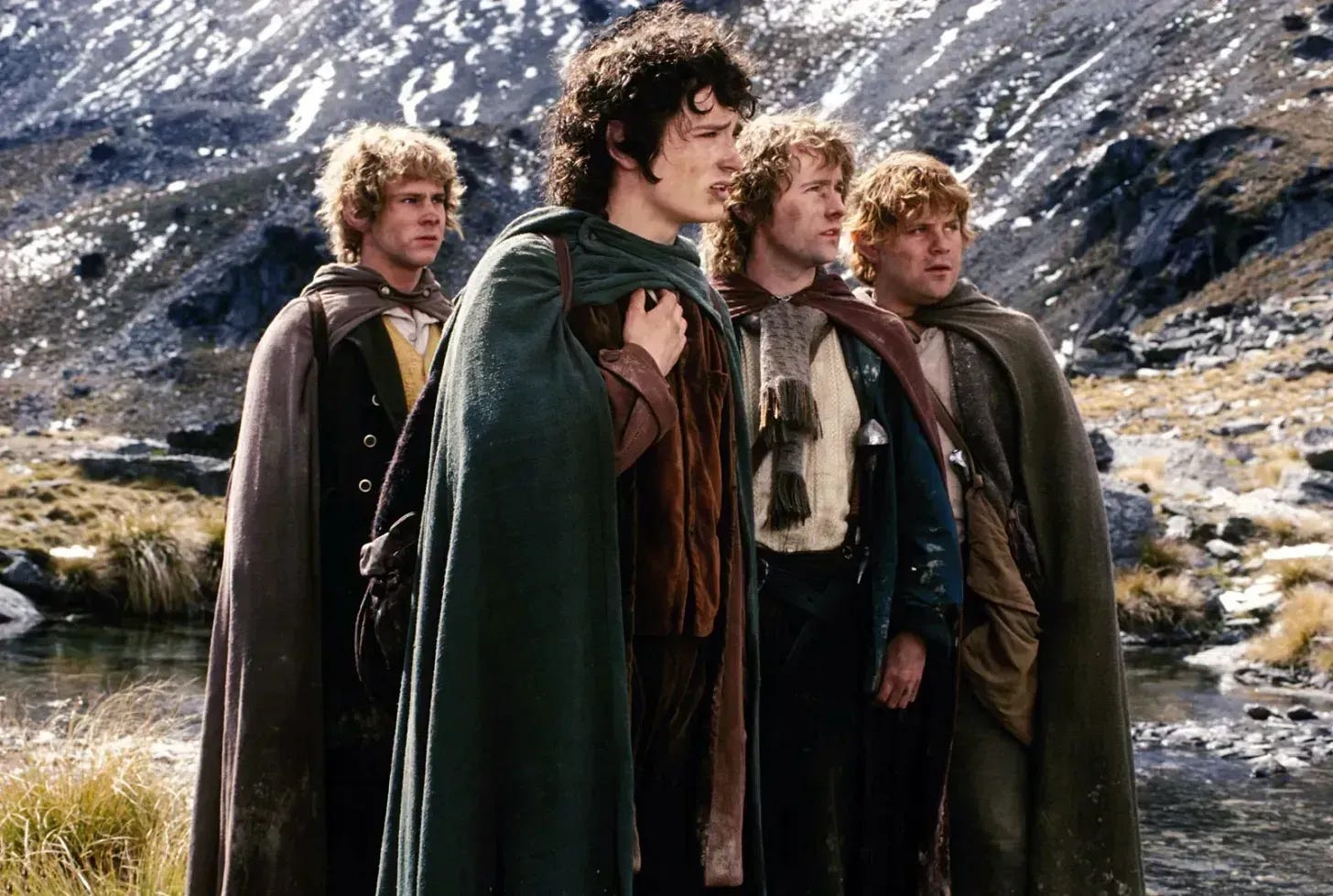
We started a retrospective on Tolkien’s rise to superstardom, which began with a left-wing movement in the 1970s appropriating his work, and has slowly migrated over time to people realizing how right-wing and Christian Lord of the Rings is. Now, we continue.
The Deplorable Cultus
The long-haired visitors arrived in the afternoon.
They came to 76 Sandfield Road in Headington, a suburb of Oxford, carrying paperback copies of The Lord of the Rings and The Hobbit. They rang the bell. They wanted autographs, conversation, an audience with the author of the book that had changed their lives. Some of them smelled of patchouli oil and incense. They wore clothing that an Oxford professor born in 1892 would have found incomprehensible.
Tolkien did not invite them in for tea.
He was polite as he always was. He was an Edwardian gentleman raised by a Catholic priest in the shadow of the Birmingham Oratory, and courtesy was a reflex deeper than irritation. But the visits unsettled him. They came at all hours. The Americans, who made up a growing proportion of the callers, frequently failed to account for time-zone differences when they telephoned, ringing after midnight. “In a house three doors away dwells a member of a group of young men who are evidently aiming to turn themselves into a Beatle Group,” Tolkien wrote in a 1964 letter. “On days when it falls to his turn to have a practice session the noise is indescribable.”
The noise, increasingly, was the sound of fame. And Tolkien did not want it.
In a letter to his colleague Norman Davis at Oxford, Tolkien coined the phrase that would follow his fandom forever. He called the American enthusiasm for his books “my deplorable cultus.” To a reporter who asked if he was pleased by the young Americans’ fervor, he was more expansive: “Art moves them and they don’t know what they’ve been moved by and they get quite drunk on it. Many young Americans are involved in the stories in a way that I’m not.”
The phrasing was precise, as Tolkien’s phrasing always was. He was a philologist. Words were his profession and his obsession. “Cultus” carried religious connotations, from the Latin for worship or veneration. Given that his fans were wearing “Frodo Lives” buttons as a deliberate response to “Jesus Lives” shirts, the choice of a quasi-religious term was pointed. These young Americans had found a substitute faith in his fiction. Tolkien, who credited his entire creative life to the Catholic Faith his mother had died for, found the substitution not flattering but disturbing.
His friend W.H. Auden, the poet, wrote to him in 1965 expressing fear that “most of the members” of the newly organized New York Tolkien Society “would be lunatics.” Tolkien replied wearily: “Yes, I have heard about the Tolkien Society. Real lunatics don’t join them, I think. But still such things fill me too with alarm and despondency.”
Alarm and despondency. From a man who had survived the Somme.
###
The fame had material consequences. Tolkien’s phone number was in the Oxford telephone directory. Once American fans discovered his address, the calls and visits became unmanageable. He and Edith discussed what to do. Tolkien loved Oxford. He had lived there, with interruptions, since 1911. His professional life, his friendships, his church, his daily routines were all rooted in the city. But Edith had never shared his attachment to the academic world. She found Oxford society stuffy and intellectuals tedious. She had loved Bournemouth for years, a seaside resort on the Dorset coast patronized by the British upper middle class.
In June 1968, Tolkien and Edith left Oxford. They moved to a bungalow called Woodridings at 19 Lakeside Road in Branksome Park, on the Poole side of the Bournemouth boundary. Tolkien was seventy-six. Edith was seventy-nine. They arranged two phone numbers at the new address: one listed, one private, given only to friends and family.
The move was an exile, however voluntary. Tolkien had been driven from his home by the consequences of his own creation. A man who preferred trees to buildings, who rode a bicycle rather than drive a car, who attended daily Mass and spent his evenings reading medieval Welsh grammar, had been chased out of the city he loved by flower children who thought his book was about marijuana.
A BBC film called Tolkien in Oxford had broadcast on March 30, 1968, shortly before the move. Tolkien hated it.
Simon Tolkien, the author’s grandson, later reflected on the peculiarity of his grandfather’s fame. “The funny thing,” he told Time magazine, “was that he was most famous on your side of the Atlantic. I think the English establishment was slightly suspicious of him.”
The English establishment was suspicious for good reason. Fantasy was not respectable. A professor of Anglo-Saxon who wrote about elves and hobbits instead of producing academic monographs was, in the view of many Oxford colleagues, engaged in something faintly embarrassing. Tolkien’s fame among American hippies confirmed the suspicion. Serious literary men did not acquire cults.
###
Tolkien spent five years in Bournemouth. He continued to work on The Silmarillion, the mythological cycle he had begun in the trenches in 1916 and never completed. In the late 1950s and early 1960s, he had returned to it after The Lord of the Rings, but his focus had shifted. Rather than completing the narratives, he spent much of his time on the theological and philosophical underpinnings of the work: the nature of evil in Arda, the origin of Orcs, the customs of the Elves, the mechanics of Elvish rebirth, the cosmological questions about the “flat” world and the myth of the Sun. Serious doubts had entered about aspects of the work that went back to the earliest versions. He felt the need to solve these problems before producing a “final” Silmarillion.
He never solved them. The problems were, in a sense, insoluble, because they touched on the deepest questions of Catholic theology applied to a fictional cosmos. How does evil arise in a world created by a good God? How do the free wills of created beings interact with divine providence? These were not narrative questions. They were the same questions that Thomas Aquinas and Augustine had wrestled with, transposed into the mythology of Arda. Tolkien, the scholar who had spent his life studying how pre-Christian peoples groped toward truths they could not name, was now trying to get those truths exactly right in his own sub-creation. The weight of the task crushed the narrative forward motion.
Edith Tolkien died on November 29, 1971, at the age of eighty-two. Tolkien had “Lúthien” engraved on her gravestone, the name of the Elf-maiden from The Silmarillion who gave up her immortality for the love of the mortal man Beren. He wrote to his son Christopher: “She was (and knew she was) my Lúthien.”
The widowed professor returned to Oxford in March 1972. Merton College gave him rooms. Queen Elizabeth II appointed him a Commander of the Order of the British Empire, and Oxford University awarded him an honorary Doctorate of Letters. He visited Bournemouth frequently to see Dr. Denis Tolhurst, the physician who had treated Edith.
On a visit to the Tolhursts in August 1973, Tolkien collapsed. He was rushed to hospital with a bleeding gastric ulcer. Surgery seemed successful. Complications set in. J.R.R. Tolkien died on September 2, 1973, at the age of eighty-one. He was buried with Edith in Wolvercote Cemetery, north of Oxford. “Beren” was added beneath his name on the shared gravestone.
The Silmarillion remained unfinished. Nine thousand pages of manuscripts, notes, drafts, and fragments sat in boxes. Some were written in pencil over half-erased earlier drafts. Names changed between the beginning and end of the same document. Entire sections existed in multiple incompatible versions. The work of sixty years, stretching from army huts on the Somme to a bungalow on the Dorset coast, waited for someone who could make sense of it.
That someone was the dead man’s son.
###
Christopher Tolkien was forty-eight years old when his father died. He had been part of the work since childhood. At age four and five, he was already concerned with the consistency of The Hobbit. As a young man training as a fighter pilot in the Royal Air Force during World War II, stationed in South Africa, he had received chapters of The Lord of the Rings in the mail from his father, reading the story as a serial written for an audience of one. He drew the original maps published in The Lord of the Rings, signing them “C.J.R.T.” His father had called him “my chief critic and collaborator.”
In J.R.R. Tolkien’s last will and testament, Christopher was appointed literary executor and granted “full power to publish, edit, alter, rewrite, or complete any work of his which may be unpublished at his death or to destroy the whole or any part or parts of any such unpublished works.”
He chose to publish. The task would consume forty-five years of his life.
Christopher worked through the mass of his father’s papers, deciphering handwriting that was often legible only with a magnifying glass. Some manuscripts had been written rapidly in battered notebooks during the First World War. Others were formal drafts in careful script. Many were palimpsests, fair copies written over erased earlier versions. The names of characters shifted without warning. Plot elements contradicted each other across decades of revision.
With the assistance of Guy Gavriel Kay, a young Canadian who would later become a celebrated fantasy novelist in his own right, Christopher compiled The Silmarillion into a publishable narrative. The work required judgment calls at every stage. Christopher drew on the latest versions of his father’s texts where possible, but for sections that had not been touched since the 1930s, he had to construct narratives from fragments. The chapter “Of the Ruin of Doriath” was, by his own later admission, assembled practically from scratch. He would eventually express regret about some of these editorial decisions, writing in The Book of Lost Tales in 1983 that “it is certainly debatable whether it was wise to publish in 1977 a version of the primary ‘legendarium’ standing on its own and claiming, as it were, to be self-sufficient.”
But the pressure was enormous. Readers and publishers demanded something. The most popular author of the twentieth century had died with his most important work incomplete. Christopher, who understood his father’s intentions better than any person alive, was the only one who could attempt the reconstruction.
The Silmarillion was published by George Allen & Unwin in September 1977. It reached the top of the bestseller lists in October. Sales were strong enough to justify the effort, though the book bewildered many readers who expected another adventure like The Lord of the Rings and instead received something closer to Genesis crossed with the Norse Eddas. Christopher wrote a presentation for the publication in which he described his father’s creative process with the precision of a scholar and the affection of a son:
“Long afterward he recorded that he wrote it ‘out of my head’ during sick-leave from the army in 1917, and he told me once that he began The Silmarillion ‘in army huts, crowded, filled with the noise of gramophones.’”
Army huts and gramophones. The creation myth of Middle-earth, the Ainulindalë in which God sings the world into existence and Morgoth introduces discord into the divine music, was born in the noise and squalor of the First World War. The gap between the seriousness of the work and the circumstances of its creation was itself a Tolkienian irony.
Christopher would spend the next four decades making the rest of his father’s papers available. Unfinished Tales appeared in 1980. The twelve-volume History of Middle-earth was published between 1983 and 1996. He edited The Children of Húrin (2007), Beren and Lúthien (2017), and The Fall of Gondolin (2018). He also brought out his father’s academic and literary works: The Legend of Sigurd and Gudrún (2009), The Fall of Arthur (2013), and Beowulf: A Translation and Commentary (2014).
Twenty-four volumes. Forty-five years. An act of filial devotion that has no parallel in English literary history. Tolkien scholars have noted that Christopher used his own training as a philologist, honed by editing medieval texts like Chaucer and Sir Gawain and the Green Knight, to research, collate, edit, and comment on his father’s writings exactly as if they were real-world legends from a vanished civilization.
In a sense, they were. J.R.R. Tolkien had wanted to create a mythology for England. His son treated the result with the same scholarly care that his father had lavished on Beowulf.
###
The same year that Christopher published The Silmarillion, an animated television adaptation of The Hobbit appeared on American screens. Rankin/Bass Productions, the studio behind numerous holiday specials including Rudolph the Red-Nosed Reindeer and Frosty the Snowman, broadcast their animated Hobbit on NBC on November 27, 1977. It premiered the same weekend that The Other Change of Hobbit bookstore opened in Berkeley, the same year that Star Wars arrived in theaters. The convergence was accidental and prophetic: 1977 was the year that geek culture began to coalesce into a recognizable subculture.
The Rankin/Bass Hobbit was a children’s production. It softened the story’s darker elements, simplified the plot, and featured songs with lyrics that bore no resemblance to Tolkien’s verse. The animation was produced by the Japanese studio Topcraft. The voice cast included John Huston as Gandalf and Orson Bean as Bilbo. It aired once, drew a large audience, and became a perennial rerun favorite.
Tolkien purists complained. The adaptation was too cute, too commercial, too willing to sacrifice the book’s texture for accessibility. But it introduced The Hobbit to millions of children who would never have encountered the book otherwise. For a generation of future Tolkien readers, the Rankin/Bass special was the gateway.
The following year, the counterculture got its own adaptation.
Ralph Bakshi’s animated The Lord of the Rings opened in theaters on November 15, 1978. Bakshi was an independent animator best known for Fritz the Cat, billed as the first X-rated animated film. His Lord of the Rings used rotoscoping, a technique in which live actors are filmed and then traced over in animation, creating a hallucinatory visual style that split the difference between live action and cartoon. The result looked like Middle-earth filtered through an acid trip.
Bakshi’s film covered roughly the first half of the story, from the Shire through the Battle of Helm’s Deep. It was intended as the first of two films, but the sequel was never produced. The studio, United Artists, had marketed it simply as The Lord of the Rings without indicating that it was only half the story, infuriating audiences who expected a complete narrative. Rankin/Bass eventually produced an animated Return of the King in 1980, creating an awkward, tonally inconsistent bridge between two very different productions.
The Bakshi film was a commercial success and an artistic curiosity. Its rotoscoped Ringwraiths were genuinely terrifying. Its visual style influenced Peter Jackson, who acknowledged Bakshi’s work as an inspiration decades later. But the film also reinforced the psychedelic association that rock music had already forged. Middle-earth, on screen, looked like a hallucination. The visual language of the counterculture had been applied directly to Tolkien’s world.
###
Between the Silmarillion, the animated adaptations, the continued paperback sales, and the fanzine culture, Tolkien’s work survived the 1970s in a state of productive contradiction. The author was dead. His son was excavating the theological and mythological foundations of his work with scholarly precision. Hollywood was turning the surface of that work into children’s entertainment and psychedelic spectacle. Fans were arguing about the books in mimeographed newsletters. Rock bands were still writing songs about Mordor.
Nobody owned the meaning of Middle-earth. The work floated between audiences, between media, between interpretations. The counterculture was losing steam. Vietnam was over. The hippie movement had curdled into disillusionment. The utopian energy of the 1960s was giving way to the cynicism of the 1970s and the materialism of the 1980s.
But the books kept selling. Three million copies a year in the English language alone, by some estimates. Whatever the counterculture had projected onto them, the books themselves remained what they had always been: a Catholic mythology grounded in Northern European tradition, a story about sin and grace and the duty to fight evil even when you cannot win.
Tolkien had described the nature of his work with perfect clarity in Letter 142 to Father Robert Murray. Christopher had now made the theological architecture of that work available to anyone who cared to look. The Ainulindalë was published. The creation myth was on the table. The parallels to Genesis, to the fall of Lucifer, to Catholic providence, were available to any reader willing to do the work.
Few did. The counterculture’s reading persisted. The literary establishment’s dismissal persisted. Tolkien remained, in the popular imagination, the author of a very long adventure story about elves, read by hippies and hobbits enthusiasts who decorated their rooms with maps of a fictional world.
The next generation of readers would not arrive until Hollywood decided that the unfilmable could be filmed. And by then, the cultural landscape would have shifted so completely that the old readings would fall away, and the real Tolkien, the Catholic Tolkien, the conservative Tolkien, the Tolkien who had been there all along, would begin to emerge.
That emergence was still twenty years away. In the meantime, Tolkien’s work entered its wilderness period: beloved, bestselling, and almost entirely misunderstood.
Epic Fantasy hasn’t been this hard-hitting since Tolkien. In a world where humanity is akin to a Roman legion, a great darkness arises. Read A Throne Of Bones today.
NEXT: An Introduction To Land & Sea By Blaine Lee Pardoe (Book 1 Review)